Sunday, 30 January 2022

Fabian’s Fine Old Furniture, Melbourne Bookshop

I first visited Fabian’s Fine Old Furniture, at 309 Swanston Street, Melbourne, during an Easter-holiday visit in 1990. Despite the name of his business, Fabian mostly sold books, and clearly had been selling books for many years, though I only discovered the shop in 1990, after many book-buying holidays in Melbourne.

Finding Fabian's was a red-letter day for me as a collector: I came away from my first visit with two eighteenth century first editions at bargain prices: a somewhat worn copy of Macpherson’s Fingal (1762), the first part of his Ossain cycle, and a very nice set of Le Sage’s Gil Blas, as translated by Smollett (1750).

Sadly, despite his long tenure in such a prominent location, Fabian’s seems to have left almost no trace on the internet. In offering up some personal memories of Fabian (and Fabian’s shop) below, I am partly relying on my recollection of my 1990 visit, but I am also making use of some notes I made in 1993, after a return visit, which I only re-discovered during a clean-up last week.
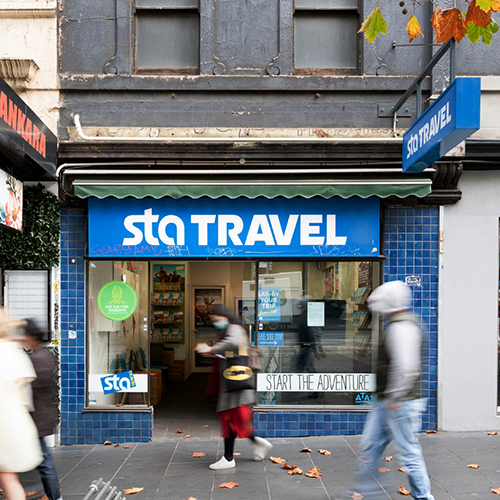

A bright, clean travel agent now occupies 309 Swanston Street (photo above), which is opposite the State Library of Victoria; but for many years it was occupied by a rather different business: Fabian’s Fine Old Furniture. The eponymous owner, Fabian, was a rather eccentric, wild-haired man who had many interesting old books held in three or four massive Victorian book cases, while a goodly number more were liberally distributed in messy piles in various corners, nooks and crannies on the floor. Like the owner, the books, and the bookcases, the shop was old.

In the early 1990s, it had the sort of deep, dusty, brass edged, shop-front display-window that all the best second hand bookshops ought to have. On display in this window were china cups and saucers, Wisden Cricketers’ Almanacks, faded copper plate engravings and maps with labels such as: “This map is 256 years old!”—“This book 152 years old!”—all with exclamation marks, silently bellowing at the passing foot-traffic. I don’t know how often these labels caught the eye of any passer by—with so much dust on the windows the signs were hard to read—but I remember very few interruptions whenever I visited Fabian’s—and all my visits to Fabian’s were lengthy.

The reason for the length of my visits was because Fabian was an unashamed biblioclast. Fabian liked neatly bound sets of books, but it was his practice to keep the different volumes of any set of books equally distributed between the shelves of however many bookcases he had or—whenever he sold a bookcase—between the shelves of the remaining bookcases and in piles on the floor.

He distributed the books in this was because—he explained to me—he wanted each bookcase to display a variety of titles, that a complete set of books was unsightly, and that complete sets would be likely to frighten off prospective buyers. His pricing is worked out on a per-volume basis, and was calculated solely on the size of a volume and the nature of its binding. I paid $45 per volume for my 12mo set (Gil Blas) and $100 for my folio volume (Fingal), but I think $80 was normally the going rate, when part of a set.

Since Fabian did not care for completeness—in fact, he disliked it—but he liked neatly bound books, he had bought and distributed around his small shop many incomplete sets. As a result, even after an extensive, laborious search, neither buyer nor seller could be entirely sure that every volume that Fabian actually had in his shop had been found, unless the books thus collected together from all corners of the shop formed an unambiguously-complete set.

Incomplete sets might be incomplete because Fabian bought them that way, or they may have been incomplete because the buyer had overlooked an odd-volume. This created a moral problem for a fastidious book buyer like myself: how could you be sure that, in the process of buying all the volumes of a seemingly-incomplete set that you had managed to accumulate, after hours spent turning over thousands of books, you were not thereby breaking up a complete set that you had simply failed to find all the volumes for?

Fabian was, obviously, unconcerned about this. Indeed, it seemed as if this sort of “accidental” breaking up of a set suited Fabian, the remaining volumes presented a more varied face to the buyer, and it made it easier for him to dispose of the remaining odd volumes.

Since I am a completist, I would spend hours patiently accumulating volumes of any and all sets that I was interested in; slowly building up piles of matching volumes. When—as was more often the case than not—I failed to find a complete set, I would leave without the books, and Fabian would re-distribute the volumes around the shop, according to whatever principle of aesthetics that drove him. A year or so later I would return, and go through the process again.

Eventually, despite the appeal of thousands of old, beautifully bound books, and the prosepect of a repeat of my 1990 success, I was worn down by my actual lack of success in finding anything that was new-to-stock or complete, and so I stopped visiting his shop. From the mid-90s, for about a decade after I moved to Melbourne I would regularly see Fabian on a Sandringham-line train, with his distinctive wild grey-white hair, on his way into or out of the city. I would seem at different times of the day, either on his way in or out, so I gather that, in old age, he simply went in whenever he felt like it. (There were no opening hours advertised on his shop, and it was often closed when I visited.)

* * * * *

Returning to 1993: a friend and I were occupied in the doomed process of uncovering the companion volumes of an early set of Smollett’s Peregrine Pickle and The Works of Madame de Genlis, ignoring Fabian’s protest that the set was probably never complete to begin with and fearing that, if it had been complete, he had probably rendered it otherwise long since due to his practice of selling off volumes at random, when a well-dressed young man came into the shop, drew the attention of Fabian, and left us to our dusty work.

The conversation began, as I recorded it, in the following fashion:

FABIAN: Hello. Can I help you?

VISITOR: Yes. I’ve bought an old table that I want to put a bit of a display on, y’know, and what I wanted was some old books. I’ve got a bit of a shelf, and some things, vases and things like that, too, but what I need is a few antique books to put on it. ’Bout four of them. It doesn’t matter what’s in them because I’m never going to look in them [this said emphatically] as long as they are old, and look good, like these [indicating a set I was accumulating of The Works of Hobbes].

FABIAN: Yes, well, I get quite a lot of people coming in who want books like you do, for display; I have lots of old books here, with old leather bindings, all sorts of sizes and colours, and prices, so I am sure to have something that will suit. Now, about how much did you want to spend?

There followed a discussion concerning how much the Visitor wished to spend, whether he preferred brown to black covers and so forth. Books in French or Latin, were offered, Fabian did his best to sell his books (“Now this one here is nearly a quarter of a thousand years old! Well, that’s older than the settlement in Australia”) and, at one memorable juncture, when Fabian was showing the Visitor a random selection of four of the twelve volumes of a Latin edition of the proceedings of the Council of Trent, the Visitor, admiring the binding, and in response to Fabian’s explanation of what the book was about, said “of course, I could always learn Latin if I bought them, and then I could read them.”

As I mentioned above, customers were rare; the shop was quiet, and the conversation struck a cord—I had recently read W. J. West’s The Strange Rise of Semi-Literate England (1991)—so I made notes as soon as I left the shop and recorded the details as well as I could soon after. Unfortunately, I did not make a note of whether the well-dressed young man bought any volumes of the proceedings of the Council of Trent. Even if he had, we will never know whether, by doing so, he was prompted to [1] learn Latin and then [2] immediately sit down to read his books, but I think it is very unlikely.

Sunday, 23 January 2022

Teaching English in Utrecht, using The Female Spectator

My Bibliography of Eliza Haywood (2004) includes two sections given over to reprints of sections of works by Haywood before 1850: "Ac. Reprints in monographs" and "Ad. Reprints in periodicals."

Referring to these two sections in my Introduction, I stated that "It is likely that more Haywood items will be identified as critical interest in the contents of eighteenth-century periodicals increases and as a greater number of electronic resources become available that make it easier to conduct searches of these periodicals." When I wrote this I had in mind E. W. Pitcher's 1995 identification of over a dozen reprints "of Eliza Haywood’s Stories in The Weekly Entertainer," which was published in Notes and Queries.

Well, there hasn't exactly been a flood of articles like Pitcher's, but I have identified so many reprints myself that I have had to give up trying to incorporate them into the numbering scheme I used in 2004. I haven't have time to establish precise word-counts and provide detailed references to the source text reprinted. And, because I could neither number the items, or knew exactly what details to record, I pretty much stopped collecting any information about reprints.

Having recently discovered a pretty nice example of a reprint from The Female Spectator—detailed below—I have decided that I will start (soon) to keep some sort of list of reprints here. If I ever publish a second edition of my Bibliography I will simply omit these sections.

* * * * *

When I was updating my post Eliza Haywood Links, which the lists eighteenth- and nineteenth-century editions of works by Eliza Haywood, I stumbled upon a reprint of a lengthy story taken (with acknowledgement, which is unusual) from The Female Spectator. The reprinted story appears in James Low's The Winter Evening Or, A Collection of English Prose and Verse, 2 vols. (1780), 1.142–87. The copy of volume one, on Google Books here, is reproduced from the incomplete set in Tilburg University Library (but digitised by the National Library of the Netherlands).


The editor of this anthology, James Low (1759–1817), was a "Teacher of the English Language in Utrecht," where he studied divinity at the university. He seems to have arrived in Utrecht in 1779, married in 1780, and as ordained at Flushing in 1783. According to William Steven, who gives a biography of Low in his History of the Scottish Church, Rotterdam (1833), 232–34 (here), "his constitution, by nature healthy and vigorous, rapidly gave way" after the death of his son (at 26) and—soon after—of his wife. "He was a high Calvinist; and he was most punctual in his attendance at church courts, in whose debates, from his perfect knowledge of Dutch, he was enabled to take a part."


Low published his anthology of English verse and prose soon after he started teaching English. It was reviewed in a number of Dutch journals (here and here), and at least one German periodical (here). Copies occasionally appeared for sale in bookseller's catalogues up to the 1840s (here). After that, The Winter Evening dissapeared from view, almost completely.


Low's Winter Evening is not on ESTC, and it appears that there is no other copy in an institutional library. There was, however, a copy for sale, so I bought it. I gather it had been for sale for a considerable period, since the vendor had increased the price in some online catalogues, but not others. When I asked about this I was told that the lower price was "very outdated". The change was minimal and the book is obviously very uncommon, so I made no complaint; and once it arrived I felt I had got a screaming bargain anyway: as you can see, it is a beautiful example of Dutch paper wrappers.


The reference that Low provides for his excerpt from The Female Spectator is interesting: "Female Spectator. vol. V. p. 290—312." The "vol. V." is an error for "vol. III"; the page reference narrows down the edition that Low used for his reprint. Of the ten editions of The Female Spectator in English, only three have the story excerpted on pages "290—312": the 4th, 5th and 6th editions of 1750, 1755 and 1766 [i.e., Ab.60.6, Ab.60.7 and Ab.60.8]. Even the most recent of these appeared when Low was a child, so I am guessing he had taken his own (second-hand) copy with him, when he went to Utrecht.


Above and below are the pages where the text appears in eight of the first nine editions. Above are Ab.60.1—Ab.60.2 did not get to volume 3—Ab.60.3, Ab.60.4, Ab.60.5; below are Ab.60.6, Ab.60.7, Ab.60.8, and Ab.60.9.

Sunday, 16 January 2022

Collecting Haywood, 2021

Although 2021 was not much of an improvement on 2020 in Covid-terms—endless lock-downs, working from home etc.—it was a significant improvement in terms of book-collecting. I have no grand theory to explain why, and it may be that I was mistaken in the explanation I offered (here) for the 18C book-drought of 2020. Whatever the reason, 2021 brought three times as much Haywoodiana to my door as 2020—and most of these items were much more interesting too.

One of the most interesting arrived yesterday. Like David Levy, the shipping of a late-2021 purchase was delayed to an extraordinary extent due to “the resurgent pandemic” (here). Having paid a hundred dollars (!!) for 2–5 day international delivery—for an item that could have been slipped into a small Christmas card—my parcel took two months to appear: with two multi-week periods in which tracking reported no movement whatever, leaving me despairing that it may have been lost.

I have been waiting for the arrival of this parcel to post a “collecting year in review”; and since my parcel should have arrived in November, I am going to pretend that it did arrive in 2021 and am including it here. As a result, I am also including everything else that arrived between my "Collecting Haywood, 2020" post, and now.


As you can see above, my long-delayed parcel contained a dated signature, taken from a letter written by the poet, sometime-friend and sometime-enemy of Haywood, Richard Savage, on 12 July 1743, less than 3 weeks before he died in Bristol Newgate Prison. I believe that this may be the last datable piece of writing in Savage’s hand—not that Savage manuscripts are exactly common. Clarence Tracey quotes from 27 letters in his biography of Savage, but most of them are from printed sources.

As I was waiting for this scrap of paper to arrive, I obtained copies of a few other examples of Savage’s writing—enough to convinced me of the authenticity of the writing, and of the attribution to “Dr. Johnson’s Richard Savage as opposed to, say, Robert Savage, sausage-maker” (as Stuart Bennett quipped). I did not expect to start collecting detached signatures in this way, but the dam broke with the acquisition in 2020 of three receipts from a signature collection—one signed by Hatchett.


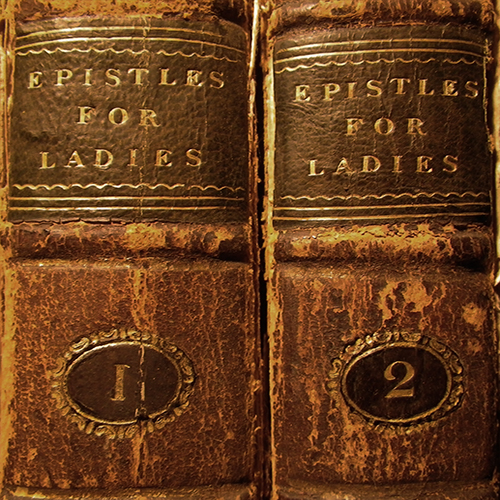
One of the two greatest contributor to 2021 being a much better collecting year than 2020 was a lot of thirteen titles in nineteen volumes that I bought at Chroley’s Spetchley Park Auction in late March. Fortunately for me, the Spetchley Park Auctions—and the presence of a Haywood item—received some news coverage, and so I was alerted to the sale (background here; the actual article here). The Haywood item reported on in the news turned out to be two Haywood items listed in the description of the lot (above; both of which I had), which turned out to be three Haywood items once the lot arrived in Melbourne: Ab.70.4 The Wife, 3rd ed., Ab.72.1 The Husband and Ab.64.3 Epistles for Ladies, 3rd ed. 2 vols.—this last one being the surprise inclusion, and one that I did not have (below).


The ten other Spetchley Park items all either works by women, or relating to women, many of which I had long wanted: Aphra Behn’s Love-Letters between a Nobleman and his Sister, Jane Collier’s, An Essay on the Art of Ingeniously Tormenting, Steele’s The Ladies Library, Salmon’s A Critical Essay Concerning Marriage, Madan’s Thelyphthora; Or A Treatise on Female Ruin, Alexander’s The History of Women, from the earliest antiquity, and Hayley’s A Philosophical, Historical, and Moral Essay on Old Maids—among others.

I cannot say much about the second great contributor to 2021 being such a good Haywood collecting year, but I can say that I discovered a French translation of a work by Haywood that I had somehow previously missed. Said work was printed many times, and translated into three other languages. Since I am in the midst of sweeping the market clean of these translations, I don’t want to risk inflating the price of any books that remain outside of institutional collections until I have a decent sample of them. I have managed to buy copies of four editions so far. My examination of these suggests that the few bibliographers who have mention the work have missed a great deal indeed. Both the collecting, and unraveling the mystery, are proving to be immensely enjoyable.

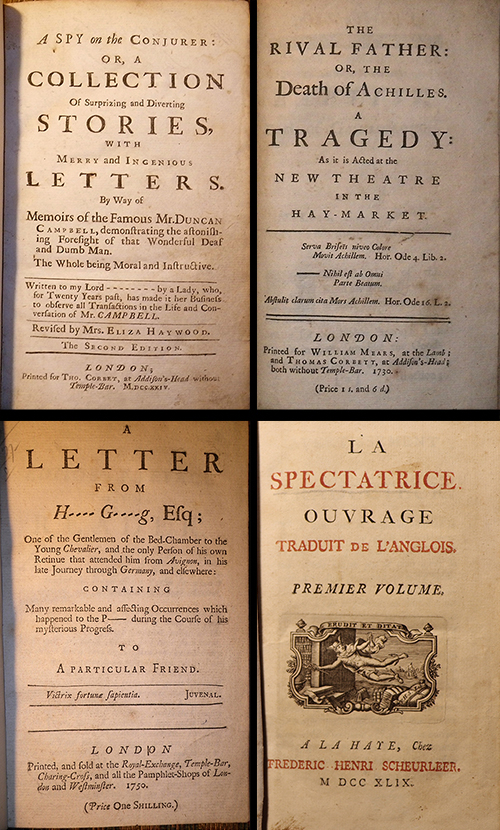
Of the items not covered above, three are by Hatchett: with the help of Stuart Bennett I picked up a copy of Dd.1.1b The Adventures of Abdalla, 2nd ed.—in a very ugly binding, but with the full complement of plates—and I also managed to get two copies of one of his plays, Dd.4.1 The Rival Father Or The Death Of Achilles: A Tragedy. I was particularly pleased about this because both were in intact sammelbands from the one, very large and very interesting eighteenth-century collection of plays, the provenance of which I was able to untangle.

The remaining Haywood items includes two more copies of the first edition of The Female Spectator in French—one with a variant title-page which has, once again, thrown into doubt my arrangement of editions (my original “Ab.60.11” has already become Ab.60.11, Ab.60.11A and Ab.60.11B!). I also received my third NQR copy of Ab.58.9 New Present for a Servant Maid. This one lacks the frontispiece, but has the final leaf, which is missing in my only copy with the frontispiece. Cookery books are particularly hard to find in nice condition, and complete, but one day I hope to find one such unicorn.


Also NQR (not quite right) was a copy of Ab.66.2 A Letter from H---- G----g [Henry Goring]—the pirate edition. Seemingly from the collection of Gershon Legman, I discovered once it arrived that it was missing an entire gathering. Fortunately, the vendor gave me both a complete refund, and the book. I also picked up at various times duplicate odd volumes of The Invisible Spy, The Female Spectator, and Jemmy and Jenny Jessamy, of interest only to someone like me.

The remaining three items are all very nice: Haywood’s Ab.11.1c A Spy on the Conjurer, 2nd ed. (1724); Elizabeth Griffith’s A Collection of Novels, Selected and Revised, 3 vols. (1777), which contains Haywood’s Fruitless Enquiry—which is quite rare (ESTC records nine copies), and often incomplete; and Ac.10b Matrimonial Preceptor, 2nd ed. (1759), which contains excerpts from The Female Spectator.

This last one is a nice segue way into a post I plan to do shortly on unauthorized and previously unrecognized reprints of works by Haywood, but I am still on holidays, so that may be another month away. Until then, thank you to all my (patient) readers, who have put up with my long silences. I will make no resolutions for 2022, but do expect to post more than I did in 2021.

Sunday, 29 August 2021

Gerald Dillon, freelance journalist

Gerald Aloysius Dillon (29 June 1897–[after 1952]), Irish-Australian soldier and freelance journalist, contributed an article on "'The Female Spectator': Mrs. Eliza Heywood's Periodical" to Australian Woman's Mirror in March of 1934. I said in my post on that article (here), that Dillon contributed a series of roughly fifty bookish essays to the Australian Woman’s Mirror, "many about women or women writers such Joanna Southcott, Ouida, Angella Burdett, Sidney Webb and Katherine Mansfield (probably his most famous essay)." I also said that "I have not been able to find out as much about Dillon as I would like"—but what I have found is below.

* * * * *

The AustLit entry for Dillon states "Gerald Dillon was a freelance writer from Sydney," and list only six of his works: one, a self-published book (Why Editors Regret: First Aid for the Free-Lance Gerald Dillon (Sydney, 1929)), the Katherine Mansfield essay mentioned above, and four pieces of his journalism that seem to have been selected more-or-less at random.

After a pretty extensive search online, I located quite a bit more information than AustLit offers. My three main sources of biographical information (reproduced below) are a series of entries for him (and his brothers) in The Catholic Who's Who and Yearbook from 1930–52 (vol. 23 (1930): 134; 29 (1936): 131; 34 (1941): 130; 35 (1952): 118), a brief article about Dillon published in The wireless weekly: the hundred per cent Australian radio journal, Vol. 36 No. 28 (12 July 1941): 3b (this article supplied the only photograh I could find of Gerald Dillon), and a National Archives entry.


The Catholic Who's Who and Yearbook entries are all much the same, the 1930 edition reading

[1930–52] "Dillon, Gerald Aloysius—b.1897, y.s. [youngest son] of late Theobald Augustus Dillon, co Roscommon; edu. Downside and R.M.C. [Royal Military College, Sandhurst]; Sec.Lieut 6 (Inniskillg) Dgns [Dragoons] 1916; resigned as Lieut 1921; served Great War; at present engaged in journalism. Author of Why Editors Regret: Box 2876N. G.P.O., Sydney, N.S.W."

The yearbooks contain entries for two bothers, which provide more details of the family:
  Gerald's father was Theobald, of Mount Dillon, co. Roscommon,
  his mother was Bertha, daughter of Nicholas Mulhall of Boyle, co. Roscommon;
  his eldest brother went to Trinity College Cambridge (B.A.), was Capt. in the Connaught Rangers (Special Reserve); served in WW1, and was called to the Irish Bar in 1922;
  the second brother, Capt. John Jospeph Dillon (b. 19 Feb. 1896), went to Sandhurst, like Gerald, was a Lieutenant in the Connaught Rangers (Special Reserve); was twice wounded in WW1, winning the Military Cross, rising to Captain in 1927 in the Royal Army Service Corps.

[1941] FILLED LIFE WITH TRAVEL
Gerald Dillon, well known for his talks on 2FC and 2BL [Sydney radio stations], has had a life crammed with travel and adventure.
  An Irishman, born in Dublin in 1897, he spent six years at an English public school before returning to Dublin to study law.
  In 1916 he abandoned law to enter Sandhurst. Graduating there with a commission in the Dragoons, he served in France in the last war.
  After the war, feeling an urge to travel, he resigned his commission in the Army, and visited Australia, Canada, New Zealand, India, and Tahiti before settling for several years in Papua as a plantation manager.
  Gerald Dillon’s variety of experience has given him plenty of material for broadcasting. He is also well known as a freelance journalist, and on one occasion he turned to authorship.
His anecdotes of life among the wild and woolly natives of Papua have proved very happy entertainment for radio audiences.

[1939–48] WW2 Service record [National Archives of Australia: Citizen Military Forces Personnel Dossier]

DILLON GERALD ALOYSIUS
Service Number - N279151
Date of birth - 29 Jun 1897
Place of birth - DUBLIN IRELAND
Place of enlistment - PADDINGTON NSW
Next of Kin - Unknown
Contents date range: 1939–1948
Item ID: 6194595
Location: Canberra
Access status: Open

[Honouringveterans.org (here) adds: "Rank: Corporal"]

Beyond The Catholic Who's Who and Yearbook and the anonymous "Filled Life With travel," Trove fills in many details concerning Dillon's freelance and radio work. However, although there are hundreds of entries for Dillon on Trove, they add little about his personal life. Apparently, he lived in "Verona," Waruda St., Kirribilli, Sydney, before WW2, but I was unable to find any record after the 1952 Catholic Who's Who and Yearbook. If we are to judge by the lack of a Next of Kin in his WW2 Military Forces Personnel Dossier, it appears he did not marry. He seems to have died obscurely, and alone, with no memorial or death notice.

* * * * *

Dillon's self-published 58-page booklet, Why Editors Regret was reasonably-well received, being reviewed in half a dozen journals throughout Australia. Although most major libraries in Australia have a copy, I have been unable to look into one due to the lock-down, but the reviews contain a number of details, so I will finish this post by transcribing three the longer reviews, and provide links to three others. The reviews below are organised chronologically.

"Franziska" [Frances Zabel], The Australian Woman's Mirror, Vol. 5 No. 48 (22 October 1929): 24c, 41b "Let's Talk about Books" (here)

Editors would have far fewer regrets if this little book were read by all those Australians seeking to break into freelance journalism The author, who can speak from experience of the ups and downs of freelancing, gives much practical advice to the budding writer and covers a wide field—what editors want, the article, book reviews, verse, the paragraph, the short story, writing for children, and so on. A foreword has been written by the editor of the Bulletin and there are special contributions by the editor of Aussie, the editor of the Mirror, Katharine Susannah Prichard, J. H. M. Abbott Professor Brennan, Edward Perugini, W. E. FitzHenry and others. Apart from a few typographical errors that should not have crept into a literary handbook, the little volume is well-produced, and it should do something toward realising the expressed purpose of Mr. Dillon the lightening of the heavy burthen which weighs on those who wander without proper sense of direction in the fugitive byways of literature.

The Bulletin, vol. 50, no. 2594 (30 Oct 1929): 5a–b (here)

Why Editors Regret
  They don’t; but the harmless fiction makes a catchy title, and prospective or potential freelances who spend half a crown on Gerald Dillon’s booklet of that name should not have any regrets, either. Editors do not regret, because theirs is the most impersonal job on earth; they buy what they want, they turn down what they don’t want. The best friend in the world ceases to be a friend when he translates himself into a piece of paper with words on it. Having done that, the best friend is a bit of copy and nothing else.
  Mr. Dillon has strong support: Bert F. Toy, editor of the Woman's Mirror, and writer here of a most compact and in formative article; Walter Jago, editor of Aussie—not very informative, but a good blow where one has been long asked for; Katharine Susannah Prichard—so so; Harold Mercer—amusing and encouraging (he says, “One bit of misleading information may destroy a growing reputation painfully built up" (and he writes sermons for sick clergymen); C. J. Brennan—an excellent page on light verse; Hugh McCrae—Hugh McCrae; Edward Perugini—one or two acute remarks on serious verse; J. H. M. Abbott—on "historical background" in fiction ("There are 700 possible separate characters available amongst the convicts of the first fleet.” May he be spared to use the five of them that he has not used already!); Edyth Bavin, wife of the N.S.W. Premier—on “writing for children," which she herself does charmingly; W. E. FitzHenry, who has grown up in The Bulletin office and knows as much about marketing paper with words on it as the next man, and his brother. A guiding foreword by S. H. Prior, editor of The Bulletin, and seven articles by Mr. Dillon covering pretty well the whole field of freelancing complete the bill of contents.

The Capricornian (Thu 5 Dec 1929): 12a: BOOKS RECEIVED (here)

S. A. Rosa, The Labor Daily (Sat 7 Dec 1929): 9g. LITERARY JOTTINGS (here)

The Advertiser (Sat 8 Feb 1930): 14f "LITERARY BEGINNERS" (here)

The West Australian (5 Jul 1930): 5d (here)

"WHY EDITORS REGRET."
(By J.P.)

A small booklet with the above title came recently before my notice, and I found it interesting to read because of the elementary hints and tips it contains for those who practice free-lance journalism in Australia. That it is written for Australians is its chief virtue. This booklet, largely the work of Mr. Gerald Dillon, but containing some brief contributions by other well-known journalists and authors, fills a want that, I imagine, many writers in Australia have felt: it sets down some guidance that should explain to the disappointed just why and how editors 'regret' when they return manuscripts. For instance: 'What the editor wants is the sort of matter he publishes' … 'Get a typewriter' … 'Never fold your manuscript more than once' … 'Enclose a stamped addressed envelope for return' … 'Never use single spacing in typing' … 'Never send a covering letter with a manuscript'—these are the first essentials to the equipment of the freelance; indeed, I think they are guides that will take him over half his journey to acceptance of his manuscript.
  The book discusses the usual methods of writing newspaper articles, short stories, serials, verse, juvenile matter and paragraphs—the last subject to some purpose, which is perhaps not unnatural in a laud where paragraph writing has become a habit rather than a practice. These discussions are slight, and the symposium to which various well-known writers have contributed is notable for its general evasion of the book's requirements. Katharine Susannah Prichard has 'nothing very much to say as to 'why the editor regrets,' except that he doesn't when he says so.' The truth is that editors often do regret: and the editor of 'Aussie' has here something to say about why they regret. Hugh MacRae says. 'I cannot see how any freelance journalist could benefit by anything I might have to say.' J. H. M. Abbott dismisses 'The Historical Back ground,' of the short story, in two paragraphs, and Edyth Bavin 'Writing for Children' in two shorter paragraphs. Perhaps the soundest and most useful article is that by the Editor of 'The Australian Woman's Mirror' on 'The Woman Free Lance.' and it is a pity that the other contributors had not approached their task with the same seriousness and desire to help, when a thorough-going handbook for the local freelance might have been the result.
  This booklet should, though, be useful to the beginner, who will soon find that his experience does not tally with Mr. Dillon's in several matters. It is said that there is practically no market in Australia for articles of the discursive essayist type: and 'The local market for short stories is practically unlimited.' With good essays on almost all subjects appearing regularly in our leading papers. I wonder what shade of meaning Mr. Dillon in tends for his word 'discursive.' As for the short story market, this is decidedly limited, because it is over-supplied, and this for the reason that short-story writing ' is the one branch of literature in which, more than in any other with the possible exception of verse, local writers have squandered their energies.

* * * * *

Four final notes: [1] In a recent essay by Martin Griffiths ("Katherine Mansfield’s Australia," Tinakori: Critical Journal of the Katherine Mansfield Society Issue 4 (Summer 2020): 60–70) Dillon is mistakenly described thusly (ibid. 63) "New-Zealand-born commentator Gerald Dillon." [2] it is nice to see a Frances Zabel review of Dillon's book. For my post on Mrs Zabel, see here. [3] I was delighted to find that Dillon wrote an article on "A Perfect Library," which I will post soon. [4] "Verona" near "Astoria" in Waruda St., Kirribilli was a boarding house (according to Anne Watson, The Art of Roland Wakelin (1975), 2.22), but a "superior" one, according to a 1930 advertisement (offering "Superior Single Rooms, fireplace, balcony, glorious views, from 15/.").

[UPDATE 2026.04.23: I have finally posted Dillon article on "A Perfect Library": see here]

Sunday, 22 August 2021

Works Falsely Attributed to Eliza Haywood

Below are links to original editions online of works falsely attributed to Eliza Haywood. These Haywood attributions are ones that I believe to be—and have previously explained at length why I believe them to be—false attributions (explanations I might add here at a later date).

In my Bibliography of Eliza Haywood (2004) I listed these items in section "Ca. REJECTED ATTRIBUTIONS"—explaining why the arguments that have been proposed for including them in the Haywood canon are suspect (a few are plausible, but unproven; many were made by accident; others are simply ridiculous or idiotic).

I have added this post to my blog for much the same reason as I added posts that include links to genuine works by Haywood (here) and William Hatchett (here): it is actually convenient for me—and I hope for others—to have these links all in one place.

All author attributions below are tentative or conventional, and are included only to help readers find more information about each title. (My interest being not so much in who wrote these works, but whether there is compelling evidence that Haywood wrote them.)

Item numbers are from my Bibliography (2004).

In the case of two false attributions made since 2004, new item numbers have been created in the appropriate alphabetical position, in the form Ca.19A for The Lady’s Drawing Room and Ca.32A Nunnery Tales, written by a Young Nobleman.

In the case of popular works, such as Ca.1 Penelope Aubin's The Adventures of the Prince of Clermont, I only listed the first edition of the work in my Bibliography, and so there is no "Spedding-number" for the later editions linked below. Rather than attemption to create a consistent series of new numbers, I simply use a lower-case "x" (in the form Ca.1.x) for all such editions.

For now, links are only to copies on Google Books, but I will add links to copies on The Internet Archive, etc. as I find them.

* * * * *

Ca.1.x [Penelope Aubin], The Adventures of the Prince of Clermont, 2nd ed. (1728) [British Library copy here]

Ca.2.3 The Busy-Body; or, The Adventures of Monieur Bigand, vol. 1 (Dublin, 1768) [University of California copy here]
Ca.2.3 The Busy-Body; or, The Adventures of Monieur Bigand, vol. 2 (Dublin, 1768) [University of California copy here]

Ca.7.3 A Present for Women Addicted to Drinking (1750) [British Library copy here]

Ca.10 The Fair Concubine, 2nd ed. (1732) [British Library copy here]
Ca.10 The Fair Concubine, 4th ed. (1732) [British Library copy here]
Ca.10 The Fair Concubine, 4th ed. (1732) [University of Michigan copy here]

Ca.15 [Bonnell Thornton, ed.], Have at You All: or, The Drury-Lane Journal (1752) [Oxford University Library copy here]

Ca.17 [Sarah Robinson Scott], The History of Cornelia (1750). [British Library copy here]

Ca.18.2a [William Bond], The History of the Life and Adventures of Mr. Duncan Campbell, 2nd ed. corrected (1720) [Oxford University Library copy here; University of Michigan copy here]
Ca.18.2c The Supernatural Philosopher: Or, The Mysteries of Magick [i.e. The History of the Life and Adventures of Mr. Duncan Campbell, 2nd ed. corrected] (1728) [New York Public Library copy here]
Ca.18.3 The Supernatural Philosopher [i.e. The History of the Life and Adventures of Mr. Duncan Campbell] trs. as Der übernatürliche Philosoph (Berlin, 1742) [University of Lausanne copy here]

Ca.19A.1b The Lady’s Drawing Room, 2nd ed. (1748). [British Library copy here]

Ca.22 Leonora: Or, Characters Drawn from Real Life (1745), vol. 1 [Oxford University Library copy here]

Ca.23 Letters from Sophia to Mira (1763) [British Library copy here]

Ca.24 [John Shebbeare], Letters on the English Nation (1755) [University of Michigan copy here]

Ca.26.x [Edward (‘Ned’) Ward], The London-Spy Compleat (1718) [British Library copy here]

Ca.28.3 [John Shebbeare], Lydia, or Filial Piety, vol. 1 (Dublin, 1763) [University of Michigan copy here]
Ca.28.3 [John Shebbeare], Lydia, or Filial Piety, vol. 3 (Dublin, 1763) [University of Michigan copy here]

Ca.29.1 [John Shebbeare], The Marriage Act. A Novel, vol. 2 (1754). [Ohio State University copy here]

Ca.30.1c Memoirs of The Court of Lilliput (Dublin, 1727) [British Library copy here]

Ca.32.2 [Dr. John Hill], [Translation: French] Caractères Modernes tirés des divers états de la vie civile, vol. 1 (Londres, 1770). [Austrian National Library copy here]
Ca.32.2 [Dr. John Hill], [Translation: French] Caractères Modernes tirés des divers états de la vie civile, vol. 2 (Londres, 1770). [Austrian National Library copy here; Bavarian State Library copy here]

Ca.32A Nunnery Tales, written by a Young Nobleman (1727) [British Library copy here]

Ca.35.1 [Joseph Mitchell], Poems on Several Occasions, vol. 1 (1729) [National Library of the Netherlands copy here]

Ca.38.3 [Samuel Croxall, ed.], A Select Collection of Novels and Histories. In Six Volumes, 2nd ed., vol. 1 (1729) [New York Public Library copy here]
Ca.38.3 [Samuel Croxall, ed.], A Select Collection of Novels and Histories. In Six Volumes, 2nd ed., vol. 3 (1729) [New York Public Library copy here]

Ca.40.2 Some Memiors of the Amours and Intrigues of a Certain Irish Dean [Part 1], 3rd ed. (1730) [Oxford University Library copy here]

Ca.41 The Spring-garden journal, by Miss Priscilla Termagant (1752). [Oxford University copy here] NEW

Ca.44.1 A Treatise on the Dismal Effects of Low-Spiritedness (ca. 1751). [British Library copy here]

Ca.45.1 Vanelia (1732). [British Library copy here]

[Updated 26 March 2022]