Showing posts with label Book History. Show all posts

Sunday, 20 September 2026

Dorothy Furman, collector of books and bookplates

Dorothy Furman (fl. 1895–1926), was a well-connected bibliophile, a staff member at the New York Times Literary Review (writing bookish-reviews and book-auction reports in the late 1890s) and was later a book dealer. She built an extensive collection of rare books, mostly first editions (but including treasures such as a fourth folio of Shakespeare's works) and bookplates—being a customer, if not a patron of sorts, to a number of bookplate artists, and corresponding widely within a community of bibliophiles.
Furman was a member of The Bibliographical Society (UK) from 1895–1917 (see here), appears in the Almanach du bibliophile pour l'année 1898 (here), was a Member of the Ex Libris Society in 1895 and 1900 (see here and here); the Bibliographical Society of America in (at least) 1905 and 1908 (see here), the American Bookplate Society in 1913 and 1918 (see here and here), and the Grolier Club in 1914.

Female members of these bibliographical and book-collecting societies were not common. In the fifty years between 1892 and 1942 The Bibliographical Society had approximately nine hundred UK members and four hundred and fifty US members (see cumulative member list here). Of these, there are 17 (UK) and 13 (US) with a "Mrs" prefix and 25 (UK) and 18 UK with "Miss"; that is, a total of 73 female members, or approximately five percent.

Given the rarity of bibliographicaly-inclined female book collectors in this period, and the significance of her bookplate collecting, it is suprising that there is so little information about Furman available online. Having just bought her copy of J. Roger Rees, The Brotherhood of Letters (New York: Lockwood and Coombes, 1889), I did some digging and am posting what I found here to save other collectors the trouble, and perhaps enable them to carry this research forward—something that can probably only be done in situ in New York.

Why New York? Well, Furman lived at a commuting distance from New York for at least two decades. Her reported addresses being 35 State Street, Flushing, Long Island, NY (1898–1905; see Almanach du bibliophile pour l'année 1898 and Ex Libris Society link above); 58 Clark Street, Glen Ridge, NJ (1905–8; see here); and 6 De Hart Street, Morristown, New Jersey (1913 and 1918; see American Bookplate Society links above), opening a bookshop there in 1919 (see here): The Publishers Weekly reporting: "Morristown, N. J.—Miss Dorothy Furman has opened a bookshop at 6 De Hart street, specializing in old, rare and current books, association copies and autographs."

The Walpole Galleries in New York sold at auction collections of her Modern First Editions in July 1920 (advertised in The New York Times on 29 and June 1920 here and here), bookplates and books on bookplates in September and November 1923 (see here and here), and China, Glass, Brass, Prints, Furniture, Pewter Objects of Art, Etc. in September 1926 (see here).

* * * * *

Regarding Furman's writing for the New York Times Literary Review: I have found four articles by her (too long to quote in full). Undoubtedly, she wrote many more since each appears to be only a sample of a series: "Books Worth Reading Again. VII. Dorothy Osbourne's Letters" The New York Times, Vol. 47, Iss. 15029 (12 March 1898): 170c–171b (see here); "Books Worth Reading Again. IX. Louisa May Alcott's Life and Letters" The New York Times, Vol. 47, Iss. 15053 (9 April 1898): 238c–239c (see here); "Books at Auction. Features of the Final Part of the Ashburnham Library Sold This Week in London" The New York Times, Vol. 47, Iss. 15083 (14 May 1898): 324a–b (see here). "Books at Auction. Prices at the Fine Mackellar Sale—Bibles and Manuscripts" The New York Times, Vol. 48, Iss. 15251 (26 November 1898): 794a–b (see here); "Two Noble Lives. Maurice de Guierin and His Sister Eugene—The Journals They Wrote" The New York Times (4 March 1899): 137a–c (see here).

Regarding Furman's collection of books: I can't find an auction catalogue for this 1920 sale, but The New York Times advertisement explains that it contained "First Editions of Modern Authors including Stevenson and Kipling; Riverside. Doves, Kelmscott, Ashendene and other Presses; best library editions of the works of famous authors; bindings; rare early English literature and autographs; being mainly the library of Miss Dorothy Furman." There was a review of the sale published in The Publishers Weekly, which reads:

The library of Miss Dorothy Furman consisting of modern first editions, books printed by private and special presses, fine sets of standard authors, rare early English literature and choice miscellaneous books, was sold at the Walpole Galleries July 1 and 2. The sale was well attended, and prices were very satisfactory. Mr. Turnbull is a careful cataloger and in sales of this character he handles them with a high degree of efficiency. A few of the items, indicating the trend of prices, were as follows: Andrew’s "Gossip about Book Collecting," New York, 1900, $50; same author, "Paul Revere and His Engraving," New York, 1901, $55; Sir Thomas More’s "Utopia," Chelsea, 1906, Ashendene Press edition, $42.50; Beaumont and Fletcher's "Fifty Comedies and Tragedies," London, 1679, second edition, $35; Lord Byron’s "Works," 13 vols., London, 1898–1901, large paper edition, $44; Blanchard's "Life of George Cruikshank," 2 vols. extended to 4 with 140 extra plates, many in colors, $75; De Morgan’s "Collected Works," 8 vols., London, 1906-14, first editions, $26; Drayton's "Poems," London, 1619, $25; Genest's "Some Account of the English Stage from the Restoration in 1660 to 1830," 10 vols., 8vo, prepared for extra illustrating with cases, $120; Hallam's "Introduction to the Literature of Europe in the Fifteenth, Sixteenth and Seventeenth Centuries," 4 vols., 8vo, London, 1837–39, $60; Ireland's "Records of the New York Stage from 1750 to 1860," New York, 1866-67, large paper copy with extra illustrations, $40; Keats's "Poetical Works," 4 vols., London, 1883, original library edition edited by H. Buxton Forman, $65; Livingston's "Bibliography of Kipling," New York, 1901, Japan paper, $35; Masefield's "Tragedy of Nan and other Plays," London, 1909, first edition and presentation copy, $52.50; Montaigne's "Essays," 3 vols., folio, Boston, 1902, Riverside Press special edition, $65; Shakespeare's "Comedies, Histories and Tragedies," 1685, fourth folio with imperfections, $375; Stevenson’s manuscript of the first draft of "St. Ives," 500 pages, written by Isobel Strong, at Stevenson's dictation with revisions and additions by the author, $340; and Stevenson's "Verses," original wrappers, privately printed, 1912, very scarce, $65.

Regarding Furman's collection of bookplates: Walpole Galleries described it (well in advance of the sale, in 1921) as "The Important Collection of Bookplates of Miss Dorothy Furman of Morristown, N. J., being over 8,000 plates—one of the largest collections in this country" (see here); elsewhere the number is inflated to "about" ten thousand (see "Prospects For The Coming Season," The Publishers Weekly, Vol. 102, No. 18 (28 October 1922): 1553–54: "It includes the sale … the bookplates, about 10,000 in number, of Miss Dorothy Furman, for many years on the staff of the New York Times Literary Review; a superb …" (here).

Furman participated in an exhibition of bookplates in New York in 1895 (see here); she commissioned bookplates from Edwin Davis French in 1902 (see here), Arthur Nelson MacDonald by 1895 and in 1907 (see here and here [and at the head of this post]); J. Winfred Spenceley in 1907 (see here).
The bookplate contained in her, now my, copy of The Brotherhood of Letters is above. This plate is described (and so, a terminus ad quem established) in Ladies' Book-plates: An Illustrated Handbook for Collectors and Book-lovers (London: George Bell and Sons, 1895), 200 (see here):

"The following lines are familiar to many:

O for a Booke and a shadie nooke,
  eyther in-a-doore or out;
With the grene leaves whispering overhede,
  or the Streete cryes all about.
Where I maie Reade all at my ease,
  both of the Newe and Olde;
For a jollie goode Booke whereon to looke,
  is better to me than Golde.

This is taken from Dorothy Furman's plate, consisting of the name written on a garter."


(For an excellent investigation into the 1860s origins of this ye-olde verse, see here.)

One of the books she owned have been scanned and are online with her bookplate: Arthur Conan Doyle, Through The Magic Door (London: Smith, Elder [and] Co., 1907) here.

A few odd bits of evidence for Furman's patronage of book plate artists: she made donations of bookplates to the Museum of Fine Arts Boston in 1901 and 1902 (see here); she made a similar donation to the British Museum by 1912 (see here); and to the Brooklyn Institute of Arts and Sciences in 1917 (see here).

Finally, I am indebted—once again—to the blog "My Sentimental Library," on which Jerry Morris (sadly, now dead) collected some information about Furman in 2018 (see here), which I have tried not to duplicate here.

Sunday, 6 September 2026

The Drunken Druggist and a Shanghai Reading Room

The book below is an odd volume from Harrison and Co.'s The Novelist's Magazine series, which has a particularly interesting provenance, spending time in the UK, China, the US, and Australia.

The Novelist's Magazine (ESTC p6358) reprinted sixty novels, broken up into weekly parts, from 1780 to 1788. Each novel has a separate title page, and each of the 23 volumes has an engraved general title page. While some of the novels stretched over more than one volume (Sir Charles Grandison occupies vols. 14–15; Clarissa occupies vols. 10–11), most volumes contain multiple novels (for example, vols. 9 and 23 both contain six novels each).
I am interested in the series primarily because it contains Eliza Haywood's Betsy Thoughtless, Jemmy and Jenny Jessamy, and The Invisible Spy (in vols. 13, 17, and 23); but I have this volume (vol. 7) because it contains some Haywoodiana: Charles De Fieux Mouhy's The Fortunate Country Maid (1740), an anonymous translation of La Paysanne Parvenue, ou les Mémoires de Madame la Marquise de L. V. (1735–36). Haywood's own translation of this French work, The Virtuous Villager, appeared in 1741, by which time The Fortunate Country Maid had gone through four editions and a Dublin reprint—pretty much running away with the market for the book.

I have had my copy of vol. 7 of The Novelist's Magazine for more than two decades. It is in pretty woeful condition (the spine is broken in three places), but it was cheap (USD10) and I haven't bothered to upgrade it because I liked the bookplate (below) on the front (fixed) endpaper: "James Watson | Manchester." This morning I was able to identify this previous owner as James Watson (1775–1820), an eccentric young druggist known in Manchester as "Doctor Watson."
Watson (below) was apprenticed to a fustian (heavy cotton) manufacturer; when that apprenticeship ended, he worked as a bookkeeper for a cotton merchant, until his father's death obliged him to take over the family's apothecary business. Apparently, "Doctor Watson" was a theatre fanatic: he was a collector of printed theatre ephemera (1799–1800) and, from 1803 onwards, produced a periodical, The Townsman. He became the first librarian of the Manchester’s Portico Library in 1806.

Apparently, Watson soon lost that position because of his "drinking habits and neglect of duty" (i.e., he was an alcoholic), and went on to lose another as a boarding school usher at Altrincham, for the same reason; after which he became homeless and dependent upon charity. After a lengthy period of destitution, he drowned (or drowned himself) in the River Mersey on 28 June 1820 and was buried at Didsbury.
(The portrait and most of the above information about Watson, is taken from a The Spirit of the Doctor: Comprising Many Interesting Poems Selected from the Original Manuscript of the Late Mr. James Watson (Manchester, 1820), online here; and Simon Beattie, Short List 6 (March 2014), online here.)

* * * * *

I took a few photos of my battered odd-volume this morning. When I was filing these, after I had returned the book itself to my "hopital for battered books," I noticed something I had missed in all my previous examinations of the book over the last two decades: there was a very faint blind stamp visible on the title leaf—so faint, that it was really only clear enough to notice on the recto. (Look again at the first photograph in this post, above, showing the whole title-page to this volume. Did you notice the blind stamp?)
I retrieved the book once again, and re-photographed the title page in strong raking light using a macro lense. While it is still the case that—even in these favourable conditions—only part of the blind stamp is visible on the title page (above), the negative on the verso is much clearer. Having reversed (flipped) my photographs of the verso using some image software, I was able to clearly make out a surprising ownership stamp (below): "Astor House Hotel | Shanghai"!
Astor House Hotel, Shanghai, has a lengthy Wikipedia page dedicated to it (here). If you read this page you will see that the Shanghai Astor had a "Reading Room." Peter Felix Richards (1846–1859), a Scottish merchant, opened the first Western hotel in China. In August 1850, Richards advertised that a reading room for shipmasters had been established in his hotel. The advertisement (here) reads: "NOTICE. SHIPMASTERS are respectfully informed that the undersigned have opened a READING ROOM in their Establishment especialy for their accommodation. P. F. RICHARDS [and] Co. Shanghae, 1th August, 1851."
Skipping ahead a half-century, a 1908 real-photo postcard (below; here), captioned "Shanghai——Astor House Hotel Co. Ltd: Lounge," shows (in the photograph) a signboard that reads "Reading and Writing Room." In 1911, when the Astor House Hotel had a grand re-opening, it was described as having "a reading room with several comfortable sofas and easy chairs upholstered in leather"—a description that nicely matches this 1908 postcard image.
Skipping ahead another half-century, the scene is rather different: the Shanghai Astor was bombed and occupied during the 2nd Sino-Japanese War and WW2 (1937–45); thereafter it went into a spiral of decline, and on 19 April 1954 the Hotel was confiscated by the CCP; much of the furniture and interior decoration was destroyed or stolen during the Cultural Revolution. After extensive renovations in the early 2000s, the hotel was bought out, and the hotel closed on 1 January 2018. The building was converted to the China Securities Museum, and the renovated premises are now once again accessible to the public (according to this site).

Pulling together the threads, it seems that my odd volume of The Novelist's Magazine was purchased, early in its existance, by the convivial Mancunian James Watson, who probably pawned it for a bottle of gin soon after. The enterprising Peter Richards picked up this volume on his travels, whether in Manchester or elsewhere, and transported it to Shanghai, included it in his 1850 Reading Room for Shipmasters. If the volume remained in situ, then it was likely looted from the Shanghai Astor by an American GI during WW2, who took it back to the states. When I bought it two decades ago, it was transported back past Asia, to Australia.

I have been unable to find any other remnant of either the James Watson library or the Astor House Shanghai library or Reading Room, and so, no images of either his book label or this blind stamp. I have also been unable to find any real information about whatever library may have at one time existed in the first Western hotels in China, and possibly one of the earliest English-language libraries in China—which is surprising. I hope that, by the time I dig this volume out of my "hospital"—for a team of book-binding robots to properly repair it—more information will be available. But until then, it is time for it to return to rest.

Sunday, 5 April 2026

The Half-forgotten Books series, 1903–1907

The "Half-forgotten Books" series, edited by E. A. Baker, M.A., and published by Routledge, 1903–1907, contained at least twenty-six titles. Above and below are a few survivors, in the distinctive series binding—which is the primary focus of the only scholarship I could locate on the series. In his 2014 essay on "Neo-Victorian Book Design," Chris Louttit writes (here, on p. 122):

The Half-Forgotten Books collection … reprinted neglected works of literature from the previous two hundred years or so in affordable but handsome volumes. [It] … includes Ann Radcliffe's The Mysteries of Udolpho, but ranges more widely into the annals of forgotten Victorian popular fiction to include novels by, amongst others, George Alfred Lawrence, George Herbert Rodwell and Edmund Yates. What is most pertinent about the Half-Forgotten Books in this context, however, is the way in which the neglected texts are presented. Each volume sports the same rather unexciting cover illustration of a collection of solid-looking books; all that differentiates them is the author and title.
* * * * *

Ernest A. Baker (1869–1941; on Wikipedia here) was, as a 1911 advertisement for this series explains, the author of A Descriptive Guide to the Best Fiction, British and American (1903; on IA), a book which offers brief descriptions, plot summaries, and critical analysis on roughly 4500 fiction titles. He was also, later—and far more importantly—the author of the ten-volume opus The History of the English Novel (1924-39) and, as I only discovered recently, A Guide to Historical Fiction (1914; on IA here).

(I initially, and rather optimistically, mis-read this latter title as being a guide to fiction published in the past, rather than a guide to fiction set in the past. Now that the Guide is 112 years old, I guess both apply, but it was a bit of a mix even when new. The book is surprisingly useful and fun guide, if you want to pair books published in—say—1718, with those set in 1718. If I ever see a copy, I’ll happily snap it up, even though Eliza Haywood does not get a mention.)

Baker seems to have been Routledge's go-to guy, being a prolific series and volume editor, for a prolific series publisher. In addition to this series, he was also series and volume editor for the fifteen-volume "Library of Early Novelists" Series (1904–1907), which I am still researching, but will do a separate post on.

My interest in both series was prompted by the discovery that Baker included in each of them a handful of curious and uncommon novels, gothic novels, and novels by women writers from the long eighteenth century. I only have his edition of Matthew Lewis' The Monk, but now I want his editions of Thomas Amory, Alain-René Lesage, Aphra Behn, Ann Radcliffe and Jane Porter.

For volumes in the Library of Early Novelists series, it might take a bit of patience for me to find decent and affordable copies of the titles that I want. But I have already given up on finding any similar volumes in the "Half-forgotten Books" series: volumes such as Sarah Fielding's The Adventures of David Simple, Ann Radcliffe's The Romance of the Forest and Le Sage's Asmodeus; or, The Devil on Two Sticks. I have given up because—although (according to Louttit) the British Library seems to hold eighteen volumes—I have only been able to confirm the existence of four volumes from the entire series, i.e., with images available online, and can only find—after a pretty comprehensive search—only two copies for sale (see links below).

* * * * *

Early advertisements (to 1905) list the volumes in the "Half-forgotten Books" series in publication order, but these advertisements only list the first eighteen or nineteen volumes (see below for the uncertainty); while the longer list (from Black Sheep, in 1911) is both alphabetical (by title) and numbered. All (?) of the volumes added to the 1911 list are marked as either "In Press" (one title) or "Ready" to be published—meaning, presumably, they were not yet published.

It is not clear how many of these "Ready" volumes were actually published in this series, and whether any novels were added later. The 1911 advertisement concludes with the claim that "Subsequent volumes will be selected from the following amongst other authors" (i.e., "…the following authors, amongst others"). The list that follows this statement enumerates thirty-eight authors, has a suspicious overlap with the "Library of Early Novelists" series.

In any event, since it seems to be impossible to accurately date either the seven unpublished, "Ready" volumes in the 1911 list, or to confirm the order of all of the first nineteen volumes, so I have transcribed below the 1911 alphabetical list and retained its numbering.

The list pretty accurately reproduced the published advertisement, except in my list below the author's name precedes rather than follows the book title, I have returned / re-arranged book titles to their natural order (thereby disrupting the alphabetical-by title arrangement), and I have dropped the all-caps. This means that "SUSAN HOPLEY (The Adventures of). Mrs. CROWE." becomes "Mrs. Crowe, The Adventures of Susan Hopley" etc.

1. A. R. Lesage, Asmodeus; Or, The Devil on Two Sticks
2. Captain Chamier, Ben Brace; Or, The Last of Nelson's Agamemnons
3. G. A. Lawrence, Breakspeare; Or, The Fortunes of a Free Lance
4. William Godwin, Caleb Williams [Ready]
5. R. M. Roche, Children of the Abbey
6. Thos. Cooper, Family Feud
7. C. Dickens, Memoirs of Grimaldi the Clown. With Introduction by Percy Fitzgerald and Plates by G. Cruikshank [Ready]
8. G. A. Lawrence, Guy Livingstone
9. Captain Morier, Hajji Baba in Isfahan
10. Harriet Martineau, Hour and the Man
11. Mrs. Radcliffe, Mysteries of Udolpho. With An Introduction by D. Murray Rose [Ready]
12. R. M. Bird, Nick of the Woods; Or, The Fighting Quaker
13. Mrs. Crowe, Nightside of Nature [1904; on IA]
14. G. A. Rodwell, Old London Bridge [Ready] [1904; on IA NEW]
15. Albert Smith, The Pottleton Legacy [In Press] [1904; on IA NEW]
16. Mrs. Radcliffe, Romance of The Forest
17. Samuel Lover, Rory O'More
18. Judge Haliburton, Sam Slick the Clockmaker [Ready] [1904; on IA]
19. W. H. Maxwell, Stories of Waterloo
20. Mrs. Crowe, The Adventures of Susan Hopley
21. Jane Porter, Thaddeus of Warsaw
22. Captain Chamier, Tom Bowling
23. R. Mounteney Jephson, Tom Bullkley of Lissington. With An Introduction By E. A. Baker, M.A. [Ready]
24. Amélie Rives, Virginia of Virginia
25. Emma Robinson, Whitefriars; Or, The Court of Charles II [Ready] [1903; copy listed here (sold)]
26. W. Carleton, Willy Reilly

* * * * *

Below are the thirty-eight authors, listed in 1911 as potential additions to the "Library of Early Novelists" series. I have expanded the thirty-five names that appear by surname only in this alphabetical list.

Ainsworth (i.e., William Harrison Ainsworth)
Amory (i.e., Thomas Amory)
About (i.e., Edmond About)
Aleman (i.e., Mateo Alemán)
Auerbach (i.e., Berthold Auerbach)
Banim (i.e., John Banim)
Mrs. Behn (i.e., Aphra Behn)
Carleton (i.e., William Carleton)
Craven (i.e., Pauline Craven or Mrs. Augustus Craven)
Conscience (i.e., Hendrik Conscience)
Feuillet (i.e., Octave Feuillet)
Sarah Fielding
Jessie Fothergill
Galt (i.e., John Galt)
Gleig (i.e., George Robert Gleig)
Gerstacker (i.e., Friedrich Gerstäcker)
Gerald Griffin
Gogol (i.e., Nikolai Gogol)
Mrs. Gore (i.e., Catherine Gore, or Mrs. Catherine Frances Gore)
General Hamley (i.e., General Sir Edward Hamley)
M. C. Hay (i.e., Mary Cecil Hay)
W. S. Hayward (i.e., William Stephens Hayward)
Heyse (i.e., Paul Heyse)
Holcroft (i.e., Thomas Holcroft)
Hook (i.e., Theodore Hook)
Mrs. Inchbald (i.e., Elizabeth Inchbald)
H. Kingsley (i.e., Henry Kingsley)
M. G. Lewis (i.e., Matthew Gregory Lewis)
Lever (i.e., Charles Lever)
Miss Manning (i.e., Anne Manning)
Mayo (i.e., William Starbuck Mayo)
Thos. Nash (i.e., Thomas Nashe)
Neale (i.e., W. Johnson Neale)
Mrs. Opie (i.e., Amelia Opie)
Mrs. Parr (i.e., Louisa Parr)
Praed (i.e., Winthrop Mackworth Praed)
Trollope (probably Anthony Trollope)
Yates (i.e., Edmund Yates)

* * * * *

Missing from both the twenty-six titles in the first list (whether published, "Ready" or "In Press") and the thirty-eight authors in the second, is Henry Brooke, The Fool of Quality, which appeared in this 1904 advertisement, only to be replaced by no. 16 in this 1911 advertisement (in The Heptameron).

Also missing from these lists is the volme below: Thomas Miller, Gideon Giles the Roper ([n.d.]), a copy of which is for sale here (and, possibly, here).
In a footnote to Louttit’s essay, quoted above, the author notes that "According to the British Library Catalogue, eighteen volumes of the series were produced between 1903 and 1906” but that "advertisements I have consulted in the individual volumes give as many as twenty-five titles" (125n14).

Given the existence of volumes not listed in advertisements, and the uncertainty concerning which of the works advertised as "Ready" or "In Press" were actually published, it may be safest (for now) to say of the series only that "between twenty and thirty volumes" were published.

Finally, if and as I can confirm the existence of volumes, and imprint dates, I will update the list(s) above with links etc.

[UPDATE 10 April 2026: I have added a few extra Internet Archive links (to nos. 14, 15) and dates of publication for all copies with links]

Sunday, 15 March 2026

The Scientific Silverfish and Moth Destroyer, ca. 1928

I recently bought the volume on the right above (The Works of Théophile Gautier), which is from the same series, and in the same binding, as the volume on the left (The Complete Romances of Voltaire … Eight Volumes in One). I have had the Voltaire since 1999, and regularly use its version of Candide in my teaching, and have long wanted more versions of Gautier's La Morte Amoureuse, since it is such an important and early representation of a female vampire, so I was very happy with this find.
The local bookshop that had the Gautier, had five more of these Walter Black volumes in the same soft leather bindings—Zola, Maupassant, Boccaccio, Balzac, and a Voltaire—but the prices were too high for me to buy any others, just for the sake of their matching bindings. Looking on eBay, I discovered someone else in Australia had nine volumes of this series (below), in the same bindings, for less than I paid for my Gautier (the listing is here), but I have so far resisted starting yet-another collection front.
Inside my Gautier, I found a card (above and below), which—at first glance—I took to be an abandoned bookmark. A closer look revealed that, although this may actually have been used as a bookmark, the purpose of the card was to "Scientifically Destroy" silverfish and moths.
As you can see above, the text reads:

THE SCIENTIFIC
SILVERFISH & MOTH DESTROYER.
—————
SIMPLY PLACE CARDS IN OR NEAR
ARTICLES TO BE PROTECTED.
—————
CONTENTS: 14 CARDS 1/- PER PACKET
DUGGAN'S 194 LIT. COLLINS ST. MELBOURNE, C.1.


The verso of the card has had some sort of insecticide painted onto it—you can see the brush strokes.
* * * * *

I was not surprised that I could find no record of these cards; but I was surprised that I was unable to find out anything very concrete about Duggan’s of Little Collins Street, Melbourne. This Facebook post suggests that Duggan's might have been a 1940s dry-cleaning business, which was bought out by Fletcher Jones, the Australian "clothing manufacturer and retailer" (which shut down only in January of this year; "Fletcher Jones to Close All Stores After Nearly 100 Years in Australian Retail," 17 January 2026, online here).

If Duggan's was a dry cleaner, I suspect that these cards were intended to be slipped into the pockets of freshly dry-cleaned coats and trousers, rather than books. But it seems to have done a sterling job anyway: the Gautier remains in lovely condition.

* * * * *

[UPDATE 8 April 2026: I am grateful to a very helpful, regular reader (PP), who ran a quick search on the address, 194 Little Collins Street, in the State Library of Victoria, Sands and McDougall directory series online (here). Although the State Library of Victoria series only includes directories from every fifth year, Duggan's makes no appearance. Only three types of businesses are recorded as operating from this address between 1910 and 1960. These businesses are: hairdresser: Walter Higginbotham (1910, 1915), Percy J. McGrath (1920); watchmaker and jeweller: T. A. Hansen (1925, 1930); tea rooms: Mrs H. M. Eddy (1935, 1940), Miss L. Buckland (1945, 1950), L. Halmson (1955), C. Coleman (1960).

As PP notes, "there is no record of a dry cleaning business at the address." It is possible—if Duggan's had a franchise in Melbourne—that it dates to a period between these five-year intervals, or between these settled buisness occupations, and that a search of the individual directories for this period would locate it. But it is also possible, as PP continues, that, "as with many circulating libraries and other businesses, the operators at the premises were merely a drop-off and collection point." Although my ignorance on the subject is close to comprehensive, I am going to assume that a watchmaker and jeweler would be a poor match for a dry cleaning drop-off and collection point, so my bet is on the tea-rooms of either Mrs Eddy or Miss Buckland, since the only evidence for a Duggan's dry-cleaning business (albeit in the western-districts of Victoria) dates from the 1940s.

Monday, 10 April 2023

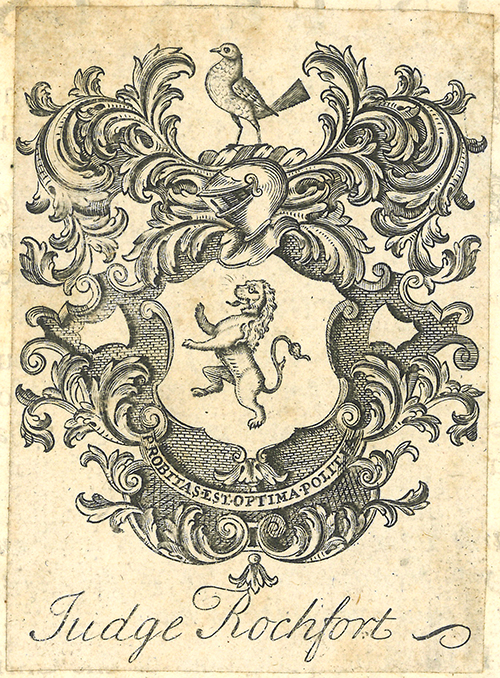
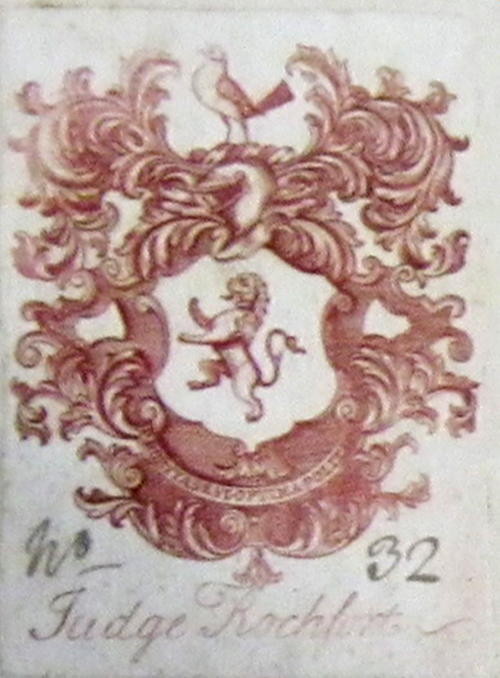
Judge Rochfort exlibris bookplate, ca. 1760


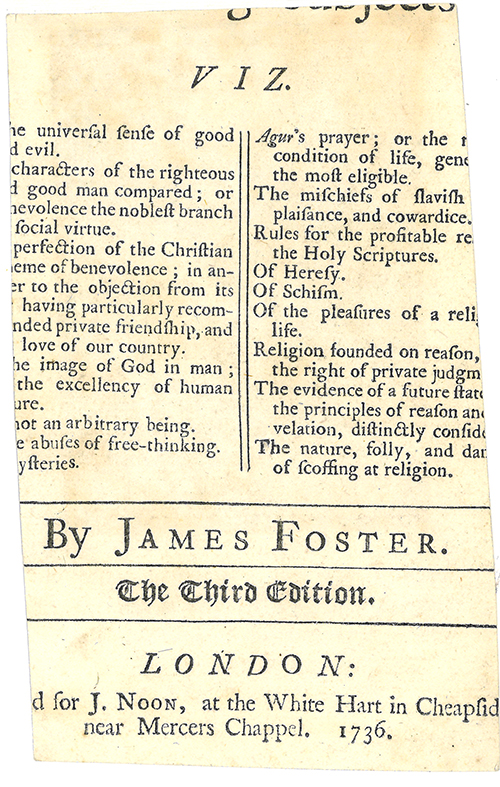
A biblioclast cut this early eighteenth century Judge Rochfort exlibris bookplate from a copy of James Foster, Sermons on the following subjects, viz. …, 3rd ed. (1736) [ESTC: n24146 (recording 15 copies); here]. I know this because, the bookplate was, and still is, fixed to the back of the titlepage, as you can see:


Bookplates are usually attached to front (fixed) endpaper, not to the title leaf; most likely, there was already a bookplate on the front endpaper, when Rochfort went to add his plate, so it was placed on the verso of the title leaf instead (more on this below).

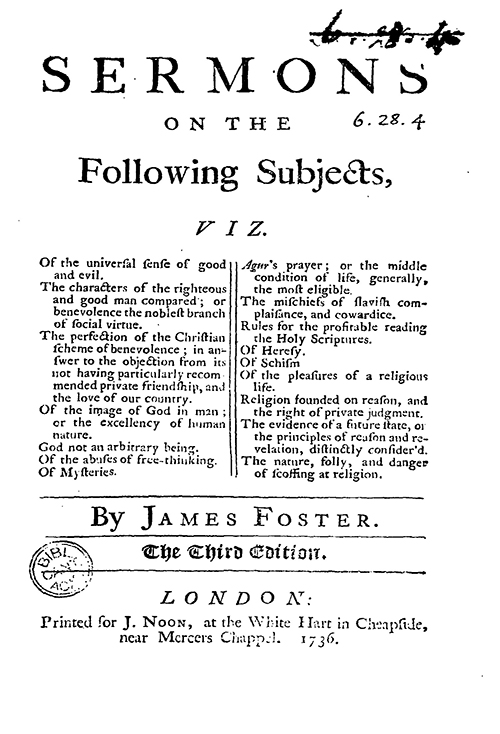
There is a copy of this edition of Foster's Sermons on ECCO, but not freely available online (yet—probably), but there are copies of the first edition of 1733 (here) and the fourth edition of 1745 (here) for anyone interested in Rochfort’s reading or book-buying preferences. Below is the full title page, taken from the University of Cambridge Library copy on ECCO:


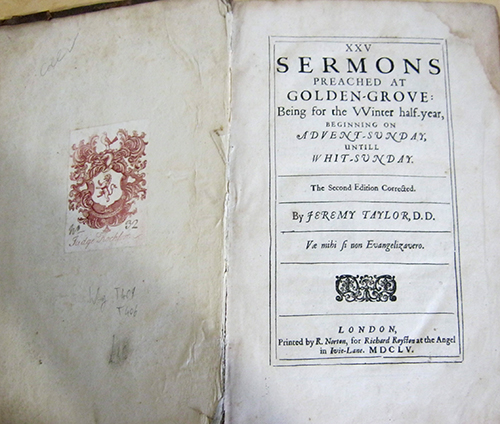
Although I have been unable to find a reference to any other Judge Rochfort bookplates in library catalogues online—or on ESTC under “Copy Specific Notes”—there is actually another book from Judge Rochfort’s library available at present on ABE (here):


The title of this book is not well represented in this ABE catalogue listing, but it is a copy of Jeremy Taylor, Eniautos. A course of sermons for all the Sundays of the year, 2nd ed. (1655) [Wing T330; ESTC: r10569 (recording 40 copies); here]. As you can see, this copy of Rochfort’s bookplate is printed in red, which is very unusual I believe.


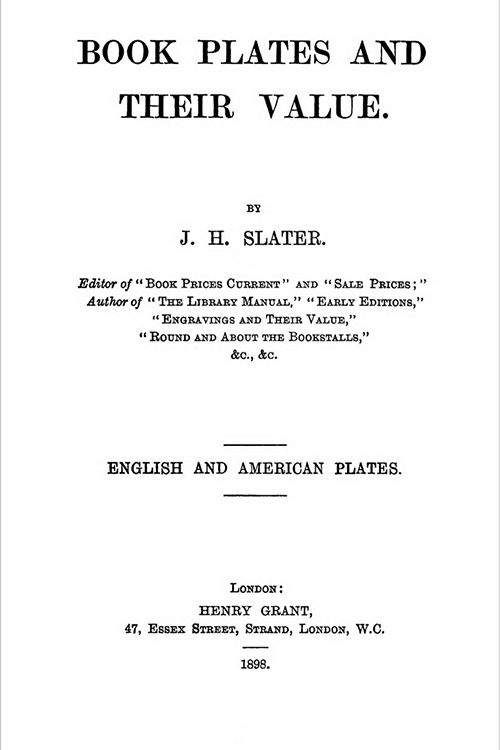
Although there is no image of it online, this armorial bookplate features in J. H. Slater’s, “Alphabetical List of Noted Book-Plates” in his Book Plates and Their Value (London: Henry Grant, 1898), 203 (online here):


According to Slater, there are actually two Judge Rochfort bookplates, mine being “distinctly ‘Jacobean’ with elaborate mantling”—although he dates is to “about 1760” (long after the Jacobean period)—but both feature the crest and motto: “Probitas est optima politia” [honesty is the best policy].

Slater, who is styled J. Herbert Slater in the books of his I have on my shelves, was particularly well informed, so I am inclined to accept his date for the bookplate. As I noted above, the unusual positioning of the bookplate suggests that Rochfort was not the first owner of his 1736 copy of Foster’s Sermons—any more than he was the first owner of his 1655 copy of Taylor’s Eniautos on ABE.

* * * * *

As for who was Rochfort—like St John Broderick, the other stray Anglo-Irish bookplate I bought in the late 80s (and blogged about here)—he is: Judge Rochfort, of Streamstown, Co. Westmeath, Ireland; High Sheriff of Westmeath in 1736.

Judge Rochfort was related to the much-better-known Rochforts of Gaulstown (Gaulstown is only about 25kms by road from Streamstown), but the link between the two families is somewhat distant, and the families may even have been at odds.

The Gaulstown Rochforts “were close friends of [Jonathan] Swift’s, and both George and John figure frequently in Swift’s letters and poems. John seems to have been a particular favorite: He was named by Stella one of her executors; and he was selected a member of the Lunacy Commission appointed, in 1742, to in quire into the state of Swift's mind” (Katherine Hornbeak, “Swift’s Letter to a Very Young Lady on Her Marriage,” Huntington Library Quarterly, Vol. 7, No. 2 (February 1944): 183).

Swift was a regular visitor to the Rochfort family at Gaulstown House—a very famous estate, which you will find information about here) and here). “It is said that it was when Dean Swift looked across the expanse of Lough Ennell one day and saw the tiny human figures on the opposite shore of the lake that he conceived the idea of the Lilliputians featured in Gulliver’s Travels” (here).

“A number of Rochforts family served in the Irish House of Commons for constituencies in Westmeath” (here); Robert Rochfort (1652–1727), of the Rochforts of Gaulstown, “had a highly distinguished career, being Speaker of the Irish House of Commons and Chief Baron of the Irish Exchequer. Robert’s grandson, also named Robert, was created 1st Earl of Belvedere in 1756. Their principal residences were Gaulstown House and, later, Belvedere House in Westmeath, of which only the latter still exists.”

Belvedere House is about 10kms from Gaulstown, but still only 25kms from Judge Rochfort in Streamstown—assuming that Judge Rochfort actually resided in Streamstown, which is by no means certain. The population of Streamstown is tiny, even today, although it is rapidly rising (increasing from 378 in 2016 to 519 in 2022; see here), and, as Arthur Sherbo notes, various members of the Rochfort family that Swift numbered among his friends were “resident in Dublin” at the time (Arthur Sherbo, “From the Westminster Magazine: Swift, Goldsmith, Garrick, et al.” Studies in Bibliography, Vol. 41 (1988), 276; here).

* * * * *

Returning to Judge Rochfort: Judge (here) was the son of Charles, son and heir of Charles Rochfort Esq. of Streamstown (ca. 1636–92; here and here), eldest son and heir of Lt.-Col. “Prime Iron” James Rochfort (ca. 1600–1652), who was court martialed and executed for killing his Major (in a duel) in Cromwell’s Army (here and here)—Lodge’s The Peerage of Ireland, vol. 3 (Dublin, 1754), 374–76 (here) provides the connections between all the otherwise disconnected references provided above.

Judge married Jane Donnellan (here), and had three daughters: Jane (here), Rebecca, who married (on 17 November 1779) Thomas Edwards, Esq. “an eminent surgeon” (here), and an un-named third daughter mentioned here.

Judge’s daughter Jane Rochfort married Rowland Rochfort (here)—a distant cousin—and had two daughters (only Harriet mentioned here, but two daughters mentioned here).

Rowland was the great, great, grandson of Lt.-Col. “Prime Iron” James Rochfort, and great grandson of Robert Rochfort (1652–1727; here; Prime Iron’s youngest son)—and wife Lady Hannah Hancock (d. 1733; here)—the friend of Swift.

Judge and his immediate family—indeed, most of the Streamstown Rochforts—have “no dates”—that I can find anyway—Robert, his ancestors, and descendants (i.e., the Gaulstown Rochforts), do. Lt.-Col. James Rochfort (d. 1652) was the father of Robert Rochfort (1652–1727), who was the father of the Rt. Hon. George Rochfort (1682–1730), who was the father of Arthur Moore Rochfort (1711–1774), M.P. for Westmeath, who was the father of Rowland Rochfort. Rowland’s father, Arthur, was the brother of Robert Rochfort, 1st Earl of Belvidere (1708–1774), aka “the wicked earl” (more on him below).

Meanwhile, the nearest dates that I can find for Judge’s immediate family are his grandfather (Charles, born ca. 1636), and the weddings of his daughters: Rebecca’s in 1779 and Jane’s (no date), but to Rowland, the brother of Lt.-Gen. George Rochfort (ca. 1739–1821).

* * * * *

I will end this ridiculously long post with a brief account of “the wicked earl” (based on the sources linked above, esp. here, here and here).

Apparently, Robert Rochfort, the 1st Earl of Belvidere, heard rumours that his young wife (Mary) had often visited—and had been having an “intrigue” with—his brother Arthur, the father of Rowland (Judge's son-in-law). According to a contemporary source: “[Arthur was] very well-bred and very well in his person and manner …[while] she is extremely handsome and has many personal accomplishments.”

As punishment, Robert had his wife locked up in the family house at Gaulstown, alone apart from her children and servants, for 31yrs. He also sued Arthur for “criminal conversation” for £2,000—a huge sum at the time; unable to pay, Arthur was thrown in a debtor’s prison where he eventually died.

Meanwhile, Mary was left so severely damaged by her long imprisonment “that she took to wandering the house and talking to portraits as if they were real people. When she was finally released after Robert’s death in 1774, Mary had become a deranged hag incapable of recognizing her own sons.”

George, the 2nd Earl of Belvedere, who freed his mother from imprisonment, demolished the Gaulstown House (where she had been imprisoned) and built a smaller house in the grounds for her. But Mary refused to stay; instead, she set sail for France, where she became a nun and lived the rest of her life as a hermit.

Given Robert’s character, if Judge allowed his daughter to marry Rowland, during the life of the wicked earl it seems very unlikely that he was at all close to Robert or the Gaulstown Rochforts—but perhaps this occurred after Robert bled to death, alone (and probably unrepentant), with his head caved in, on the grounds of his estate.

[Corrected: 15 June 2026]

Thursday, 30 March 2023

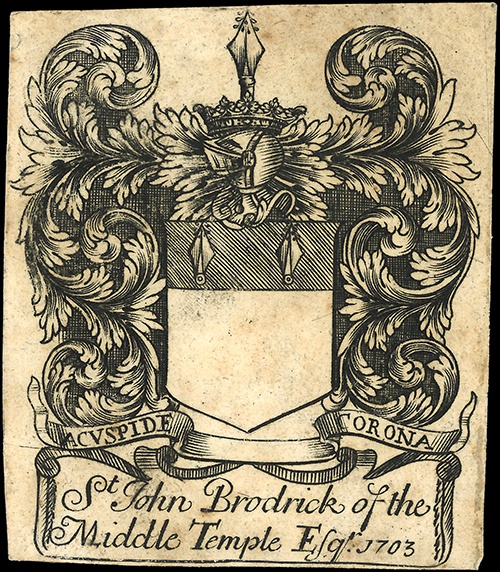
St John Broderick of the Middle Temple, 1703


This “Early Armorial” Restoration exlibris bookplate (Ginn, slide 14; see below) was created for St John Broderick of the Middle Temple, later The Honourable St John Brodrick (ca. 1685–1728), son of Alan, Baron Brodrick (ca. 1655–1728)—who outlived his son by only six months (Wikipedia pages here and here).

The short Wikipedia entry on St John Broderick characterises him as “an Anglo-Irish politician who sat in the Irish House of Commons from 1709 to 1728 and in the British House of Commons from 1721 to 1727”; since he was a parliamentarian, a few more details appear in Romney Sedgwick’s The History of Parliament: the House of Commons 1715–1754 (1970; online here).

Combining details from Wikipedia, Sedgwick and C. M. Tenison’s “Cork M.P’s, 1559–1800,” Journal of the Cork Historical and Archaeological Society, vol. 1, 2nd ser. (1895): 177 (here), the details of his life can be summarized as follows:

St. John Brodrick of Ballyanane, alias Midleton, was the eldest son, by his first wife, of Alan Brodrick, M.P., who was afterwards created Viscount Midleton. He was educated at Eton, 1698, and King’s College Cambridge, 1700, and was admitted to the Middle Temple, 1700; barrister-at-law, Ireland; Recorder of Cork, in succession to his father, 1708.

Brodrick was M.P. Castlemartyr, 1709–13 (then “of Cork”); Cork City, 1713–14 (then “of the Middle Temple”); Cork County, 1715–27; and 1727 (then Right Hon. St. John Brodrick) till his death in 1728. Brodrick was M.P. also for Beeralstown, county Devon, 1721–27; a Privy Councillor, 1724.

He married Anne, daughter of Michael Hill, of Hillsborough. She died 1752, leaving five daughters, of whom Anne married James Jeffreys, and Mary married Sir J. R. Freke, M.P. (q.v.). He died s.p. and s.p.m., 21st February, 1728.


A “Sketch Pedigree exemplifying the Brodrick M.P’s” is in Tenison here and a “Pedigree of Broderick” (that includes St. John and his daughters) can be found here

* * * * *

I found only a few references to this 1703 bookplate. It seems that Broderick owned a copy of Donne's Poems (London, 1633), now at Texas Tech University, Lubbock (here, but no photograph).


There appear to be no modern photograph or scan of St John Broderick’s bookplate online, but Egerton Castle reproduced a copy of this bookplate in his English Book-plates: Ancient and Modern (1893), 60 (above; text here); and this image was used by both Linda K. Ginn, for her 2017 lecture on “Digital Bookplates: Old Technology and New Applications” [University Libraries Workshops and Presentations, 6 (pdf online here]) and Paul Magrath in his 2021 post for the ICLR [Incorporated Council of Law Reporting for England and Wales] on “(L)ex Libris — the art of the legal bookplate” (here).


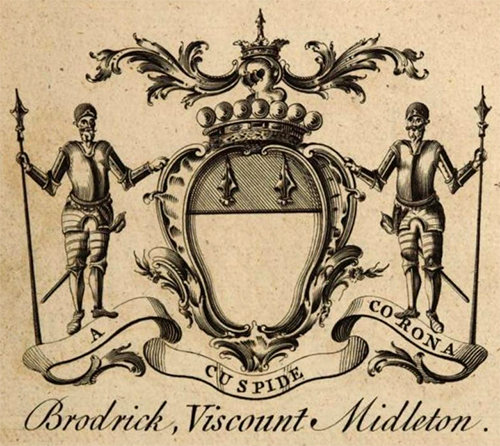
Regarding the Brodrick family motto: “a cuspide corona” can be translated as “from a spear, a crown” (i.e., one receives honour [a crown] for military exploits [a spear]). This motto can also be seen on the 1754 engraving above, taken from John Lodge, The Peerage of Ireland, vol. 3 (Dublin, 1754), pl. 29 (here).

* * * * *

I have no record, and no clear memory of when I acquired this bookplate—but I think I have had it and a one other anglo-Irish bookplate (which I blogged about here) for decades, probably since the late 80s. I have a pretty strong aversion to supporting “breakers”—biblioclasts who disassemble books for engravings, or sammelbands and nonce-volumes for individual works, especially plays—so I can only assume that I bought the collection of bookplates [1] not from the beaker themselves (to avoid encouraging this sort of thing) and [2] out of a desire to protect bookplates themselves.

As you can see, I have managed to protect this one so far. But it occurred to me recently, when I was going through my ephemera, that it might be even better to post images and information about some of my ephemera here. Destruction is only a bushfire away after all and the bookplates are both very attractive—as the appearance of this one in Egerton Castle’s English Book-plates suggests.

Sunday, 5 March 2023

Leonora Meadowson in Sams's Royal Subscription Library, 1826

Haywood’s The History of Miss Leonora Meadowson (London: Francis Noble, 1788) is a two-volume collection of four, short works, only the first of which is by Haywood—this being the titular “Leonora Meadowson,” which is a lightly-revised reprint of Haywood’s Cleomelia: Or, The Generous Mistress (1726).

In addition to a 1997 conference paper and a long entry in my 2004 Bibliography, I have published two essays on Leonora Meadowson: “Eliza Haywood’s last (‘lost’) work: The History of Miss Leonora Meadowson (1788)” (BSANZ Bulletin, 1999)—which announced my 1997 (re-)discovery of a copy at the Fales Library in New York—and “Twice-Told Tales in Eliza Haywood’s Leonora Meadowson” (Notes and Queries, 2016)—which corrects my mistaken attribution to Haywood of the three shortest works in this anthology.

In my 1997 conference paper and 1999 essay, I explained how rare it is to find any reference at all to Haywood’s long-lost work. After a prolonged and extensive search, diligently pursued, I had found practically nothing. The “puny discovery” (1999:43) of a single advertisement, in another book issued by Noble, was all the reward I had for my efforts—until I accidently discovered a copy of the book at the Fales library in 1997.


Above is one of the blurry, ye-olde-tech photos I took of my discovery in 1997:

Over twenty-five years later, it is obviously very quick and easy to repeat and extend my previous, broad-scale searches for “some record, even if only a trace, of the fleeting existence of this ‘lost’ book” (1999:43)—and I am pleased to say that I found something more.

What I found is only another trace—but the location of that trace is interesting. In the essay I wrote on my search for, and discovery of a copy of Leonora Meadowson, I explain that:

“the main outlet for [the Noble bothers’] new publications was through wholesale distribution to other circulating libraries and to retail outlets. Leonora Meadowson appears never to have made it to this stage of distribution, or to have barely started it. If the book had been distributed, we would find it listed in the catalogues of dozens of the circulating libraries that the Nobles supplied; but, as I have shown above, it is not to be found in any of them. ” (1999:40)

I can now replace “not to be found in any of them” with “only to be found in one of them”—in the Catalogue of Sams’s Royal Subscription Library, No. 1 St James Street London (London: Joseph Sams, [1826]), 168 (no. 6658): “History of Miss Leonora Meadowson. a Novel, 2 vols. 12mo. 6s” (available here)


This “puny discovery” doesn’t change my original analysis, since finding just one entry in a circulating library catalogue supports my interpretation that the process of distribution can have only “barely started” for the book to disappear so comprehensively since. If anything, it offers more support for my interpretation, which is nice.


I will keep searching for traces of Leonora Meadowson. As more ephemeral publications (like the Catalogue of Sams’s Royal Subscription Library) are scanned and published online, it is possible that I will find yet more traces, but as I approach nearly thirty years of searching (!), my expectations are very modest indeed.

Sunday, 6 March 2022

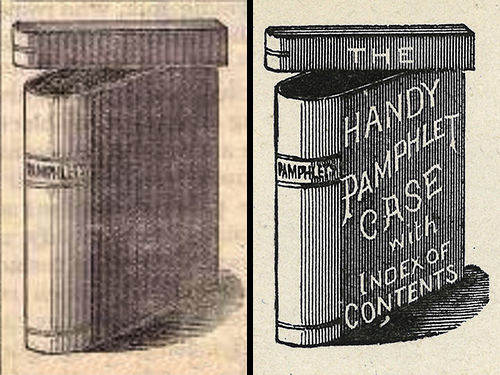
The H. B. Nims Handy Pamphlet Case, 1876


The Handy Pamphlet Case (depicted above) was produced by H. B. Nims and Co., Troy, NY, and advertised from 1875 to 1877. An 1875 advertisement in The American Stationer (here), reads as follows:

The HANDY PAMPHLET CASE.
With Index of Contents.

Useful to librarians and literary men for classifying pamphlets.
Useful to physicians for holding their journals previous to binding.
Useful to clergymen to keep their sermons in.
Useful to business men to keep price lists and catalogues in.
Useful to everyone who takes a magazine.

A neat, cheap and handy invention to preserve all kinds of paper-covered literature, that would otherwise be impaired or destroyed.

LARGE 8vo., PER DOZEN, $2.50
Samples sent by mail upon receipt of 25c

H. B, NIMS [and] CO., Manufacturers,
TROY, NEW YORK.


The advertisement text was re-set in the 1877 advertisements I have seen in The American Library Journal (here, for example), and the accompanying image changed to include the words "THE | HANDY | Pamphlet | CASE | with | Index of | Contents".


In addition to the advertisements in The American Stationer and The American Library Journal, Henry B. Nims—running a descendant business of W. H. Merriam (est. 1840)—printed advertising slips that were loosely inserted in new publications they sold. I found one (above) in a copy of H. R. Fox Bourne's The Life of John Lock (New York: Harper and Brothers, 1876), which provides a sharper image than those in the magazines on Google Books.

Unfortunately, I can find no trace of a surviving example of the Nims Handy Pamphlet Case, which is a shame. If they were tin they probably did a lot of damage to the pamphlets, journals, sermons and catalogues they contained, but if they were made of stiff card and paper they might have saved many of the same from destruction.


Anyone interested in H. B. Nims and Co., of Troy, New York—"the largest and most complete book store between Boston and Cleveland"—will find some information in The Industrial Advantages of Troy, N.Y. and Environs (1895; here; the source of the quote and the photos above and below) and The City of Troy and Its Vicinity (1886; here).


BTW: anyone interested in another example of the wonderful, book collecting-related, stationary items developed in the States in the late nineteenth-century, should see my post on "The Van Everen Fitsanybook Adjustable Book Cover" (here).

Sunday, 6 February 2022

Slip cancellation in 1904

Below are some images of one of my books with a cancelled imprint—The Letter of Petrus Peregrinus on the Magnet A.D. 1269, translated by Brother Arnold, and with an Introductory Note by Brother Potamian (New York, 1904).* (For my previous posts concerning cancellation, see here.)


There are three copies of this edition of The Letter of Petrus Peregrinus available to buy at present: all record the imprint as “McGraw-Hill.” As you can see, however, the printed imprint is “McGraw Publishing Company.”


But you can also see that my copy (and, I assume, the ones for sale) have a nicely printed slip bound in that covers the imprint, which states that the book was published by the “McGraw-Hill Book Company … successors to Book Departments of the McGraw Publishing Company [and the] Hill Publishing Company.”


There is a copy on the Internet Archive (here https://archive.org/details/letterofpetrusp00pieriala) that does not have this printed cancellation slip, so it is unclear whether all copies have the slip-cancel. Which raises an interesting question: how should the imprint be recorded: “McGraw Publishing Company” or “McGraw-Hill Book Company”?**


While looking at this book again I noticed something else—which the astute reader may also have noticed—it has a page number on the title-page! It also has one on the verso of the title leaf, on the imprint page, as well as the half-title, part-titles etc.

Conventionally, these pages do not have page numbers on them. It would be interesting to know whether other publications by McGraw consistently included printed pagination in this way, or whether this was a one-off—an accidental oversight effecting just this book, bought on by the disruption of amalgamation.


*BTW: Wikipedia informs me (here) that the AKAs for Petrus Peregrinus, Brother Arnold and Brother Potamian are: Pierre Pelerin de Maricourt, Joseph Charles Mertens and M. F. O’Reilly.

**The answer from WorldCat (here)—or the overwhelming majority of its subscriber-libraries—is “Norderstedt Hansebooks GmbH 2018”! The main entry for The Letter of Petrus Peregrinus (with 171 copies in “all 9 editions”) has this imprint. Under this main entry you can insist on only seeing “just this [print-on-demand] edition,” but not just one of the other 8 editions, one or two of which are the real one. A secondary WorldCat entry with the imprint as I gave it at the head of this post (“New York, 1904”) has only one holding in Denmark. Three cheers for the Danes, for getting it right.

Sunday, 29 August 2021

Gerald Dillon, freelance journalist

Gerald Aloysius Dillon (29 June 1897–[after 1952]), Irish-Australian soldier and freelance journalist, contributed an article on "'The Female Spectator': Mrs. Eliza Heywood's Periodical" to Australian Woman's Mirror in March of 1934. I said in my post on that article (here), that Dillon contributed a series of roughly fifty bookish essays to the Australian Woman’s Mirror, "many about women or women writers such Joanna Southcott, Ouida, Angella Burdett, Sidney Webb and Katherine Mansfield (probably his most famous essay)." I also said that "I have not been able to find out as much about Dillon as I would like"—but what I have found is below.

* * * * *

The AustLit entry for Dillon states "Gerald Dillon was a freelance writer from Sydney," and list only six of his works: one, a self-published book (Why Editors Regret: First Aid for the Free-Lance Gerald Dillon (Sydney, 1929)), the Katherine Mansfield essay mentioned above, and four pieces of his journalism that seem to have been selected more-or-less at random.

After a pretty extensive search online, I located quite a bit more information than AustLit offers. My three main sources of biographical information (reproduced below) are a series of entries for him (and his brothers) in The Catholic Who's Who and Yearbook from 1930–52 (vol. 23 (1930): 134; 29 (1936): 131; 34 (1941): 130; 35 (1952): 118), a brief article about Dillon published in The wireless weekly: the hundred per cent Australian radio journal, Vol. 36 No. 28 (12 July 1941): 3b (this article supplied the only photograh I could find of Gerald Dillon), and a National Archives entry.


The Catholic Who's Who and Yearbook entries are all much the same, the 1930 edition reading

[1930–52] "Dillon, Gerald Aloysius—b.1897, y.s. [youngest son] of late Theobald Augustus Dillon, co Roscommon; edu. Downside and R.M.C. [Royal Military College, Sandhurst]; Sec.Lieut 6 (Inniskillg) Dgns [Dragoons] 1916; resigned as Lieut 1921; served Great War; at present engaged in journalism. Author of Why Editors Regret: Box 2876N. G.P.O., Sydney, N.S.W."

The yearbooks contain entries for two bothers, which provide more details of the family:
  Gerald's father was Theobald, of Mount Dillon, co. Roscommon,
  his mother was Bertha, daughter of Nicholas Mulhall of Boyle, co. Roscommon;
  his eldest brother went to Trinity College Cambridge (B.A.), was Capt. in the Connaught Rangers (Special Reserve); served in WW1, and was called to the Irish Bar in 1922;
  the second brother, Capt. John Jospeph Dillon (b. 19 Feb. 1896), went to Sandhurst, like Gerald, was a Lieutenant in the Connaught Rangers (Special Reserve); was twice wounded in WW1, winning the Military Cross, rising to Captain in 1927 in the Royal Army Service Corps.

[1941] FILLED LIFE WITH TRAVEL
Gerald Dillon, well known for his talks on 2FC and 2BL [Sydney radio stations], has had a life crammed with travel and adventure.
  An Irishman, born in Dublin in 1897, he spent six years at an English public school before returning to Dublin to study law.
  In 1916 he abandoned law to enter Sandhurst. Graduating there with a commission in the Dragoons, he served in France in the last war.
  After the war, feeling an urge to travel, he resigned his commission in the Army, and visited Australia, Canada, New Zealand, India, and Tahiti before settling for several years in Papua as a plantation manager.
  Gerald Dillon’s variety of experience has given him plenty of material for broadcasting. He is also well known as a freelance journalist, and on one occasion he turned to authorship.
His anecdotes of life among the wild and woolly natives of Papua have proved very happy entertainment for radio audiences.

[1939–48] WW2 Service record [National Archives of Australia: Citizen Military Forces Personnel Dossier]

DILLON GERALD ALOYSIUS
Service Number - N279151
Date of birth - 29 Jun 1897
Place of birth - DUBLIN IRELAND
Place of enlistment - PADDINGTON NSW
Next of Kin - Unknown
Contents date range: 1939–1948
Item ID: 6194595
Location: Canberra
Access status: Open

[Honouringveterans.org (here) adds: "Rank: Corporal"]

Beyond The Catholic Who's Who and Yearbook and the anonymous "Filled Life With travel," Trove fills in many details concerning Dillon's freelance and radio work. However, although there are hundreds of entries for Dillon on Trove, they add little about his personal life. Apparently, he lived in "Verona," Waruda St., Kirribilli, Sydney, before WW2, but I was unable to find any record after the 1952 Catholic Who's Who and Yearbook. If we are to judge by the lack of a Next of Kin in his WW2 Military Forces Personnel Dossier, it appears he did not marry. He seems to have died obscurely, and alone, with no memorial or death notice.

* * * * *

Dillon's self-published 58-page booklet, Why Editors Regret was reasonably-well received, being reviewed in half a dozen journals throughout Australia. Although most major libraries in Australia have a copy, I have been unable to look into one due to the lock-down, but the reviews contain a number of details, so I will finish this post by transcribing three the longer reviews, and provide links to three others. The reviews below are organised chronologically.

"Franziska" [Frances Zabel], The Australian Woman's Mirror, Vol. 5 No. 48 (22 October 1929): 24c, 41b "Let's Talk about Books" (here)

Editors would have far fewer regrets if this little book were read by all those Australians seeking to break into freelance journalism The author, who can speak from experience of the ups and downs of freelancing, gives much practical advice to the budding writer and covers a wide field—what editors want, the article, book reviews, verse, the paragraph, the short story, writing for children, and so on. A foreword has been written by the editor of the Bulletin and there are special contributions by the editor of Aussie, the editor of the Mirror, Katharine Susannah Prichard, J. H. M. Abbott Professor Brennan, Edward Perugini, W. E. FitzHenry and others. Apart from a few typographical errors that should not have crept into a literary handbook, the little volume is well-produced, and it should do something toward realising the expressed purpose of Mr. Dillon the lightening of the heavy burthen which weighs on those who wander without proper sense of direction in the fugitive byways of literature.

The Bulletin, vol. 50, no. 2594 (30 Oct 1929): 5a–b (here)

Why Editors Regret
  They don’t; but the harmless fiction makes a catchy title, and prospective or potential freelances who spend half a crown on Gerald Dillon’s booklet of that name should not have any regrets, either. Editors do not regret, because theirs is the most impersonal job on earth; they buy what they want, they turn down what they don’t want. The best friend in the world ceases to be a friend when he translates himself into a piece of paper with words on it. Having done that, the best friend is a bit of copy and nothing else.
  Mr. Dillon has strong support: Bert F. Toy, editor of the Woman's Mirror, and writer here of a most compact and in formative article; Walter Jago, editor of Aussie—not very informative, but a good blow where one has been long asked for; Katharine Susannah Prichard—so so; Harold Mercer—amusing and encouraging (he says, “One bit of misleading information may destroy a growing reputation painfully built up" (and he writes sermons for sick clergymen); C. J. Brennan—an excellent page on light verse; Hugh McCrae—Hugh McCrae; Edward Perugini—one or two acute remarks on serious verse; J. H. M. Abbott—on "historical background" in fiction ("There are 700 possible separate characters available amongst the convicts of the first fleet.” May he be spared to use the five of them that he has not used already!); Edyth Bavin, wife of the N.S.W. Premier—on “writing for children," which she herself does charmingly; W. E. FitzHenry, who has grown up in The Bulletin office and knows as much about marketing paper with words on it as the next man, and his brother. A guiding foreword by S. H. Prior, editor of The Bulletin, and seven articles by Mr. Dillon covering pretty well the whole field of freelancing complete the bill of contents.

The Capricornian (Thu 5 Dec 1929): 12a: BOOKS RECEIVED (here)

S. A. Rosa, The Labor Daily (Sat 7 Dec 1929): 9g. LITERARY JOTTINGS (here)

The Advertiser (Sat 8 Feb 1930): 14f "LITERARY BEGINNERS" (here)

The West Australian (5 Jul 1930): 5d (here)

"WHY EDITORS REGRET."
(By J.P.)

A small booklet with the above title came recently before my notice, and I found it interesting to read because of the elementary hints and tips it contains for those who practice free-lance journalism in Australia. That it is written for Australians is its chief virtue. This booklet, largely the work of Mr. Gerald Dillon, but containing some brief contributions by other well-known journalists and authors, fills a want that, I imagine, many writers in Australia have felt: it sets down some guidance that should explain to the disappointed just why and how editors 'regret' when they return manuscripts. For instance: 'What the editor wants is the sort of matter he publishes' … 'Get a typewriter' … 'Never fold your manuscript more than once' … 'Enclose a stamped addressed envelope for return' … 'Never use single spacing in typing' … 'Never send a covering letter with a manuscript'—these are the first essentials to the equipment of the freelance; indeed, I think they are guides that will take him over half his journey to acceptance of his manuscript.
  The book discusses the usual methods of writing newspaper articles, short stories, serials, verse, juvenile matter and paragraphs—the last subject to some purpose, which is perhaps not unnatural in a laud where paragraph writing has become a habit rather than a practice. These discussions are slight, and the symposium to which various well-known writers have contributed is notable for its general evasion of the book's requirements. Katharine Susannah Prichard has 'nothing very much to say as to 'why the editor regrets,' except that he doesn't when he says so.' The truth is that editors often do regret: and the editor of 'Aussie' has here something to say about why they regret. Hugh MacRae says. 'I cannot see how any freelance journalist could benefit by anything I might have to say.' J. H. M. Abbott dismisses 'The Historical Back ground,' of the short story, in two paragraphs, and Edyth Bavin 'Writing for Children' in two shorter paragraphs. Perhaps the soundest and most useful article is that by the Editor of 'The Australian Woman's Mirror' on 'The Woman Free Lance.' and it is a pity that the other contributors had not approached their task with the same seriousness and desire to help, when a thorough-going handbook for the local freelance might have been the result.
  This booklet should, though, be useful to the beginner, who will soon find that his experience does not tally with Mr. Dillon's in several matters. It is said that there is practically no market in Australia for articles of the discursive essayist type: and 'The local market for short stories is practically unlimited.' With good essays on almost all subjects appearing regularly in our leading papers. I wonder what shade of meaning Mr. Dillon in tends for his word 'discursive.' As for the short story market, this is decidedly limited, because it is over-supplied, and this for the reason that short-story writing ' is the one branch of literature in which, more than in any other with the possible exception of verse, local writers have squandered their energies.

* * * * *

Four final notes: [1] In a recent essay by Martin Griffiths ("Katherine Mansfield’s Australia," Tinakori: Critical Journal of the Katherine Mansfield Society Issue 4 (Summer 2020): 60–70) Dillon is mistakenly described thusly (ibid. 63) "New-Zealand-born commentator Gerald Dillon." [2] it is nice to see a Frances Zabel review of Dillon's book. For my post on Mrs Zabel, see here. [3] I was delighted to find that Dillon wrote an article on "A Perfect Library," which I will post soon. [4] "Verona" near "Astoria" in Waruda St., Kirribilli was a boarding house (according to Anne Watson, The Art of Roland Wakelin (1975), 2.22), but a "superior" one, according to a 1930 advertisement (offering "Superior Single Rooms, fireplace, balcony, glorious views, from 15/.").

[UPDATE 2026.04.23: I have finally posted Dillon article on "A Perfect Library": see here]