Showing posts with label Printing. Show all posts

Sunday, 6 February 2022

Slip cancellation in 1904

Below are some images of one of my books with a cancelled imprint—The Letter of Petrus Peregrinus on the Magnet A.D. 1269, translated by Brother Arnold, and with an Introductory Note by Brother Potamian (New York, 1904).* (For my previous posts concerning cancellation, see here.)


There are three copies of this edition of The Letter of Petrus Peregrinus available to buy at present: all record the imprint as “McGraw-Hill.” As you can see, however, the printed imprint is “McGraw Publishing Company.”


But you can also see that my copy (and, I assume, the ones for sale) have a nicely printed slip bound in that covers the imprint, which states that the book was published by the “McGraw-Hill Book Company … successors to Book Departments of the McGraw Publishing Company [and the] Hill Publishing Company.”


There is a copy on the Internet Archive (here https://archive.org/details/letterofpetrusp00pieriala) that does not have this printed cancellation slip, so it is unclear whether all copies have the slip-cancel. Which raises an interesting question: how should the imprint be recorded: “McGraw Publishing Company” or “McGraw-Hill Book Company”?**


While looking at this book again I noticed something else—which the astute reader may also have noticed—it has a page number on the title-page! It also has one on the verso of the title leaf, on the imprint page, as well as the half-title, part-titles etc.

Conventionally, these pages do not have page numbers on them. It would be interesting to know whether other publications by McGraw consistently included printed pagination in this way, or whether this was a one-off—an accidental oversight effecting just this book, bought on by the disruption of amalgamation.


*BTW: Wikipedia informs me (here) that the AKAs for Petrus Peregrinus, Brother Arnold and Brother Potamian are: Pierre Pelerin de Maricourt, Joseph Charles Mertens and M. F. O’Reilly.

**The answer from WorldCat (here)—or the overwhelming majority of its subscriber-libraries—is “Norderstedt Hansebooks GmbH 2018”! The main entry for The Letter of Petrus Peregrinus (with 171 copies in “all 9 editions”) has this imprint. Under this main entry you can insist on only seeing “just this [print-on-demand] edition,” but not just one of the other 8 editions, one or two of which are the real one. A secondary WorldCat entry with the imprint as I gave it at the head of this post (“New York, 1904”) has only one holding in Denmark. Three cheers for the Danes, for getting it right.

Thursday, 8 April 2021

Slip cancellation in 1980

As Sarah Werner and Mitch Fraas observe (in a Folger library blog post, here) "Pasting in slips of paper to correct errors was not unusual practice in the hand-press period." Sarah went on to give a lot of examples of a variety of slip cancels from the hand-press period (here), with lots of fabulous photos.

Even after 1800, slip cancellation was not uncommon, and anyone who has handled a lot of old books will probably have seen quite a few imprints from the machine-press period that have been updated via little printed pieces of paper pasted over an old imprint—sometimes, half torn off again by curious readers. Most of the slip-cancells I have seen, or remember seeing, are from the late ninteenth and early twentieth century, but I have seen a few from the 70s and 80s too.

The present example is such a good one, since it is not just an imprint update, and such a late one, that I thought it might be worth posting. And, having looked online and found that there are almost no other "recent" examples, I decided to go ahead. I might even post a few more of these as I notice them (again) among my books.

Today's slip cancel is from Mariel Dewey, 12 Months Harvest (Edinburgh: John Bartholomew and Son Ltd., 1980), first published in 1975 by Ortho Books, San Francisco as A Guide to Preserving Food for a 12 Months Harvest: Canning, Freezing, Smoking, and Drying; Making Cheese, Cider, Soap and Grinding Grain; Getting the Most from Your Garden (the sort of comprehensive title that was popular in the 18C.).


I have had my copy of Dewey's 12 Months Harvest for thirty years, so I have often seen the cancel, and been struck by just how good an example it is of slip-cancellation.

As well as shortening the title, John Bartholomew and Son messed up the index. Probably, this was because—after they had compilied the Index—they made some late changes to the text and layout, which resulted in changes to the pagination, though it may be because they simply reprinted the American index without twigging that their own setting was different, and that this would result in changes to layout, index etc.


In any event, having printed the book with a faulty index, and realised that they had done so, they needed to either reprint the final gathering or paste in a slip explaining the error. Obviously the latter is cheaper and easier and so, as you can see, they opted for it (as printers have for hundreds of years).


As you can also see, by the shadow in the above photo, because the slip is pasted over the start of the index, it is attached by one edge only. You have to lift the left-hand side of the slip to see the index entries underneath for anything starting with an "A."

Saturday, 15 December 2018

Bookseller trade cards of the 18C

Sir Ambrose Heal's "Bookseller and Stationers' trade-cards of the eighteenth century" appeared in The Penrose Annual, vol. 45 (1951), 29–32. It contains one page of introductory text (which says nothing about the production, publication, distribution and history of bookplates and trade cards or anything of note concerning bookselling and printing in the eighteenth century), four pages of illustrations (showing sixteen separate trade cards, below) and three pages of notes on the booksellers.

About four years ago, shortly after publishing my post on Bookplates of Booksellers and Circulating Libraries, I checked out Heal's essay in the hope that it would provide either more information on (no), or more images of (yes), the 164 bookplates and trade-cards listed in the Franks Bequest Catalogue—of which I was only able to provide two in my original post.

I am not sure why it has taken four years to post these scans, perhaps I was hoping to find more images in his other works. If so, it would appear that I was unsuccessful. However, I have fond a few more images on line, which I will post shortly.

* * * * *

The sixteen trade-cards below are of for James Adams, John Bromley, James Brooke, James Buckland, Thomas Edlin, William Kerby, Lackington, Allen & Co., Arthur Lyon, Ralph Minors, Francis Noble, Bartholomew Penny, Daniel Richards, William Sanby, J. Shove, Samuel Stillingfleet, and Thomas Worrall (none of which are in the Franks Bequest Catalogue).


Wednesday, 12 December 2018

Henry Lasher Gardner publisher’s device

I included Henry Lasher Gardner publisher’s device in an appendix to my essay: "Thomas Gardner's Ornament Stock: A Checklist" (Script and Print, vol.39, no.2 (May 2015): 111).


As I noted in my article, this device (32x35mm) "is a monogram made up of two mirrored elements: an H, and a flourish that resembles both an L and, when reversed, a G. The device appears on at least four items between 1771 to 1773." (Elements crudely highlighted below.)


Through a happy accident, I have now identified the source of Henry Lasher Gardner's publisher’s device: Samuel Sympson's A new book of cyphers, more compleat and regular than any yet extant. Wherein the whole alphabet (twice over,) Consisting of Six Hundred Cyphers, is variously changed, interwoven and reversed (London: Printed for Samuel Sympson Engraver in Catherine-Street in the Strand, B. Cole Engraver at the Sun a Lace Shop in St. Paul’s Church-Yard, and sold by [six engravers and print-sellers], 1726), plate 44 (ESTC: T145073), which was reprinted in 1736 (N471341) and ca. 1750 (T132195; online here).


As you can see, the resemblance of the reversed G to an L is entirely fortuitous. I bet Henry Lasher was pleased.

BTW: The happy accident I refer to above was that I recently spotted a copy of the first edition of Sympson's A new book of cyphers on eBay (here). Although it started at GBP5, entirely unsurprisingly, it sold for more than one hundred times that (GBP586). (In case anyone is interested, a copy of the ca. 1750 edition is still available for twice this price: USD1495; here.)

As soon as I saw that the "cyphers" in the title were actually "monograms," I wondered whether Henry Lasher may have got his monogram from such a source. As you can see, my hunch was a good one. The two monograms are identical.

* * * * *

For my other posts on Gardner, see A very crude Gardner ornament catalogue, 1995 and Works Containing Gardner Ornaments.

Thursday, 2 March 2017

Works Containing Gardner Ornaments

I spent the second half of 2013 on study leave. During that time I compiled two lengthy articles of Thomas Gardner, his wife and son, who carried on his publishing business after he died in 1765. Both articles were published in Script and Print in the first half of 2015. (They were going to appear together, but at over eighty pages of print, were too long for a single, sixty-four-page issue.) I think of them as Gardner 1 and Gardner 2 or "Bio" and "Checklist," but the titles are:

[1] "Thomas, Lucy and Henry Lasher Gardner, Opposite St. Clement's Church in the Strand, 1739–1805" Script and Print, vol.39, no.1 (February 2015): 21–58. Copy on Academia.com.

[2] "Thomas Gardner's Ornament Stock: A Checklist" Script and Print, vol.39, no.2 (May 2015): 69–111. Copy on Academia.com.

These article started with material I was going to publish in a blog post here. But, as the material rapidly grew, I realised it would have to be a few posts, then an article, then two articles! Long as my articles are, quite a bit of the material I collected during my research was never going to make it into them. But I tried to hold off posting anything here until my articles were in print (emphasis on tried: one moment of weakness, quickly led to another).

Since 2015, I have published one more article:

[3] "A Postscript on Thomas Gardner’s Printing," Script and Print, vol. 40, no. 1 (May 2016): 43–45. Copy on Academia.com.

And while drafting a few others I recently identified an error in the printing of the ornament catalogue. Because I was still researching and drafting essays, I had still been kind-of holding off posting anything more here. However, now that my main articles are in print, and I have an error to correct, there really doesn't seem to be any good reason to hold off publishing anything more about Gardner here, and at least one good reason to not hold off. So I won't.

The printing error in Gardner 2 is that the image of one headpiece (H16) is repeated (it appears as both H16 and H18), while a second headpiece image (of H18) is omitted. This is the image of H18 that ought to have appeared in Gardner 2:


* * * * *

Below is a bibliography of the books, pamphlets etc. that contain Thomas Gardner ornaments (i.e., the forty-nine ornaments I identified as belonging to him), but which I did not include in my "Checklist" Bibliography (Part A [only containing Gardner ornaments] or B [containing a mix of ornaments]). Although the lists below may contain items I accidentally omitted from my article, they are not lists of errata and corrigenda. Rather, they are supplement to my "Checklist"—since they are/will be mostly made up of items that [a] I did not locate using the method I outlined in my "Checklist" or [b] which were intentionally left out of my "Checklist," such as the dozens of items not available on ECCO or in digital surrogate elsewhere.

It is possible that the bibliography below, combined with the "selection of Gardner’s output" I included in my "Checklist," may, in time, amount to a near-complete list of items printed by Gardner. I certainly hope it does, and so I will be very grateful for any information provided to expand the lists below. I have started today with only the two items identified by Carlo Dumontet, which he reported to me almost immediately after my "Checklist" was published, and one by David Levy, which he sent me last week. (A big thank you to Carlo and David.) I will add the Haywood and Shakespeare items I identified in Gardner 3, as soon as I get a chance.

Given the progress Hazel Wilkinson has now made in "developing methods of identifying unknown printers using digital imaging" (i.e., using image-recognition software to locate and match printer’s ornaments on ECCO files), there is a new and enticing method for identifying extra Gardner items: Fleuron: A Database of Eighteenth-Century Printers' Ornaments. David found his addition to this list using Fleuron. My first attempts on this site suggest that there is very good chance that I will soon be able to greatly-expand these lists. If so, great! It may not take decades—which is normal for such enterprises—to reach the point where it is possible to obtain a much more complete picture of the scope of Gardner’s printing activities.

* * * * *

A: List of eleven items containing only Gardner ornaments (NB: new items will be numbered sequentially, A1, A2 etc., but will be arranged chronologically).

A11. [Elizabeth Cooper], The Historical and Poetical Medley: Or Muses Library; being a choice and faithful collection of the best antient English poetry, from the times of Edward the Confessor, to the reign of King James the First. With The Lives and Characters of the known Writers taken from the most Authentick Memoirs. Being The most valuable Collection of the Kind now extant, affording Entertainment upon all Subjects whatsoever (London: Printed for T. Davies, in Duke’s Court over-against St. Martin’s Church, in St. Martin’s Lane, 1738); ESTC: T61451; available on GB here. Ornaments: [i] (T13). ¶ The Gardner ornament appears on the title-page (only) of what is the third issue of a book that was issued four times. It is possible that Gardner printed this title-leaf only and had no role in printing either the book itself, or any of the other title-leaves. The other issues are: [i] The Muses Library; or a series of English poetry, from the Saxons, to the reign of King Charles II. Containing, the lives and characters of all the known writers in that Interval, the Names of their Patrons; Complete Episodes, by way of Specimen of the larger Pieces, very near the intire Works of some, and large Quotations from others. Being a general collection of almost all the old valuable poetry extant, now so industriously enquir’d after, tho’ rarely to be found, but in the Studies of the Curious, and affording Entertainment on all Subjects, Philosophical, Historical, Moral, Satyrical, Allegorical, Critical, Heroick, Pastoral, Gallant, Amorous, Courtly, and Sublime, by Langland, Gower, Chaucer, Lidgate, Occleve, Harding, Barclay, Fabian, Skelton, Howard Earl of Surrey, Sir T. Wyat, Dr. Bourd, Sackville Earl of Dorset, Churchyard, Higgens, Warner, Gascoign, Turberville, Nash, Sir Philip Sidney, Grevill L. Brook, Spencer, Sir John Harrington, Chalkhill, Fairfax, Sir John Davis, Sir W. Raleigh, Sir Edw. Dyer, Daniel, etc. Vol.1. (London: Printed for J. Wilcox in the Strand; T. Green at Charing-Cross; J. Brindley in New-Bond-Street; and T. Osborn in Gray’s-Inn, 1737); ESTC: T144867; reissued [ii] as The Muses Library; or, a series of English poetry, … The second edition. Vol. 1. (London: Printed for T. Davies, [1737]); ESTC: N69586; reissued [iv] as The Muses Library; or, a series of English poetry… (London: Printed for James Hodges, at the Looking-Glass, overagainst St. Magnus Church, London-Bridge, 1741); ESTC: T144866 .

A3. Luke Ogle, The Natural Secret History of Both Sexes: Or, A Modest Defense of Public Stews, 4th ed. (London: Printed in the year, 1740); ESTC: T230930; reissued as Part 3 (Part 7 of 9 in the contents list) in William Beckett, A collection of chirurgical tracts (London: Printed for E. Curll, sold by C. Rivington, Messrs. Birt, Ware, Longman, Hitch, Wood and Company, J. Clark and J. Hodges, on London-Bridge, [1740]); ESTC: T114928. Ornaments: [i] (H07), xii (H09), [1] (H08, F07), 77 (H08), 79 (T11), 80 (H09), 90 (T11), 91 (H08).

A5. Samuel Wesley, Sexus invicem depraeliantes: ex Anglico Latine redditum (London: C. Corbett, 1740); ESTC: T48007 . Ornaments: [i] (T01), 2 (07), 3 (F09), 52 (T09), 53 (T10).

A4. Catherine Douglas, Duchess of Queensberry, A Proper Reply to a Late Very Extraordinary Letter from the Hon. T----s H----y, Esq; to Sir Thomas Hanmer, Bart. (London: Printed for W. Webb, near St. Paul’s, 1742); ESTC: T53983; available on GB here. Ornaments: [1] (T10), [3] (H06).

A7. John Cookesey, Christianity founded on argument. A sermon Preached before the University of Oxford, on Palm Sunday, March 27, 1743 (London: printed for William Sandby, at the Ship without Temple-Bar, 1743); ESTC: T30688 ; available on GB here. Ornaments: 1 (H06, F05), 23 (T01).

A2. Edward Vernon, Authentic papers relating to the expedition against Carthagena (London: Printed for L. Raymond, and sold by J. M. in Pater-noster-Row, 1744); ESTC: T22782 ; available on GB here; reissued as Authentic papers relating to the expedition against Carthagena, 2nd ed. (London: Printed for L. Raymond, and sold by M. Cooper at the Globe in Pater-noster-row, 1744); ESTC: T22783. Ornaments: 100 (T06).

A1. Edward Legge, A letter to a certain eminent British sailor, occasion'd by his Specimen of naked truth (London: Printed for M. Moore, 1746); ESTC: T89560; available on IA here. Ornaments: [1] (T05), [3] (H06, F08), 32 (T13).

A8. The Edge taken off: Or The Conundrums and Home-Clinches Of The Whet-Stone Unriddled. To which are added, Some Fresh Conundrums, and their Answers (London: Printed for J. Robinson, at the Golden-Lyon in Ludgate-Street, 1745); ESTC: T75787; L copy (incomplete) available on GB here. Ornaments: [1] (T12), [8] (H12, inverted), [1] (H09).

A9. The whet-Stone: or the spawn of puzzle. Being a fresh collection of conundrums, never before publish’d (London: Printed for J. Robinson, at the Golden-Lyon in Ludgate-Street, 1745); ESTC: T75838; L copy (incomplete) available on GB here. Ornaments: [1] (T12), [1] (H09).

A10. An Earnest Address to Britons. Wherein the Several Artifices Made Use of by the Emissaries of France and Rome, to Corrupt the Minds of the People, and to Overturn Our Happy Constitution, are Explained, and Laid Open to Public View … (London: Printed for J. Robinson, at the Golden-Lyon in Ludgate-Street, [1745]); ESTC: T72093 (which dates this pamphlet to 1745); O copy available on GB here. Ornaments: [1] (H03, F02), [30] (T07).

A6. Memoirs of the Nutrebian court: discovering The Distresses of the Queen, happy Birth, and surprizing Deliverance of her Children, the Intrigues and Cabals of the Grandees; the Providential …, 2 vols. (London: printed for M. Laugham and sold by J. Robinson and W. Reeves, 1747); ESTC: T57810; vol.1 available on GB here; vol.1 available on GB here; reissued as Nutrebian tales, Or the strange and surprising adventures of a captive Queen, Wonderful Deliverance of her Children; Curious Metamorphosis of a Monkey, Butterfly, etc. Anecdotes of a Convent, History of the Prince de Barnaville and the Count. The whole Interspersed with many entertaining amours and Secret Histories, 2 vols. (London: R. Dodsley, 1765); ESTC: T57811; Ornaments: vol.1: [iii] (H18), [vii] (H06), [x] (H01), [1] (H07, F07), 31 (H20), 50 (H20), 73 (H20), 89 (H20), 109 (H20), 122 (T10), 123 (H20), 137 (H20), 151 (H20), 165 (T07), 166 (H20), 197 (H20), 214 (T13), 215 (H20); vol.2: [1] (H06, F07), 21 (H20), 43 (T13), 44 (H20), 65 (H20), 87 (H20), 110 (H20), 113 (T12), 128 (H20), 150 (H20), 173 (H20), 191 (H20), 210 (H20), 230 (H20), 256 (T02).

* * * * *

B: List of five items containing a mix of ornaments (NB: new items will be numbered sequentially, B1, B2 etc., but will be arranged chronologically).

B2. Thémiseul de Saint-Hyacinthe, The history of Prince Titi. Book the fourth. Translated by a lady (London: Printed for E. Curll, at Pope’s Head, in Rose Street Covent-Garden, 1736); ESTC: N33012 ; Ornaments: [i] (printer's device: Pope’s Head), [1] (H06), 94 (T07).

B3. Richardson Pack, Major Pack's Poetical remains. Published from his original manuscripts (London; Printed for E. Curll, at Pope's Head, in Rose Street, Covent-Garden, [1738]); ESTC: T132220 ; Ornaments: 12 (T07), 19 (mystery tailpiece), 24 (T07), 30 (T07), 36 (T01).

B1. Canute Young, Chronologia enucleata. Or, a pocket library. Shewing the most material occurrences from the creation of the world down to this time (London: Printed for the author, and sold by Mr. Hodges, Mr. Meadows, P. Morony, Mr. Clark, Mr. Jefferies, Mr. Jackson, Mr. Millan, Mr. Lewis, Mr. Meighan, 1739); ESTC: T78099; reissued as The historian's vade mecum; or a pocket companion ([London]: Printed by Catherine Clifton, for P. Morony, 1741); Fleuron: 0140500900; ESTC: T112175. Ornaments: [i] (H16), [1] (H06, F09), 14 (T01), 15 (H10), 26 (H10), 44 (T07), 45 (mystery headpiece), 53 (T05), 54 (H16), 65 (H17), 74 (H16), 82 (T13), 83 (H10), 97 (H17), 109 (T07), 110 (H18), 116 (T05), 117 (H10), 125 (T13), 126 (H17), 140 (T07), 141 (H10), 146 (T13), 147 (H17), 153 (H18), 167 (T05), 168 (H10, T07), 169 (mystery headpiece), 176 (T03), 178 (H17), 190 (T13), 191 (H10), 198 (T07), 199 (mystery headpiece), 209 (T13), 210 (H17), 211 (H10, T01), 212 (mystery headpiece, T05).

B4. The School of Venus: Or, the Lady's Miscellany, 2nd ed. (London: Printed for E. Curll, at Pope’s Head, in Rose Street Covent-Garden, 1739); ESTC: T73534; Ornaments: [3] (mystery headpiece), 19 (T07), [23] (mystery headpiece), 30 (T05), 31 (H02), 36 (mystery headpiece), 40 (T01), 43 (mystery headpiece), 56 (T03), [57] (mystery headpiece), 66 (T05).

B5. Claude Prosper Jolyot de Crébillon, The Skimmer: or the history of Tanzai and Neadarne, 2 vols (London: Printed for F. Galicke near Temple-Bar, 1742); ESTC: T118232; reissued as The Skimmer: or the history of Tanzai and Neadarne, 2 vols. (London: printed only for Daniel Lynch, in Cock Court, next Door to Stationers-Hall, 1748); ESTC: T97241; Ornaments: vol.1: [i] (mystery tailpiece), [iii] (mystery factotum), [1] (F07), 151 (T11), 249 (T10); vol. 2: [1] (F09), 45 (T10), 101 (T13).

[UPDATED 27 January 2018]

Wednesday, 24 August 2016

A very crude Gardner ornament catalogue, 1995

In my recent “Checklist” of Thomas Gardner’s ornament stock (link to article here), I mentioned that I compiled a very crude catalogue of Gardner ornaments in 1995, by sketching some of the ornaments into a notebook that I carried from library to library. I have recently been scanning and disposing of some old files, in the process of which I re-discovered my 1995 notebooks. So I thought I’d post a few images here as a kind-of footnote to my article.

From my notes it appears that I did my first sketches in mid-September 1995 at Oxford, while examining a copy of Da.5.1 The Right Honourable, Sir Robert Walpole, (Now Earl of Orford) Vindicated. My transcript for this item describes the ornaments as “unidentified”—but by the time my Bibliography was published, I had identified these as “by Thomas Gardner.”

There are eight Garner ornaments in Sir Robert Walpole Vindicated, all of which I sketched: three headpieces (H06, H08 [broken form], H17; T09), three tailpieces (T07, T11, T05), and a factotum (F05). I used these to identify six Gardner items (including this one) in my Bibliography.

As I have said, my method was crude, and it appears even more crude today, with high-definition digital cameras on every mobile phone, and very relaxed attitudes about photography in most libraries. But, at the time, it was difficult and risky carrying around high-quality cameras (my prized Pentax was stolen on my first night

A final thought about these sketches: as well as identifying Gardner as the publisher of a handful of the works I examined, I also identified a few Woodfall ornaments not in Goulden’s catalogue. The latter discovery was the subject of my 2003 article “A note on the ornament usage of Henry Woodfall” (in the BSANZ Bulletin), the former resulted in my 2015 article “Thomas Gardner’s ornament stock: A Checklist” (in Script and Print): eight years and twenty years (!!) later.

I have previously blogged about the ten-year gap between discovering the common mistake of assuming that Fanny had an obscene meaning in the eighteenth century, and publishing an article on the subject with James Lambert (see here). It appears that I have a new, solo, record for lengthy research-to-publication, and a new example to offer of the difficulty of measuring “impact” on very short time frames.

* * * * *


Thursday, 18 September 2014

More on a Popular 18C Tailpiece Design

In January I did a post (here) on an eighteenth-century printer's ornament design, which appears in two ornaments by Thomas Gardner (T03 and T04; used 1735–56) and another used by T. Saint in 1785.

The design features two crossed cornucopias (or cornucopiæ if you prefer; one containing fruit and one flowers), with a bird above each cornucopia and a number of bumble bees (four or two) hovering nearby. As well as containing a different number of bees, the two Gardner ornaments are easy to distinguish since the second has a large ribbon joining the crossed cornucopias.


In an update to my post I added a similar (and earlier) design: one with a pomander bouquet hanging beneath the crossed cornucopias from a large ribbon—a ribbon like the one in the second Gardner ornament (T04). This pomander ornament appears in a 1727 edition of Gulliver's Travels printed for Benjamin Motte.


Jonathan Magus has pointed out that a very similar pomander ornament appears in Henry Plomer, English Printers Ornaments (1924), 227 (no.109)—where it is described as having been owned by Cornelius Crownfield and dated to ca.1730—and Magus also told me that the same ornament appears in Joseph Clarke, A Further Examination of Dr. Clarke's Notions of Space, etc. (Cambridge: Printed for Cornelius Crownfield, 1734), 3 (A2r). (ESTC: n8727 [here]).

The ornament from Clarke’s A Further Examination on ECCO is not as clear as the one in Plomer’s English Printers Ornaments (on Internet Archive here), so I have given the latter here. (I searched through a dozen earlier Crownfield publications, but was unable to find an earlier example.)


But, after a little digging online, I discovered an intriguing connection between Crownfield and an even-earlier book containing a version of this same pomander ornament: The Works of the Right Honourable Joseph Addison, Esq; In four volumes (London: Printed for Jacob Tonson, 1721), on 1.32, 1.149, 4.2Pv. (ESTC: t89167 [here]; vol.1 online here; vol.4 online here). Crownfield was a subscriber to this popular set.


Of course, since Clarke’s A Further Examination was printed for, but not necessarily by Crownfield, it may only be a coincidence that a copy of this 1721 ornament appears in works he published in 1734. And, in fact, all three works here have imprints that only identify the financier (“Printed for”) not the printer (“Printed by”), which is frustrating. (I was surprised that nobody appears to have identified the printer of The Works of the Right Honourable Joseph Addison, since this is an important collection of a famous author’s works by a very prominent publisher.)

Returning to the three ornaments with a pomander bouquet, printed in 1721, 1727 and 1734, there is not a lot of differences between the two earliest ornaments, but I suspect that the 1727 ornament is a copy of the 1721 ornament—it is a little less sketchy, especially on the wings of the birds, the edges of the pomander and the branch protruding from the fruit cornucopia. And, since ornaments were often reversed in copying, and the 1727 image is reversed compared to the 1721 ornament, this tends to support the idea that 1727 ornament is the copy.

The 1734 ornament is also a copy (note the leaves beneath the bee at the far right in each ornament), tough not reversed; and, it seems to me, a better one. Unfortunately, I can only base my judgement on reproductions, since no copy of the book is in Oz. (Unlike the Addison, which is everywhere, including in my own collection.)

As Plomer explains, from early in the sixteenth century "and from thence onwards to the close of the seventeenth [actually, to the mid-eighteenth century], almost every head and tail piece and initial letter was copied and copied again without limit … and it is frequently very hard to distinguish between them" (28); and again: "Indeed, one can never be sure whether they are dealing with the original or only a copy, as most of these blocks were copied over and over again" (86).

And, since "baskets of fruits and flowers became a feature of nearly all head and tail pieces of the eighteenth century" (77) it is unlikely that the 1721 ornament is the original ornament from which all crossed cornucopia ornaments are derived. However, The Works of the Right Honourable Joseph Addison is a particularly ambitious, prestigious, prominent and beautiful publication and so it may be that this ornament was commissioned for it and that it is, therefore, the ur-ornament.

I am indebted to Jonathan Magus for this lead and I would be very pleased to hear from anyone else who has seen this ornament or the other ornament in use anywhere else, especially, and for obvious reasons, if it is in an earlier publication.

[UPDATE 23 June 2015: I have had to find a new image host and have decided to try Imgur.com. If any of the above images fails to load, let me know and I'll look into it.]
[UPDATE: 2 July 2016: After my pictures have disappeared again, I have decided to give up on external hosts for large versions (1000px) of my image files, and will stick with the smaller images (500px) that Blogger is prepared to host.]

Wednesday, 29 January 2014

Disambiguating 18C Tailpieces

I have recently completed an ornament catalogue for Thomas Gardner (fl.1735–65). On the day I submitted it for publication I found a book on eBay which has an ornament which is extremely similar to one he used: a pair of crossed conucopias with surrounding birds. In fact, it is similar to two he used.

Here are the two Gardner tailpieces, with the reference numbers I used in my article. (Click on the image to see a larger version of each.)


(T03; 32x56mm; used 1735–56)


(T04; 30x53mm; used 1754–56; note ribbons at lower centre replace two smaller birds)


And here is the mystery ornament (32x55mm; used 1785; note that it is signed "WP" at lower centre).

It is clear that the mystery ornament is not the exactly the same as either Gardner’s T03 or T04—though it is very, very similar to T03. The tailpiece appears to be a copy or, if the ornament was quite old when used by Saint, I guess both of Gardner’s ornaments could be copies of the Saint ornament.

The book with the mystery ornament in it is particularly interesting for being an unrecorded "Eighth" edition of Croxall's Fables of Æsop and Others … Illustrated with Cuts, issued in Newcastle by T. Saint in 1785.

Since Saint is very well known for issuing, in 1784, Thomas Bewick’s first major work, Select Fables. In Three Parts, it is possible that WP was another woodcut artists he employed. Not being very familiar with Saint’s (or Bewick’s) life I have no clue who this person might be.

If anyone has any suggestions about the identity of WP, or has seen this ornament in use elsewhere (I looked in many Saint publications without luck), or has seen other very similar ornaments, I’d be obliged for the lead!

[UPDATE: 27 Feb 2014. Here is another ornament, similar to T04 rather than T03, but it adds a further detail to the ribbons: a pomander bouquet (or floral pomander), which is hanging by a ribbon. It appears in an edition of Gulliver's Travels printed "for" Benjamin Motte (ESTC: t139027 [here]; Teerink 294 [here, on page 201]) in 1727 (making it earlier than the Gardner ornaments.]


[UPDATE: 2 July 2016: After my pictures disappeared again, I decided to give up on external hosts for large versions (1000px) of my images, and stick with the smaller ones (500px) that Blogger is prepared to host.]

Monday, 6 July 2009

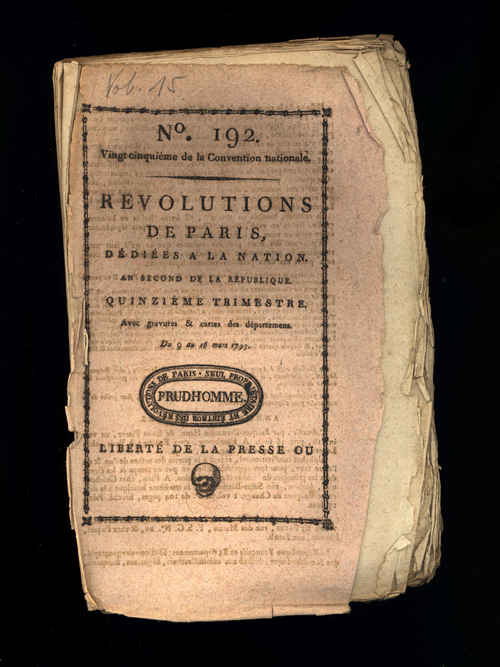
Liberty of the Press, or Death!


This revolutionary periodical is from the amazing collection of Prof. Wallace Kirsop in Melbourne. I liked the imprint so much I asked, and was given permission, to reproduce it here.

The periodical, by Louis-Marie Prudhomme, is Revolutions de Paris, Dediees a la Nation (9 to 16 March 1793). The imprint translates as "Liberty of the Press, or Death!" I just love the hieroglyphic death's head.


[UPDATE: 2 July 2016: After all my pictures disappeared (again) I decided to give up on external hosts for large versions (1000px) of my image files and, for now on, will stick with the smaller images (500px), which Blogger is prepared to host.]