Showing posts with label bookselling. Show all posts

Monday, 27 July 2026

AI is not eating antique books

It seems that the latest injection of disinformation, or "FUD" (Fear, Uncertainty, Doubt), into discussions about AI is that AI companies are "eating" physical copies of rare and antique books in the same way that data-centres are believed to be "drinking" water. (I asked Nano Banana to generate an appropriate image of this imagnined process—using the same starting prompt I used previously—to help my readers visualise this action. Please enjoy the result!)
This, somewhat alarmist, 25 July article by Frank Landymore, for instance, suggests that AI companies are purchasing antique books in large volumes (this is in the article title: "AI Companies Are Buying Antique Books…") to use as high-quality training data, as these texts are free from modern digital AI content. Because it is cheaper, destructive, high-speed automated scanning processes are being used to digitize the books (i.e., book spines are guillotined off, the covers removed, page-stacks are fed into scanner hoppers, then thrown away). The practice is facilitated by book database services that keep the tech company buyers anonymous. Rare booksellers have ethical concerns about selling books to these services, warning that it permanently destroys some of the last surviving copies of historic literature.

The FUD here is the "antique books" and "historic literature" claim. Once you read through the parent and grandparent linked articles (3 April essay by Val Giordano, promoting the practice, here; 25 June [anonymous] essay on the NL Times, reporting concerns of European book dealers, here; a 26 June article by Benj Edwards here; a solid, 21 July essay by Emanuel Maiberg here) it becomes clear that the books being hoovered up by Anthropic (and possibly others) all post-date 1969 (when ISBNs were introduced) and most, it seems likely, post-date 2006 (when ISBN barcodes became ubiquitous)—about the same time, coincidently, that the arrival of modern smart-phones ended civilisation as we knew it.

That the AI-company proxies are exclusively interested in books with an ISBN is made very clear from the following anecdote reported by Maiberg:

The seller told me that … Bulk purchases … usually reflect interest in a specific topic, whereas the recent, very large purchases were of books that had little in common, except for the fact that they all had ISBNs. This seller also sells rare books that do not have ISBNs, and none of those were part of the bulk purchases. (emphasis added)

That the bulk-purchase companies are likely to prefer later, bar-coded books, seems probable from the scale they are working on—it is simply easier and cheaper to scan the bar codes of hundreds of thousands of books, than it is to key in the ISBN (and then check for errors) on the same number.

From the articles I mention above, it seems that second-hand book dealers are getting what I take to be in-fill requests, for any ISBN that has not shown up in the literal truck-loads of books donated to charities, that are sold off to bulk-book dealers / waste-paper merchants (on this, see my post here concerning Mubin and Raza Ahmed's "Wrap Ltd."—a "printed matter," "waste and scrap paper" import/export business with an annual turnover of £6.5M "or more.")

It simply wouldn’t be economical to buy a book via ABE, Alibris etc. if you could buy the same book at a fraction of the price from parasites, excuse me, erm … paper-dealers like Mubin and Raza Ahmed. I.e., you'd start with whatever your local large-scale charity can wring from a well-meaning public, checked-off against a master-list of ISBNs via bar-code scanning, and then back-fill the gaps in that master-list via ABE, Alibris etc.

For me, this is where it gets interesting. Anthropic et al. have more money than they know what to do with, and have just been stung to the tune of USD3K per book, for all the digital books they stole, and then got sued for stealing. That being the case, the following observation should come as no surprise:

there's a total disregard for the price of the book. I've had some books that sold through this way that were [...] greatly overpriced. That's kind of a tell for AI because they have just so much money.

* * * * *

Since I was born before ISBNs were a thing, it is hard for me to think of books after 1970 as "antique" or "historic" ("rare," especially, "rare on market" is another matter completely). Perhaps, this is easier for Frank Landymore—who seems to be in his early 30s. In any event, I asked one of the water-guzzling, book-eating monsters (ChatGPT) to estimate how many books have been published since 1970 (and 2006) and the answer should be reassuring.

It seems likely that something like 80 million English-language ISBN editions have been released, or which approximately 60 million editions were printed with a barcode. The number of unique works (i.e., with Pride and Prejudice counting once) is obviously much smaller—perhaps 10–20 million, but the number of physical copies printed is much larger, likely "well over 100 billion copies since the 1980s."

So, it seems Anthropic is attempting to gobble up millions of recent books (emphatically-not antique you baby-faced ageists!), mostly comprised of unwanted donations, fenced by the likes of Messers Ahmed, and otherwise unsold obscuriana, laying heavily on the hands of dealers who once supplied libraries, out of a pool of something like 100 billion copies printed.

If it were possible to pile this 100-billion copies one atop the other, it seems that the pile would likely extend 2.5 million kilometres, or about 6.5 times the distance from the Earth to the Moon. Indeed, only 14.5 billion books would be need to reach the moon, or 14.5% of all books printed with an ISBN.

I would wager as many books as I could carry, that far, far more than this 14.5%—perhaps 80% of these 100 billion books—have already been pulped, without once raising the interest of Landymore et al., making this story a pretty good parallel to widely-disseminated concerns about the water consumption of data centres. (Which is mostly FUD too, since most new data centres consume no water—they use closed-loop cooling—and the water usage of older AI data centres that do use evaporative cooling etc., is dwarfed by the water consumption of golf-course and intensive cattle farms. I.e., this is a gnat on the arse of a flee in the grand scheme of things.)

And while most AI tokens will doubless go to things like generating fake security footage of President John F. Kennedy and Marilyn Monroe in flagrante delicto, or self-insert versions of Terminator or Twilight, it is already clear that AI can, and probably soon will, cure every disease known to man and put a complete stop to the death and mutilation caused by badly-driven cars on the road—to name but two of life’s miseries. If they need to guillotine a copy of each my books to do this (**), they are welcome to do so.

(**) if AI can also restore my use of AdobeCaslonExpert in the later versions of Word, they can have all my essays too.

Monday, 2 March 2026

Book Shop, Place of Worship

I was browsing for bookshops in Blackburn (Melbourne), when I spotted this:
(you have to imagine the "record scratch" sound-effect here): Did I read that right?!
Sweet! For comparison, here is the nearest "real" bookshop
So, what is a "Place of Worship"? Well, it turns out that it is not a Christian church, Jewish synagogue, Buddhist temple, Hindu mandir or Shinto shrine, each of which have their own symbols on Google Maps, nor (according to the post here) is it a Sikh gurdwara, Jain temple, Japanese Buddhist temple, or—in all liklihood—a pagan temple. It seems that this symbol…

…first appeared on Google Maps at the same time that the star-and-crescent symbol dissapeared, to (checks notes) "promote inclusivity" and to "avoid favouring one religion over another." I am guessing that this is also reason why there is no street number for this Place of Worship, and that Google Maps has deleted all post-2008 street-view data for one end of this street.

All of which is a shame, since I'd like to see any Book Shop that could accurately be described as a Place of Worship, and I have nothing but respect for any faith that so well captures my own sentiments in relation to book shops and book shopping. I'll have to resist the urge to visit this location to see the book shop for myself, in case I end up in a Nineteen Eighty-Four / Total Recall-type situation after Google remotely deletes the relevant data from my head.

Sunday, 6 March 2022

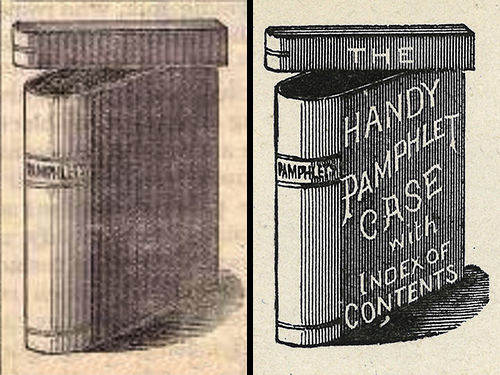
The H. B. Nims Handy Pamphlet Case, 1876


The Handy Pamphlet Case (depicted above) was produced by H. B. Nims and Co., Troy, NY, and advertised from 1875 to 1877. An 1875 advertisement in The American Stationer (here), reads as follows:

The HANDY PAMPHLET CASE.
With Index of Contents.

Useful to librarians and literary men for classifying pamphlets.
Useful to physicians for holding their journals previous to binding.
Useful to clergymen to keep their sermons in.
Useful to business men to keep price lists and catalogues in.
Useful to everyone who takes a magazine.

A neat, cheap and handy invention to preserve all kinds of paper-covered literature, that would otherwise be impaired or destroyed.

LARGE 8vo., PER DOZEN, $2.50
Samples sent by mail upon receipt of 25c

H. B, NIMS [and] CO., Manufacturers,
TROY, NEW YORK.


The advertisement text was re-set in the 1877 advertisements I have seen in The American Library Journal (here, for example), and the accompanying image changed to include the words "THE | HANDY | Pamphlet | CASE | with | Index of | Contents".


In addition to the advertisements in The American Stationer and The American Library Journal, Henry B. Nims—running a descendant business of W. H. Merriam (est. 1840)—printed advertising slips that were loosely inserted in new publications they sold. I found one (above) in a copy of H. R. Fox Bourne's The Life of John Lock (New York: Harper and Brothers, 1876), which provides a sharper image than those in the magazines on Google Books.

Unfortunately, I can find no trace of a surviving example of the Nims Handy Pamphlet Case, which is a shame. If they were tin they probably did a lot of damage to the pamphlets, journals, sermons and catalogues they contained, but if they were made of stiff card and paper they might have saved many of the same from destruction.


Anyone interested in H. B. Nims and Co., of Troy, New York—"the largest and most complete book store between Boston and Cleveland"—will find some information in The Industrial Advantages of Troy, N.Y. and Environs (1895; here; the source of the quote and the photos above and below) and The City of Troy and Its Vicinity (1886; here).


BTW: anyone interested in another example of the wonderful, book collecting-related, stationary items developed in the States in the late nineteenth-century, should see my post on "The Van Everen Fitsanybook Adjustable Book Cover" (here).

Sunday, 30 January 2022

Fabian’s Fine Old Furniture, Melbourne Bookshop

I first visited Fabian’s Fine Old Furniture, at 309 Swanston Street, Melbourne, during an Easter-holiday visit in 1990. Despite the name of his business, Fabian mostly sold books, and clearly had been selling books for many years, though I only discovered the shop in 1990, after many book-buying holidays in Melbourne.

Finding Fabian's was a red-letter day for me as a collector: I came away from my first visit with two eighteenth century first editions at bargain prices: a somewhat worn copy of Macpherson’s Fingal (1762), the first part of his Ossain cycle, and a very nice set of Le Sage’s Gil Blas, as translated by Smollett (1750).

Sadly, despite his long tenure in such a prominent location, Fabian’s seems to have left almost no trace on the internet. In offering up some personal memories of Fabian (and Fabian’s shop) below, I am partly relying on my recollection of my 1990 visit, but I am also making use of some notes I made in 1993, after a return visit, which I only re-discovered during a clean-up last week.


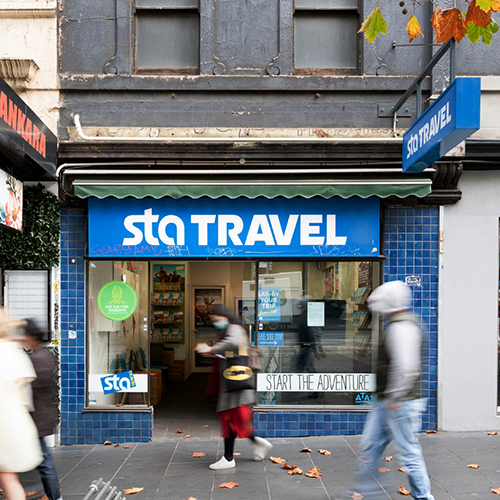
A bright, clean travel agent now occupies 309 Swanston Street (photo above), which is opposite the State Library of Victoria; but for many years it was occupied by a rather different business: Fabian’s Fine Old Furniture. The eponymous owner, Fabian, was a rather eccentric, wild-haired man who had many interesting old books held in three or four massive Victorian book cases, while a goodly number more were liberally distributed in messy piles in various corners, nooks and crannies on the floor. Like the owner, the books, and the bookcases, the shop was old.

In the early 1990s, it had the sort of deep, dusty, brass edged, shop-front display-window that all the best second hand bookshops ought to have. On display in this window were china cups and saucers, Wisden Cricketers’ Almanacks, faded copper plate engravings and maps with labels such as: “This map is 256 years old!”—“This book 152 years old!”—all with exclamation marks, silently bellowing at the passing foot-traffic. I don’t know how often these labels caught the eye of any passer by—with so much dust on the windows the signs were hard to read—but I remember very few interruptions whenever I visited Fabian’s—and all my visits to Fabian’s were lengthy.

The reason for the length of my visits was because Fabian was an unashamed biblioclast. Fabian liked neatly bound sets of books, but it was his practice to keep the different volumes of any set of books equally distributed between the shelves of however many bookcases he had or—whenever he sold a bookcase—between the shelves of the remaining bookcases and in piles on the floor.

He distributed the books in this was because—he explained to me—he wanted each bookcase to display a variety of titles, that a complete set of books was unsightly, and that complete sets would be likely to frighten off prospective buyers. His pricing is worked out on a per-volume basis, and was calculated solely on the size of a volume and the nature of its binding. I paid $45 per volume for my 12mo set (Gil Blas) and $100 for my folio volume (Fingal), but I think $80 was normally the going rate, when part of a set.

Since Fabian did not care for completeness—in fact, he disliked it—but he liked neatly bound books, he had bought and distributed around his small shop many incomplete sets. As a result, even after an extensive, laborious search, neither buyer nor seller could be entirely sure that every volume that Fabian actually had in his shop had been found, unless the books thus collected together from all corners of the shop formed an unambiguously-complete set.

Incomplete sets might be incomplete because Fabian bought them that way, or they may have been incomplete because the buyer had overlooked an odd-volume. This created a moral problem for a fastidious book buyer like myself: how could you be sure that, in the process of buying all the volumes of a seemingly-incomplete set that you had managed to accumulate, after hours spent turning over thousands of books, you were not thereby breaking up a complete set that you had simply failed to find all the volumes for?

Fabian was, obviously, unconcerned about this. Indeed, it seemed as if this sort of “accidental” breaking up of a set suited Fabian, the remaining volumes presented a more varied face to the buyer, and it made it easier for him to dispose of the remaining odd volumes.

Since I am a completist, I would spend hours patiently accumulating volumes of any and all sets that I was interested in; slowly building up piles of matching volumes. When—as was more often the case than not—I failed to find a complete set, I would leave without the books, and Fabian would re-distribute the volumes around the shop, according to whatever principle of aesthetics that drove him. A year or so later I would return, and go through the process again.

Eventually, despite the appeal of thousands of old, beautifully bound books, and the prosepect of a repeat of my 1990 success, I was worn down by my actual lack of success in finding anything that was new-to-stock or complete, and so I stopped visiting his shop. From the mid-90s, for about a decade after I moved to Melbourne I would regularly see Fabian on a Sandringham-line train, with his distinctive wild grey-white hair, on his way into or out of the city. I would seem at different times of the day, either on his way in or out, so I gather that, in old age, he simply went in whenever he felt like it. (There were no opening hours advertised on his shop, and it was often closed when I visited.)

* * * * *

Returning to 1993: a friend and I were occupied in the doomed process of uncovering the companion volumes of an early set of Smollett’s Peregrine Pickle and The Works of Madame de Genlis, ignoring Fabian’s protest that the set was probably never complete to begin with and fearing that, if it had been complete, he had probably rendered it otherwise long since due to his practice of selling off volumes at random, when a well-dressed young man came into the shop, drew the attention of Fabian, and left us to our dusty work.

The conversation began, as I recorded it, in the following fashion:

FABIAN: Hello. Can I help you?

VISITOR: Yes. I’ve bought an old table that I want to put a bit of a display on, y’know, and what I wanted was some old books. I’ve got a bit of a shelf, and some things, vases and things like that, too, but what I need is a few antique books to put on it. ’Bout four of them. It doesn’t matter what’s in them because I’m never going to look in them [this said emphatically] as long as they are old, and look good, like these [indicating a set I was accumulating of The Works of Hobbes].

FABIAN: Yes, well, I get quite a lot of people coming in who want books like you do, for display; I have lots of old books here, with old leather bindings, all sorts of sizes and colours, and prices, so I am sure to have something that will suit. Now, about how much did you want to spend?

There followed a discussion concerning how much the Visitor wished to spend, whether he preferred brown to black covers and so forth. Books in French or Latin, were offered, Fabian did his best to sell his books (“Now this one here is nearly a quarter of a thousand years old! Well, that’s older than the settlement in Australia”) and, at one memorable juncture, when Fabian was showing the Visitor a random selection of four of the twelve volumes of a Latin edition of the proceedings of the Council of Trent, the Visitor, admiring the binding, and in response to Fabian’s explanation of what the book was about, said “of course, I could always learn Latin if I bought them, and then I could read them.”

As I mentioned above, customers were rare; the shop was quiet, and the conversation struck a cord—I had recently read W. J. West’s The Strange Rise of Semi-Literate England (1991)—so I made notes as soon as I left the shop and recorded the details as well as I could soon after. Unfortunately, I did not make a note of whether the well-dressed young man bought any volumes of the proceedings of the Council of Trent. Even if he had, we will never know whether, by doing so, he was prompted to [1] learn Latin and then [2] immediately sit down to read his books, but I think it is very unlikely.

Saturday, 3 April 2021

Ron Abbey on the Cornerstones of Civilisation

In July 1968, Eve and Ron Abbey founded Abbey's Bookshop, a business which continues to this day at 131 York Street, Sydney (here).

Ron owned several other bookstores, most of which I remember: a Penguin bookshop, the Oxford and Cambridge Bookshop, Galaxy Bookshop, the Language Book Centre, and Henry Lawson's Bookshop, Pickwick Bookshop, and Ron Abbey's Bookhouse (according to his obituary).

Ron was vice-president of the Australian Bookseller's Association from 1973–75 and president from 1975–77 (according to Austlit); he died, aged 78, on 16 July 2005 (according to Informit).

I have recently been reading a little about Ron in an essay by Joan Lawrence on "Sydney Bookshops," which was published in December 2020 in Biblionews.

Given his significance in the Australian (particularly Sydney) book scene, it is disappointing that there is not more information readily available about Ron.

The photograph of Frank Moorhouse (right, speaking) and Ron Abbey (left, listening) is the only one I can find online (here). It was taken during Australian Library Week in September 1974, when Ron was vice-president of the ABA.


The most extensive account I can find comes from the obituary written by his son Alan Abbey (linked above). According to Alan:

Ron Abbey greatly admired the self-educated man, living his life by the words of Bertrand Russell: "Books and bookshops are the cornerstones of civilisation; as to self-education, what other kind is there?"

* * * * *

Although it has been years since I read any Bertrand Russell, I was once a great fan. Curious about this unfamiliar quotations, which Joan also quotes, I went looking for the source … and couldn't find one. In fact, I can't find anything even close to it.

It is possible that this quotation is beyond the reach of Google, that it was said in an interview rather than a book or article, and has never been quoted in print, but it is more likely that either Ron or Alan (or both Ron and Alan) have misremembered it, and rephrased it during many years of repetition.

However, Googling both "Books and bookshops are" and "are the cornerstones of civilisation" does lead to some interesting claims:

Books and bookshops are a beloved hobby (here)
Books and bookshops are full of nostalgia and imagination (here)
Books and bookshops are retail therapy (here)
Books and bookshops are doomed (here)
Books and bookshops are fighting back (here)
Books and bookshops are moving up (here)
Books and bookshops are reinventing themselves (here)
Books and bookshops are always essential (here)
Books and bookshops are flourishing (here)

Reading and writing are the cornerstones of civilisation (here)
Story, or discourse are [sic] the cornerstones of civilisation (here)
Knowledge and culture are the cornerstones of civilisation (here)
Knowledge and expertise the cornerstones of civilisation (here)
Liberty, equality and a cup of tea are the cornerstones of civilisation (here)
Families are the cornerstones of civilisation (here)
Humour and sex are the cornerstones of civilisation (here)
Toleration and respect are the cornerstones of civilisation (here)
Judgement and public shaming are the cornerstones of civilisation (here)

The closest match I could find for the (seemingly, faux-)Russell quote is: "At EIBF, we recognise the importance of books and reading in people’s lives. Books, and bookshops, are one of the cornerstones of our civilization. Booksellers enrich the communities they are part of, offering cultural, economic, and educational contribution to society" (here).

In the faux-Russell quote, "cornerstones" is plural: an acknowledgment that "Books and bookshops" are separate things, and that each is a cornerstone in its own right. This does raise the question: how many cornerstones can a building have? A rectangular building will have four, though many buildings have more corners than this, it is customary to only celebrate one, the first.

(In the image below we see three cornerstones, though only one has been dated—1909—and celebrated.)


So, faux-Russell / Ron Abbey is making a claim to double the usual number; whereas the European and International Booksellers Federation (EIBF) wants you to know they are only claiming one: weak! Pathetic! Are they setting aside scores of imaginary cornerstones for Reading, Writing, Liberty, Equality, Families, Humour, Sex, Public Shaming and a cup of tea!?

I would expect a Booksellers Federation to make a stronger claim these EU flunkies: why not either two cornerstones (if you allow more than one) or the only cornerstone (if one). I hope Ron Abbey's successors at the Australian Bookseller's Association reject this cowardly and pusillanimous EIBF statement, and embrace, instead, that of their one-time president.

[UPDATE 2021.04.08: Blogger tells me that this was my 300th post]

Tuesday, 9 March 2021

Frances Zabel, pioneering bookseller, book reviewer, journalist

Mrs Frances Zabel (1868–1933) was the copyright holder (and, I assume, publisher) of the poem in my January post: “The Lender’s Library” (here). Curious about the poem, I found myself quickly becoming intrigued by both the author and publisher too.

I have now completed my post concerning the author (here). Typically, what was intended to be a short post about the publisher has grown well beyond what I had in mind, such that it now threatens to become a collaborative research project!

Rather than leave Mrs Zabel completely neglected until the results of that research can be published I thought that—as a placeholder, a teaser, and an International Women's Day celebration—I'd transcribe and reprint an interview with Zabel that was written by the late, great Zora Cross (1890–1964): Australian poet, best-selling novelist and journalist.

The Cross-Zabel interview was published in the Sydney Mail (22 January 1930): 29 (on Trove, here), and is reproduced below in its entirety.

* * * * *

Australian Women Pioneers: In the Literary World

When the story of Australian literature is finally told it will not be complete without mention of that brave band of pioneers who blazed trails for others to follow.

IN this field the name of Mrs. Zabel, the first woman to establish a literary journal—the ‘F.Z. Review,’ in Perth, in 1904—must, be remembered. Her little paper, which she managed, wrote, and distributed herself, is a credit not only to Perth, but to Australia.
  Born in Victoria. Mrs. Zabel, who now conducts a library in Sydney, was one of the first women on the goldfields in Western Australia. But her heart had been given to books from childhood, and when she later settled in Perth she wrote book reviews for a local paper.
  At, that time, there was only one woman bookseller in Australia—Mrs. H. Champion, wife of the late H. H. Champion, the man who was the first, daring enough to publish one of George Bernard Shaw’s novels. Mrs. Champion was selling books in Melbourne.
  “All honour to Mrs. Champion,” Mrs. Zabel says, “for she was the woman pioneer of book-selling, which I believe is a woman’s business, not a man’s. A woman has the intuition to fit the book to the reader more readily than a man has.”
  Mrs. Zabel was the second woman bookseller in the Commonwealth, and she also began on a small scale. She began in Perth at the Book Lovers’ Library, and it was from there she published her unique and admirable newspaper. Nothing commercial seems to have entered into her scheme, for here in her journal are reviewed rare and foreign books, belles lettres, historical studies, essays, poetry, as well as the latest in fiction, showing that as a buyer of books she discriminated.
  One is struck by the ability Mrs. Zabel had for judging a book for posterity as well as the day. Thus, in her review of Marie Corelli’s work she never gave extravagant praise, as so many papers of the time did, even though, as recorded in the “F.Z. Review,” 43 tons of paper were used in the first edition of one of Miss Corelli’s popular books of the time. Mrs. Zabel did not trade in best-sellers.

ABOUT five years ago this interesting woman took over the Roycroft Library, which Miss Peacock established in Sydney over thirty years ago. A charming historical library, this!
  I asked Mrs, Zabel recently if she did not become tired of books, having had them for daily companions so long.
  “Not a bit,” she replied, just as enthusiastic over the new writers now as she was twenty years ago. “I was born to sell books, and I put in twenty years’ spade work before I came here. But isn't this beautiful? It has only just come in.”
  I admired the new Lily Yeats masterpiece of framed embroidery—a veritable Irish garden of flowers woven of bright threads, reminiscent of something out of faerie or the Land of Heart's Desire itself.
  “This is from a most beautiful and interesting women’s industry,” Mrs. Zabel explained, “conducted by Lily and Elizabeth Yeats, sisters of the famous W. B. Yeats—the Cuala Press and Industries in Dublin. Jack Yeats, a brother, does coloured woodcuts characteristic of Irish life; Elizabeth conducts the Press, and has produced lovely editions (highly prized by collectors) of W. B. Yeats. Lily attends to the needlecraft industry; she has taught, and employs, Irish peasant girls, and from Cuala comes exquisite scarves, traditional Irish cloaks, as well as pictures; and their white linen with colour design is seemingly out of fairyland. Mrs. Lane-Poole, their cousin, now in Canberra, was one of the designers. I must show you some of their illuminated manuscripts, rare and beautiful—done on a hand press, of course. There! Isn’t that something like one of the old Celtic vellums?”

TRAVEL has broadened Mrs. Zabel’s out look on all things, and it is her delight to go to the source, for the beautiful glass and pottery wares which she self up as a coloured background for her books.
  About four years ago she began to import curious and quaint and beautiful objects of art and pottery as well as books. She did not do this purposely to create an ideal atmosphere for her beloved books, but naturally it became that.
  Though she hides her writing identity under pen-names her pen is never idle, and it is a very graceful and charmingly witty one.
  Specialising as she does in limited editions, foreign plays and poetry, children’s books and the books that are not ephemeral, it is a delightful experience to wander amongst them with her for a while and listen to her as she discusses literature.
  Old boys of the Melbourne Church of England Grammar School will recall memories of Mrs. Zabel's son, whose untimely end abroad deprived Australia of one of her greatest geologists.

Thursday, 20 December 2018

More Bookseller Trade Cards of the 18C

The trade-cards, trade tokens or bookplates below, are from a collection of English engraved advertisements compiled around 1758 by F. Legge of St. James’s Market preserved at Yale’s Walpole Library.

The Legge collection has been given the title “Trade tokens and bookplates, 1705–1799 (bulk 1757–1758)” and a scan of the entire volume has been published online (here). The images have been colour-corrected and reduced to 500 pixels wide.

The fourteen trade-cards below are of for “Darres,” John Kendray, John Leake, Henry Lewis, James Noyes, Samuel Paterson, S. Pitt, John Pridden, William Separd, G. Vander Gucht, John Ward, John Wilke, Robert Withy, and Ryall Withy (again, none of which are in the Franks Bequest Catalogue).

For my previous posts on bookseller trade cards of the eighteenth century, see here and here.

* * * * *


Saturday, 15 December 2018

Bookseller trade cards of the 18C

Sir Ambrose Heal's "Bookseller and Stationers' trade-cards of the eighteenth century" appeared in The Penrose Annual, vol. 45 (1951), 29–32. It contains one page of introductory text (which says nothing about the production, publication, distribution and history of bookplates and trade cards or anything of note concerning bookselling and printing in the eighteenth century), four pages of illustrations (showing sixteen separate trade cards, below) and three pages of notes on the booksellers.

About four years ago, shortly after publishing my post on Bookplates of Booksellers and Circulating Libraries, I checked out Heal's essay in the hope that it would provide either more information on (no), or more images of (yes), the 164 bookplates and trade-cards listed in the Franks Bequest Catalogue—of which I was only able to provide two in my original post.

I am not sure why it has taken four years to post these scans, perhaps I was hoping to find more images in his other works. If so, it would appear that I was unsuccessful. However, I have fond a few more images on line, which I will post shortly.

* * * * *

The sixteen trade-cards below are of for James Adams, John Bromley, James Brooke, James Buckland, Thomas Edlin, William Kerby, Lackington, Allen & Co., Arthur Lyon, Ralph Minors, Francis Noble, Bartholomew Penny, Daniel Richards, William Sanby, J. Shove, Samuel Stillingfleet, and Thomas Worrall (none of which are in the Franks Bequest Catalogue).


Monday, 26 October 2015

Lisping Booksellers and La Belle Affemblee

Earlier this year I stumbled bought two odd volumes of Haywood’s La Belle Assemblée. I located the first (below) in a general search of eighteenth-century books on eBay—which surprised me, way since I have a number of searches which run continuously on eBay that should have picked it up and sent me an alert. It took a moment to realise why none of my searches had worked: the book was listed as La Belle Affemblee!


Since just about everyone reads the long esse and an eff the first time they see it, it should have occurred to me before to go looking for lisping versions of her titles. But it hadn’t. So I did a search for Belle Affemblee and found another odd volume straight away. What amused me about the second one was, while the first seller was obviously an enthusiastic amateur, the second was sold by “World of Rare Books”!

You’d think, that a specialist “rare book” dealer—who has sold 37,656 items on eBay, has over one hundred and twenty thousand books presently listed, including over five hundred eighteenth-century books—could distinguish an esse from an eff. But that would be a no.

However, “World of Rare Books” did know exactly how much to charge for it: an excessive amount, but not so excessive that I wouldn’t buy it. That I bought it at all, as a duplicate no less, says something about my present priorities. (And, possibly, that there really is a sucker born every minute.) Here is the description:

Brown leather hardback with gilt lettering and decoration to spine. Prelims missing. Internal hinges cracked. Wear and tear to pages with some losses. Heavy use marking, foxing and tanning present. Some pages creased. Text remains clear and legible throughout on yellowed pages. Illustrated. Binding has weakened due to hinge cracking. Heavy scuffing, edge wear and use marking present with sunning to spine. Bumped and torn corners.

I believe this is called lowering buyer expectations. I wish I could say that this was the ugliest Haywood volume I have bought, but it isn’t, not by a long shot. (this one might be, or possibly this one.)

* * * * *

Returning to the first Belle Affemblee—which had an old diary cover sticky-taped over the original full calf binding (so, also ugly)—I am grateful to the vendor (Billy), who bought this camouflaged volume, without realising it, in a huge box of books at an estate sale in West Virginia. Not only is there a battered Caesar Ward and Richard Chandler trade card pasted onto the front fixed endpaper (below; compare this to my other copy here)—which suggests both that Ward and Chandler may have been the original vendors of the volume and that it was sold, bound, with their trade card in place—but there is also some provenance and reading records in this volumes, which are gold for my present research.


A faded note has been tapped onto the front free endpaper; it reads:

To John from Cystlina Feb. 1953 | [I] bought this book over | from England when I | returned after 11 months | absence”

“John J. Jones, Malden WVA” and “John J. Jones — Malden, W Va. | Telephone WA53-838” are stamped on the endpaper and in the middle of the volume. There are also two dates, which appear to indicate where John (?) had reached with his reading, when he picked up the book nine years later: “Sep 29, 62” (on page 194) and “Dec 27, 62” (page 198). And, as you can see on the title-page at the head of this post, John (?) worked out that his book was 234 years old in 1966, which he updated to 238 years in 1970.

It is not clear whether it was, but it is certainly tempting to conclude that the huge box of books Billy bought was, from the estate of John J. Jones, of Malden, West Virginia. It is also not clear whether it was, but it is certainly tempting to conclude that it was, John who (read and) annotated this volume. But whether or not there were other owners since Cystlina in 1953, John is certainly the most important for my purposes. So, if anyone reader knows anything at all about John J. Jones, Cystlina or even Malden, West Virginia—the Wikipedia entry here is not particularly informative—I’d be grateful if you could drop me a line.

Sunday, 18 January 2015

The Betsy Thoughtless Stockmarket

The first book by Eliza Haywood that I purchased was the Pandora edition of Betsy Thoughtless (1986). I bought it on 9 December 1991 for $10. I don't know how many copies of Betsy Thoughtless I have bought since then, but it would be a lot, and all of them would have cost me more than $10. Some of them, a lot more than $10. So, although my copy of Betsy Thoughtless has great sentimental value to me, I have always considered it to be the least valuable of the lot. But no more!

Last Wednesday I was doing a search on AddAll and discovered that an extremely reliable bookseller who is offering a copy for $458 (USD364.37). My battered old copy of Betsy Thoughtless is doubling in value every four years! Unfortunately, when I look again this morning, it is clear that there has been a market correction. Sensible investors who had multiple copies have clearly been selling into this rising market and the price has fallen back to $149 (USD119.12). Those of you who have invested heavily in copies of the Pandora edition of Betsy Thoughtless can follow the value of your investment on Biblio here or ABE here.


It is always pleasing to find an extremely reliable bookseller, and so I wanted to know more about the vendor, who is called "ExtremelyReliable"—an extremely helpful choice of name, since it makes it extremely easy to remember. I pretty quickly found a page on the Zubal books site titled Never Buy Books From ... BOOKJACKERS which includes ExtremelyReliable in a list of forty bookjackers.

A bookjacker is someone who takes a genuine online listing for a book, then re-post the listing at an inflated price somewhere else. They might take a listing from Amazon, and post it on ABE.com, or from Half.com, and put it on Amazon, or eBay, or somewhere else. If a reader is foolish enough to buy from the bookjacker, the bookjacker buys the book from the original seller, providing them with the address of the actual reader. The bookjacker never sees or handles the book, but they collect their margin. Bookjacker work on a vast scale and make a lot of money from people who don't shop around, and don't suspect the practice. If you don't want to pay this tax on laziness or ignorance, don't buy from bookjacker! (Zubal explains how to avoid them.)

(Of course, a more polite form of bookjacking is as old as bookselling. Dealers buy from each other. They do it all the time, and there is a well-established, standard 10% discount offered by dealers to each another. Dealers who do not offer this discount (like—apparently—the Berkelouws), are considered arseholes by the rest of the trade. Specialist dealers obtain their stock almost exclusively in this way. At almost every book fair, dealers trawl each other's stock for any bargain (an oversight in pricing) or for stock in their specialist area: sometimes a special time is set aside before a fair opens to the public, to make sure that dealers get all the bargains. They then inflate their prices to cover their costs. This is one of the reasons specialist dealers charge more: they have to do so to cover the cost of obtaining stock. A book may change hands among dealers, many times, before a collector gets a chance to purchase it, each dealer collecting their margin like the bookjackers. The internet did not changed this method in any essential way: the specialist dealer now buys from a larger number of general dealers—whether amateur or professional—but they are still making money out of a buyer's laziness or ignorance, or by profiting from restrictive trade practices.)

Returning to the Pandora edition of Betsy Thoughtless (1986): bookjacking is only half of the explanation for the ExtremelyReliable price of USD364.37. The other half is dealers—huge ones, with a vast amounts of stock (some of them charities)—who use software to price their books. The prices are regularly updated. The software uses an algorithm to match a book to online listings (via an ISBN), establish the existing market price for that book, then undercut it by a small margin, so that their copy is neither a bargain, nor the most expensive copy online.

Bring these two dealers together and this is what happens: McDealer offers a book at $100, bookjacker relists it at $110, McDealer relists it at $105, bookjacker relists it at $115, McDealer relists it at $110, bookjacker relists it at $125, McDealer relists it at $120, and so on. This is why the price of the Pandora edition of Betsy Thoughtless wanders up and down, all on its own.

Zubal links to a very entertaining page on Amazon’s $23,698,655.93 book about flies. I went looking and found a book for USD759 billion, on Religious Plurality in Africa. (The vendor is not on Zubal's list.)


If looking for insanely-priced books is your idea of a good time, this is how you do it: go to the Amazon, Advanced Search page for books here, enter the publication date as After 1450, and Sort Results by Price: High to Low. For some reason this search doesn't work when I add Haywood as an author, but this search for Eliza Haywood on ABE (paperbacks, 1915–2015, sans print-on-demand) will help you track the value of your thirty-year old paperbacks. (Today's winner is the 1997 Oxford University Press edition of Betsy Thoughtless—another book I have! Winning again!) [For more on the Pandora edition of Betsy Thoughtless (1986) and Pandora's "Mothers of the Novel" series, see my post here]

Wednesday, 10 July 2013

American Book-Prices Current, Book-Prices Current, Book Auction Records etc

Most of the early volumes of American Book-Prices Current (ABPC) are available online, some of them many times over, thanks to the Internet Archive. Unfortunately, the Internet Archive suck at cataloguing, so it is hellishly difficult to find a specific volume. I made the following list to simplify the task for myself. I am probably re-inventing the wheel, but I hope other people will find it useful.

Despite the title of this post, I have not yet gone looking for the original, British Book-Prices Current (BPC) and Book Auction Records (BAR)—the other two standard sources for information on book sale records and the second-hand trade in books in general, but I will. And, if I find any, I will add them below.

[UPDATE 11 July 2013: I have added BPC and BAR now. The Internet Archive has outdone itself in trying to hide some of these files, many of which are catalogued as A Winter in North China (!). I was only able to locate some of the below by guessing URLs based on sequences of correctly-catalogued files. As I use the files I will re-arrange them so that, where there are duplicates, the best files appear first. (Best being the cleanest colour scans, with text and pdf files available.) I have reluctantly included a few Hathi Trust files, which combine appalling catalogue layout with an even worse user interface.]

* * * * *

NB: final four volumes of ABPC in this list probably should not be available for download, and may not be available for download for long, for copyright reasons. (On the Hathi Trust catalogue page these files are described—when you can find them—as "Limited (search only).")

ABPC 1 (1895) here
ABPC 2 (1896) here; here; here
ABPC 3 (1897) here; here; here
ABPC 4 (1898) here; here; here
ABPC 5 (1899) here; here; here; here
ABPC 6 (1900) here; here
ABPC 7 (1901) here; here; here
ABPC 8 (1902) here; here; here; here
ABPC 9 (1903) here; here; here; here
ABPC 10 (1904) here; here
ABPC 11 (1905) here; here; here; here; here; here
ABPC 12 (1906) here; here
ABPC 13 (1907) here; here
ABPC 14 (1908) here; here; here
ABPC 15 (1909) here
ABPC 16 (1910) here
ABPC 17 (1911) here; here
ABPC 18 (1912) here; here
ABPC 19 (1913) here; here
ABPC 20 (1914) here; here
ABPC 21 (1915) here; here
ABPC 22 (1916) here
ABPC 23 (1917) here; here; here
ABPC 24 (1918) here; here; here
ABPC 25 (1919) here; here; here
ABPC 26 (1920) here; here
ABPC 27 (1921) here; here
ABPC 28 (1922) here [NB Hathi Trust]
ABPC 29 (1923) here
ABPC 30 (1924) here
ABPC 35 (1930) here
ABPC 38 (1933) here
ABPC 48 (1943) here

ABPC Index for 1916-1922 (1925) here [NB Hathi Trust]
ABPC Index for 1941-1945 (1946) here

* * * * *

BPC 2 (1889) here
BPC 3 (1890) here
BPC 4 (1891) here; here
BPC 5 (1892) here
BPC 6 (1893) here
BPC 7 (1894) here; here; here
BPC 8 (1895) here
BPC 9 (1896) here
BPC 10 (1897) here; here; here
BPC 11 (1898) here; here
BPC 12 (1898) here; here; here
BPC 13 (1899) here; here
BPC 14 (1900) here; here
BPC 15 (1901) here; here
BPC 16 (1902) here; here
BPC 17 (1903) here; here
BPC 18 (1904) here; here; here; here
BPC 19 (1905) here
BPC 20 (1906) here; here
BPC 21 (1907) here; here
BPC 22 (1908) here; here; here; here
BPC 23 (1909) here
BPC 24 (1910) here; here
BPC 25 (1911) here
BPC 26 (1912) here
BPC 27 (1913) here; here
BPC 28 (1914) here
BPC 29 (1915) here
BPC 31 (1917) here
BPC 32 (1918) here
BPC 33 (1919) here
BPC 34 (1920) here
BPC 35 (1921) here
BPC 36 (1922) here

BPC Index 1887–96 here
BPC Index 1897–1906 here

* * * * *

BAR 1, pt.2 (1904) here
BAR 2 (1905) here
BAR 3 (1906) here
BAR 4 (1907) here
BAR 5 (1908) here
BAR 6 (1909) here
BAR 7 (1910) here
BAR 8 (1911) here
BAR 9 (1912) here
BAR 10 (1913) here
BAR 12 (1915) here
BAR 13 (1916) here
BAR 14 (1917) here
BAR 15 (1918) here
BAR 16 (1919) here
BAR 17 (1920) here
BAR 18 (1921) here
BAR 19 (1922) here

* * * * *

Auction Prices of Books; A Representative record … of the English Book-prices current in 1886 and the American book-prices current in 1894 to 1904, and including some thousands of important auction quotations of earlier date (1905):
  Vol.1 here; here
  Vol.2 here; here
  Vol.3 here; here
  Vol.4 here; here

[LAST UPDATE 11 July 2013]

Friday, 21 December 2012

1934 Magazine Stand and Bookshop

This anonymous photo of an unidentified newspaper stand and bookshop(?) is not really typical of the photos that turn up on eBay, but it is the sort of photo that does turn up regularly—regularly enough to keep me going back to eBay to see what is on offer.


Here we have, it seems, the proprietor and his assistants standing in front of a counter and display-racks of magazines, outside a bookshop or general store which has kites, film and sunglasses on show in the window.


On display are a mix of popular magazines, from the innocuous (Argosy) to the sort that occasionally alarmed censors in Australia (Love Story and Complete Underworld Novelettes). As well as detective and sporting magazines there are endless film and radio titles (Silver Screen, Picture, Radioland and Radio Guide).


This last magazine, at the bottom, right side of the image, appears to be the 1 September 1934 issue.


Since Radio Guide was a weekly—and nothing dates more quickly than a radio or tv programme, this magazine allows me to date the image to the first week of September 1934. (I found the cover here.)


Notice that on display in the window behind the proprietor is a sign “Circulating Library.”


Also captured in the image, in the reflection of the shop-window at the top-left of the image, is a private and engaging moment of a family passing by. Some fiddling in Photoshop brings out a few details.


Having stopped, perhaps, while the proprietor and his assistants were posing for the photo, we see a father has lifted his infant son up onto his shoulders to watch the event, while his wife looks on.

* * * * *

I am not really sure what an image like this adds to our knowledge of book history: I cannot locate the establishment, though I can date it, the range of magazines is not really remarkable, we learn nothing of the Circulating Library, and proprietors, assistants, and passers-by are much the same now as then.

Perhaps images like these, like evidence of reading, book ownership etc in general, are really only useful when brought together in large enough numbers … which is all the justification I need to keep looking on eBay.

[UPDATE: 2 July 2016: After my pictures have disappeared again, I have decided to give up on external hosts for large versions (1000px) of my image files, and will stick with the smaller images (500px) that Blogger is prepared to host.]