Showing posts with label Eliza Haywood. Show all posts

Monday, 17 August 2026

Eliza Haywood's Henry Goring Identified

The subject of Eliza Haywood's "Jacobite literary fabrication," A Letter from H---- G----g, Esq; One of the Gentlemen of the Bed-chamber to the Young Chevalier (1749), is Charles Edward Stuart (1720–88), son of James Francis Edward Stuart (1688–1766), son of James II (ruled 1685–88), who was overthrown as King of England because of his Catholicism in the “Glorious Revolution” of 1688.
In my Bibliography of Eliza Haywood (2004), I opened my entry on this 64-page pamphlet almost exactly as stated above. Although I filled in the dashes ("H[enry] G[orin]g") whenever I used the full title of the pamphlet, and titled my entry (actually, entries) for it A Letter from Henry Goring, and cross-referenced both "'G—g, H—' (i.e. Goring, Henry)" and "Goring, Henry" to my entries for "A Letter from H[enry] G[orin]g (Ab.66, Da.9)," I nowhere say anything whatsoever about the putative author of Haywood's Letter.

The reason for this silence is because I was unable—up until (*looks at watch*) today(!)—to identify the Goring concerned. It occurred to me this morning that I might now—with the amount of material online, and AI-powered searches now able to sift almost all of this material—make more progress than I did using the resources at my disposal in the pre-internet era. I was right. Although Google’s Gemini struggled, ChatGPT bought home the gold.

Henry Goring (1707–1755)

It seems that the Gorings were an old Catholic-leaning Sussex family. According to The Westminster School archive (**), Henry Goring was born 11 April 1707, the son of Sir Henry Goring, 4th Baronet (1679–1731; Wikipedia entry here) and Elizabeth Mathew. The archive identifies him specifically as the Henry Goring who became a Gentleman of the Bedchamber to the Young Pretender.

Henry’s elder brother, Charles Mathew Goring, inherited the baronetcy to become Sir Charles Mathew Goring, 5th Baronet (1706–1769; details here).

Henry pursued a military career on the Continent. He appears to have joined Charles Edward's circle in the 1730s, being with the Prince in Italy around 1737. He subsequently served in the Austrian army, and this military background was probably one reason he was useful to Charles. Later, Goring became one of the Prince's most trusted personal attendants and accompanied him during his clandestine wanderings after the collapse of the 1745 enterprise.

Haywood’s pamphlet pretends to be a genuine account of Goring accompanying Charles from Avignon through Germany and elsewhere. By 1752–54, Charles's private life and increasingly erratic behaviour were causing serious alarm among his remaining supporters. One particularly damaging episode involved Charles’s mistress Clementina Walkinshaw (1720–1802) (below).
Charles sent Goring to Dunkirk to bring Clementina to him. Goring apparently regarded her very unfavourably and bitterly complained that Charles was treating him as little more than a pimp! Although there is no entry for “our” Henry Goring on Wikipedia, an account of this incident does appear under the entry for Clementina (here).

The never-failing Andrew Lang offers an historical account of Goring, partly based on genuine contemporary reports from a government spy—"Pickle" (the traitor Alastair MacDonnell, ca. 1725–1761)—as being the Prince's loyal servant who eventually abandoned his service. (See, Pickle the Spy: Or, The Incognito of Prince Charles (1897) and the sequel The Companions of Pickle (1898).) Goring was concerned about Charles's mistress, his treatment of loyal adherents, his increasing suspiciousness, his financial difficulties, and what Goring regarded as his ingratitude and political irresponsibility.
Charles effectively dismissed Goring at Liège in May 1754. Goring then went to Berlin, where he entered Prussian service. According to Lang, in Pickle the Spy, he "went to Berlin, and presently died in Prussian service" (here) and in The Companions of Pickle, "The Earl [George Keith, 10th Earl Marischal] left Paris in the end of June (carrying with him to Berlin poor Henry Goring, who was near death)" (here).

What happened next is unclear. The Westminster School archive (based on a 1928 publication) claims that—although Lang represents Goring as being near death in 1754—he went on to become a General in the Prussian Army and that, in 1755, he married a Susan, daughter of Prince Stanever, Transylvania.

I suspect this last claim is an error, and possibly a confusion of Goring with Earl Marischal, who joined the Prussian Army, became a close confidant of Frederick the Great, and served as the Prussian ambassador to Spain, France and Great Britain. Unfortunately, I have been unable to find anything definitive regarding this since the evidence points in all directions.

* * * * *
A Prince Stanever is mentioned in an early nineteenth-century historical and genealogical work. In James Dallaway's A History of the Western Division of the County of Sussex, Vol. 2, Pt 2 (1830), 133, on the Goring family tree, Dallaway notes (as seen, at right, above) that "Henry, a general in the Prussian service" married "Susan, dau[ghter]. of … [sic, elipsis] Stanever, a prince of Transylvania, living in London in 1781" (here).

From 1711, Transylvania was under the direct rule of the Austrian Habsburgs, meaning that a title of Prince of Transylvania only might apply to a Habsburg prince in 1755 (when Susan and Henry are supposed to have married), or 1781 (when the prince was supposedly in London), but there were no Habsburg princes of this name. Likewise, none of the pre-1711 princes of Transylvanian have this name.

The only Prince named in the London newspapers between 1745 and 1781 in relation to Transylvania is Prince Sulkowski, seemingly a member of the Sułkowski family of Poland (see here), who was campaigning on the boarder of Transylvania, and is an unlikely candidate for a "Prince Stanever."

In a strange hallucination (I think!) ChatGPT claims that "Prince Stanever of Transylvania" appears as a character name in a 1755 Westminster School Archive theatrical play, but I am unable to find any such play.

It did occur to me that, since Earl Marischal really did join the Prussian Army and achieve some seniority, there might be some confusion of Goring with the Earl, but Earl Marischal did not marry (it seems), and I find nothing to link him to either a Susan or a Prince Stanever of Transylvania.

(**) the Westminster School archive is based on material concerning Goring, including his marriage to Susan etc., that was first printed in The Record of Old Westminsters: A Biographical List of All Those who are Known to Have Been Educated at Westminster School from the Earliest Times to 1927, vol. 1 (1928), 386 (here).

Wednesday, 22 July 2026

A French Review of Haywood's Anti-Pamela, 1741

Nine years ago now, I added to my list of “Eliza Haywood Reviews” (here), the following review in French, of the French translation of Eliza Haywood’s The Anti-Pamela; or Feign'd Innocence Detected. At that time, I merely linked to the Google Books text of the review in Bibliothèque Britannique, 22.2 (January–March 1744): 358–66.

Somewhat belatedly, I have now transcribed and translated this fascinating review, which is quite positive towards Haywood’s Anti-Pamela, and (rightly) strongly negative towards Richardson’s improbable, inconsistent, and implausible Pamela. Haywood’s Syrene is praised as realistic, consistent, and psychologically plausible—unlike Richardson’s idiotic Pamela. The reviewer specifically praises Haywood’s “moral design,” since the novel genuinely serves, as promised, as a moral warning.

Although the reviewer complains that Anti-Pamela (and Pamela) is badly translated, full of awkward expressions, and solecisms, he praises the translator—in a wonderful peroration—for omitting the many indecencies found in the English original: French readers, the reviewer notes, are spared from reading “a quantity of filth, which English readers are fortunate enough not to be so alarmed by.” Naughty, filthy English readers.

* * * * *
|358|
ARTICLE VII.
I.

L'Anti-Pamela, ou la fausse Innocence, découverte dans les Avantures de Syrene: Histoire véritable, et attestée par l'Expérience de tous les Jours, écrite pour servir de Préservatif aux Jeunes-Gens contre les Ruses des Coquettes, et traduite de l'Anglois par Mr. de M ***. Amsterdam, Arkstée et Merkus, 1743, in 12, 445 pages, sans l'Avertissement.

CET Anti est un Roman Moral, fait pour en réfuter un autre de même Espece, composé par un Mr. RICHARDSON, intitulé Pamela, ou la Vertu récompensée, et dans lequel, selon l'Avertissement qui précede celui-ci, les Regles de la Vraisemblance sont assez mal obsérvées.
  EN EFFET, y dit-on, l'on eft surpris, en lisant cet Ouvrage, d'y voir une Fille, qu'on nous donne pour une Niaise, raisonner, tantôt en Philosophe, tantôt en Théologienne; une Fille, qui a un Attachement presque inoui pour la Vertu; et qui, néanmoins, est la plus grande Grimaciere, et la plus ambitieuse du Monde. Elle veut, et ne veut pas: elle semble n'aimer la Vertu, que pour jetter de la Poudre aux Yeux, et pour mieux parvenir à ses Fins. En un mot, c'est un Caractere si compliqué, |359| qu'à chaque Feuille du Livre on croit voir une autre Héroïne …. Et l'on pourroit peut-être ajouter bien d'autres Choses sur ses Défauts, et ceux de son Panégyrique: ne fussent, par Exemple, que la Grossiéreté, et même la Brutalité des prémieres Propositions et Démarches du Héros de la Piéce, qui ne peuvent que rebuter d'abord tout Lecteur tant soit peu délicat et sensé; et que la ridicule Envie de devenir les Maitreffes et les Epouses de leurs Maitres, que la Réüffite des Minauderies de PAMELA peut aussi abusivement que naturellement faire naitre dans la petite Cervelle de quantité de sottes et imbécilles Créatures que son Avanture aura séduites.
  ON n'aura pas lieu, continue l'Avertissement déjà cité, d'appliquer ces Reproches généraux à SYRENE. Ici, le Caractere est soutenu du Commencement jusqu'à la Fin. C'est toujours une Coquette, qui ignore tout, excepté l'Art de tromper, dans lequel elle excelle. On voit même croitre son Habileté avec son Age: et, par un Effet ordinaire à la Coquetterie, son Gout pour la Débauche augmente à mesure qu'elle a plus d'Habitude avec les Hommes; et, à la fin, elle accorde par Libertinage ce qu'elle ne cédoit que par Intérêt …… Pamela est malheureusement une Espece de Phénix, qu'on ne trouve nulle-part. Syrene est un Personnage, qui est dans tous les Païs, et dans toutes les Villes du Monde. En un mot, on voit avec agrément, dans ce Roman-ci, le Tableau réel et naïf de la Vie, des Ruses, |360| et des Déréglemens outrez des Femmes débauchées; au lieu qu'on voit d'abord à regret, que l'autre n'est qu'un Conte fait à plaisir, forgé dans le Cabinet de l'Auteur, qui y parle toujours, sans laisser presque jamais parler, comme il l'auroit dû selon son Plan, une Fille simple et modeste, dont l'aimable Naïveté auroit cent fois fait plus de Plaisir à tout Lecteur judicieux, que tous les Rafinemens d'Amour quintessenciez et mistiques, qu'on lui prête très mal-habilement. S'il est vrai, comme on le débite, qu'un Prédicateur de Soutwarck n'ait point fait Difficulté de recommander publiquement en Chaire la Lecture de cette Histoire Romanesque, on ne doit point craindre d'y recommander de même celle de Télémaque, de Guzman d'Alfarache, et de quelques autres Romans Moraux de pareille Espece: car les Leçons de Morale, qu'on y donne, y sont bien plus habilement enchassées, beaucoup plus judicieusement distribuées, et par conséquent bien plus propres à produire un heureux Succès.
  POUR répondre parfaitement au Titre de Pamela, ou la Vertu récompensée, la Réfutation, dont il s'agit ici, auroit peut-être dû être intitulée Anti-Pamela, ou le Vice puni, puisqu'en effet chaque Projet criminel de Syrene est toujours mis à néant par le Manque de Succès: en quoi la Conduite et les Leçons de l'Auteur paroissent très judicieuses et très dignes d'Approbation. Quoi qu'il en soit, ces Avantures qui sont |361| au Nombre de IX, peuvent effectivement tenir lieu de Préservatif contre les Ruses des Coquettes: et c'est ce dont on pourra se former une Idée par le Détail suivant.
  I. DANS la prémiere, Syrene, mise en Apprentissage à contre-cœur chés une Couturiere, et bien instruite par sa Mere, Femme d'Intigue fort expérimentée, de ne jamais s'attacher à qui que ce fût que par Intérêt, mais entrainée par son Penchant à la Volupté, s'amourache étourdiment d'un Aigresin de Lieutenant, quil'entraine adroitement dans une Taverne, où, moïennant une Paire de Bas, et quelques Verres de Ratafia redoublez, il en obtient enfin les Gans. Après quoi, à propos de quelques Plumes qu'elle tâche en vain de lui arracher, il la plante-là enceinte de son Fait: mais, à l'aide d'un Breuvage officieux, sa digne Mere, Femme de longue-main familiarisée avec le Crime, la tire bientôt de ce mauvais Pas.
  II. LA seconde se passe dans une Maifon de Qualité, où Syrene, placée pour lire auprès d'une vieille Dame, et avoir soin de sa Chambre, trouve Moïen de mettre dans ses Filets son Gendre, et le Fils de ce Gendre, auquel elle s'abandonne enfin, mais qu'elle accuse aussi-tôt de l'avoir violée, et qui se voïoit sur le Point d'être forcé à l'épouser, ou exposé aux Rigueurs de la Justice, si une Lettre, imprudemment écrite par la Mere de Syrene, et heureusement remise à la Famille du Jeune-Homme, |362| n'avoit enfin découvert leur Complot scélérat.
  III. LA Scene de la troisieme fut à Greenwich, où Syrene, déjà entretenue par un Marchand Portugais, lie encore deux autres Intigues, l'une avec un Capitaine de Vaisseau, et l'autre avec un Jeune-Homme de Distinction, qui, aïant découvert, que sa Perfidie, et la Scélératesse de sa Mere, avoient causé la Mort de sa Fiancée, l'accable des plus violens Reproches, la quitte avec Horreur, et va porter sa Douleur et ses Regrets en Amérique.
  IV. L' OPERA et la Mascarade furent l'Occasion de la quatrieme, où l'on voit Syrene s'accrocher fort cavaliérement à un Lord déguisé de même qu'elle, passer fort voluptueusement la Nuit avec lui; après l'avoir effrontément ensuite été relancer jusque dans son propre Domicile, en recevoir les Railleries les plus ameres, et les Menaces les plus accablantes; et, enfin, en être le plus ignominieusement chassée.
  V. ON remarque dans la cinquieme avec quelle Facilité elle plume impitoïablement un Idiot de Marchand, qui, aïant enfin découvert son Infidélité et ses Friponneries en faveur d'un Avanturier, et se voïant à peu près ruïné, veut se tuër lui-même, mais en est empêché par sa Femme, qui lui pardonne généreusement ses Egaremens, pendant que, d'autre côté, Syrene et son
Galant, après avoir promtement dissipé ce |363| qu'ils lui avoient volé, se brouillent, se querellent, se battent, et enfin se quittent pour toujours.
  VI. ON voit dans la sixieme Syrene s'abandonner brutalement à son Insatiabilité pour les Hommes, se livrer sans mesure, non seulement aux Desirs empressez d'un Lord qui l'entretenoit en Chambre, mais même aux Emportemens brutaux de tout Venant, de qui elle ne manque point de recevoir de fort mauvais Présens, qu'elle communique au Lord, qui ne s'abstient de la traiter comme elle méritoit, que pour ne point appreter à rire au Public à ses Dépens.
  VII. LA septieme, l'une des plus intéressantes de tout le Livre, représente Syrene comme aïant fortuitement fait Connoissance dans le Parc de Saint-James avec un vieux Gentil-Homme veuf, qui la prend pour diriger sa Maison, et de l'Esprit duquel elle sait si bien s'emparer, par son Maintien modeste et hipocrite, qu'il alloit incessamment l'épouser, si son Fils, qu'il lui présentoit, n'eût fait d'Etonnement quatre Pas en arrierre, et si elle-même à son Aspect n'eût jetté un grand Cri de Surprise, qui jettérent le Bon-Homme dans un Embarras encore plus grand que le leur. Le Dénoûment fut, que ce Jeune-Homme se jetta aux Pieds de son Pere, lui demanda Pardon de ses Débauches, et lui avoua sincérement que cette Créature étoit une Fille-de-Joie des plus impudiques, et qui lui avoit passé quantité de fois par les Mains, |364| dans divers mauvais Lieux; ce qui la sit aussitôt, non seulement dépouiller des Habits magnifiques et des Joïaux précieux dont on l'avoit parée, mais même ignominieusement chaffer d'une riche et puissante Maison, dont elle alloit devenir la Maitresse.
  VIII. LE Héros de la huitieme fut un Jeune-Homme d'assez bonne Famille, mais pour le moins aussi gueux que Syrene, et qu'elle acheva de dépouiller impitoïablement jusqu'au dernier Fardin, sous prétexte de Mariage: mais, l'aïant enfin surprise en flagrant Délict avec le prémier Avanturier qui l'avoit débauchée, l'un et l'autre indignez de se voir également jouëz et duppez, la couvrirent d'Injures, et l'abandonnérent à sa mauvaise Conduite.
  IX. LA neuvieme et derniere commença à un Encan, d'où un Gentil-Homme la tira pour la mettre en Chambre, d'où sa Femme, extrémement jalouse, sçut à son Tour la tirer, pour être conduite, par Ordre du Magistrat, dans une Prison de Prostituées, en attendant qu'on la chassat honteusement de Londres, et qu'on la reléguât dans le Fond du Païs de Galles.
  TELLES sont les prémieres Avantures de Syrene, qui en font naturellement attendre de secondes. Et s'il est vrai qu'elle n'eût alors que dix-sept Ans, comme le dit expressément quelque part le Livre, elle pouvoit à très juste Titre parodier ainsi pour elle-même ce fameux Vers du Cid de Corneille: |365|

   Je suis jeune il est vrai; mais, aux Ames mal nées,
   Le Vice n'attend pas le Nombre des Années.

  IL ne sera peut-être pas inutile d'ajouter, que les deux Traductions de ces Romans de Pamela, et d'Anti-Pamela, ne sont nullement bien écrites, et se sentent fort souvent du Langage altéré des Lieux qu'habitent leurs Auteurs. Sans insister sur la prémiere, qui est fort irréguliere dans l'Edition de Londres, et que par cette Raison l'on a été obligé de rajuster tant bien que mal en beaucoup d'Endroits des Editions d'Amsterdam, il suffira d'indiquer ici quelques Irrégularitez de la seconde, telles que la Barette quittée par une Fille, pag. 3; une Tailleuse, pag. 4; tourner des Dispositions vers des Desirs, pag. 7; faire un Tour fur la Cour, pag. 24, et de même pagg. 31, 42, &c; ce fut férieux, pag. 25; se torturer, pag. 54; le Milord jugea … que Syrene … deviendroit une Espece de Bardane, pag. 236; une Cloaque, pag. 273; et sur-tout cet admirable Vers,

Fuiez la dangereuse Beauté des. Coquettes,

pag. 266: en sorte qu'on peut très légitimement conclurre, qu'ainsi que le Crispin Médecin de Haute-Roche étoit aussi habile en Astrologie qu'en Médecine, le Traducteur |366| de l'Anti-Pamela n'est guere moins habile en Vers qu'en Prose.
  AU RESTE, les Lecteurs François lui doivent être fort redevables de leur avoir épargné la Lecture de quantité de Saletez, dont les Lecteurs Anglois sont en Possession de ne s'effaroucher pas de même.

* * * * *

|358|
ARTICLE VII.
I.


The Anti-Pamela, or False Innocence, Discovered in The Adventures of Syrene: A True Story, Attested by Everyday Experience, Written to Serve as a Preservative for Young Men Against the Tricks of Flirts, and Translated from the English by Mr. de M***. Amsterdam, Arkstée [and] Merkus, 1743, in 12mo, 445 pages, without the Advertisement.

This Anti is a Moral Novel, written to refute another of the same kind, composed by a Mr. RICHARDSON, entitled Pamela, or Virtue Rewarded, and in which, according to the Advertisement preceding it, the Rules of Verisimilitude are rather poorly observed.
  Indeed, it is said, one is surprised, upon reading this work, to see a girl, whom we are told is a simpleton, reasoning sometimes like a philosopher, sometimes like a theologian; a girl who has an almost unheard-of attachment to virtue; and who, nevertheless, is the greatest charlatan and the most ambitious in the world. She wants and she doesn't want: she seems to love virtue only to throw dust in people's eyes and to better achieve her ends. In short, she is such a complicated character, |359|, that on every page of the book one thinks one sees another heroine…. And one could perhaps add many other things about its faults, and those of its praise: for example, the crudeness, even the brutality, of the hero's initial proposals and actions, which cannot help but repel any reader with even a modicum of refinement and sense; and the ridiculous envy of becoming the mistresses and wives of their masters, which the sheer volume of PAMELA's coquettishness can so easily, yet naturally, inspire in the small minds of countless foolish and imbecilic creatures whom her adventure has seduced.
  It will not be necessary, continues the already-cited Advertisement, to apply these general reproaches to SYRENE. Here, the character is consistent from beginning to end. She is always a coquette, ignorant of everything except the art of deception, in which she excels. We even see her skill grow with her age; and, by an effect common to coquetry, her taste for debauchery increases as she becomes more accustomed to men; and, in the end, she grants through libertinism what she previously yielded only through self-interest… PAMELA is unfortunately a kind of phoenix, which is found nowhere else. SYRENE is a character who is found in every country and in every city of the world. In short, we see with pleasure, in this novel, the real and naive picture of the life, the ruses, |360| and the extreme debaucheries of debauched women; instead, we see at first with regret that the other is only a Tale made for pleasure, forged in the Author's Cabinet, who always speaks there, without almost ever letting a simple and modest Girl speak, as he should have according to his Plan, whose amiable Naiveté would have given a hundred times more Pleasure to any judicious Reader than all the quintessential and mystical Refinements of Love, which are very clumsily attributed to him. If it is true, as is claimed, that a preacher from Southwark had no difficulty publicly recommending the reading of this historical romance from the pulpit, then one should not hesitate to recommend likewise that of Telemachus, Guzman d'Alfarache, and some other moral romances of the same kind: for the moral lessons given therein are much more skillfully embedded, much more judiciously distributed, and consequently much more likely to produce a happy success.
  To perfectly match the title Pamela, or Virtue Rewarded, the Refutation in question here might perhaps have been entitled Anti-Pamela, or Vice Punished, since indeed every criminal scheme of Syrene is always thwarted by its lack of success: in which respect the author's conduct and lessons appear very judicious and highly worthy of approval. In any case, these Adventures, which |361| number IX, can indeed serve as a safeguard against the wiles of coquettes: and this is something one can form an idea of from the following detail.
  I. In the first story, Syrene, reluctantly apprenticed to a seamstress and well-instructed by her mother, a woman of considerable experience and intrigue, never to become attached to anyone except for self-interest, but led astray by her inclination towards pleasure, falls foolishly in love with a swindler of a lieutenant, whom she cleverly lures into a tavern, where, by means of a pair of stockings and several glasses of double-strength ratafia, he finally obtains her gloves. After which, over some feathers she tries in vain to pluck from him, he leaves her pregnant with his child; but, with the help of a potent brew, her worthy mother, a woman of long standing familiar with crime, soon rescues her from this predicament.
  II. The second takes place in a House of Quality, where Syrene, placed to read beside an old Lady and to look after her Room, finds a way to ensnare her son-in-law and his son-in-law, to whom she finally gives herself, but whom she immediately accuses of having raped her. He was about to be forced to marry her or exposed to the rigors of Justice, if a letter, imprudently written by Syrene's Mother and fortunately delivered to the Young Man's Family, |362| had not finally uncovered their wicked plot.
  III. The scene in the third scene took place in Greenwich, where Syrene, already kept by a Portuguese merchant, becomes embroiled in two further affairs, one with a ship's captain, and the other with a young man of distinction. This young man, having discovered that her treachery and his mother's wickedness had caused the death of his fiancée, heaps the most violent reproaches upon her, abandons her in horror, and goes to America to bear his grief and regrets.
  IV. The opera and the masquerade were the occasion for the fourth scene, in which Syrene is seen quite cavalierly latching onto a lord disguised like herself, spending the night with him in a most voluptuous manner; after having brazenly pursued him even to his own home, receiving the bitterest mockery and the most crushing threats. and, finally, to be most ignominiously driven out.
  V. One notices in the fifth one with what ease she mercilessly fleeces an idiotic merchant who, having finally discovered his infidelity and roguery in favor of an adventurer, and seeing himself nearly ruined, wants to kill himself, but is prevented by his wife, who generously forgives his indiscretions, while, on the other hand, Syrene and her gallant, after having promptly squandered |363| what they had stolen from her, quarrel, fight, and finally part forever.
  VI. In the sixth scene, we see the Syrene brutally abandon herself to her insatiable hunger for men, surrendering herself without restraint not only to the eager desires of a Lord who entertained her in his chamber, but also to the brutal outbursts of every passerby, from whom she invariably receives very poor gifts, which she then passes on to the Lord, who only refrains from treating her as she deserves so as not to become a laughingstock to the public at her expense.
  VII. The seventh, one of the most interesting in the whole book, represents Syrene as having fortuitously made acquaintance in the park of Saint James with an old widowed gentleman, who takes her to manage his house, and whose mind she knows so well how to seize, by her modest and hypocritical demeanor, that he was about to marry her, if his son, whom he was presenting to her, had not taken four steps back in astonishment, and if she herself at his sight had not thrown a great cry of surprise, which threw the good man into an embarrassment even greater than theirs. The outcome was that this young man threw himself at his father's feet, begged his forgiveness for his debauchery, and sincerely confessed that this creature was a most shameless prostitute who had passed through his hands many times |364| in various disreputable places; which immediately led to her not only being stripped of the magnificent clothes and precious jewels with which she had been adorned, but even ignominiously taken from a rich and powerful household, of which she was to become the mistress.
  VIII. The hero of the eighth tale was a young man from a fairly good family, but at least as destitute as Syrene, whom she ruthlessly stripped of every last penny under the pretext of marriage. But, having finally caught him in the act with the first adventurer who had seduced her, both, indignant at being equally deceived and tricked, heaped insults upon her and abandoned her to her wicked ways.
  IX. The ninth and last began at an auction, from which a gentleman took her to put her in a chamber, from which his extremely jealous wife in turn took her, to be taken, by order of the magistrate, to a prison of prostitutes, while waiting to be shamefully driven out of London, and relegated to the depths of Wales.
  Such are the first adventures of Syrene, which naturally lead one to expect more. And if it is true that she was only seventeen at the time, as the book expressly states somewhere, she could quite rightly parody for herself that famous line from Corneille's Le Cid: |365|

   I am young, it is true; but, for ill-born souls,
  Vice does not wait for the number of years.

It may perhaps be useful to add that the two translations of these novels, Pamela and Anti-Pamela, are by no means well written, and very often reflect the altered language of the places inhabited by their authors. Without dwelling on the first, which is quite irregular in the London edition, and which for this reason has had to be readjusted as best as possible in many places in the Amsterdam editions, it will suffice to point out here some Irregularities of the second, such as the Barette left by a Girl, p. 3; a Seamstress, p. 4; turning Dispositions towards Desires, p. 7; taking a Tour of the Court, p. 24, and similarly pag. 31, 42, etc.; it was ferocious, p. 25; torturing oneself, p. 54; the Lord judged… that Syrene… would become a Kind of Burdock, p. 236; a cesspool, p. 273; and above all this admirable Verse,

Flee the dangerous beauty of… Coquettes,

p. 266: so that one can very legitimately conclude that, just as Crispin Physician of Haute-Roche was as skilled in Astrology as in Medicine, the Translator |366| of Anti-Pamela is scarcely less skilled in Verse than in Prose.
  Moreover, French readers owe him a great deal of gratitude for having spared them the reading of a quantity of filth, which English readers are fortunate enough not to be so alarmed by.

Sunday, 21 June 2026

A French Review of Haywood's Letter from Henry Goring

Eliza Haywood's Ab.66 A Letter from H---- G----g Esq; One of the Gentlemen of the Bed-chamber to the Young Chevalier … To a Particular Friend (1749) was translated as Lettre de H.... G....g Ecuyer, un des Gentilshommes de la Chambre du jeune Chevalier de S. George … qui l'ait accompagne d'Avignon … Traduite de l'Anglois par M. l'Abbe *** (1756).

This French translation was reviewed (in French) in L'Année littéraire, 7 (1756): 38–43, which is online here (as previously noted on this blog), but also here. Below is my transcription and translation (via Google Translate). If anyone cares to improve on either transcription or translation please let me know.
* * * * *
Lettre sur le Prétendant.

  L'histoire des disgraces du Prince Edouard a fait autrefois, Monsieur, le sujet d'une de mes Lettres *. Les voyages de ce Prince depuis son départ d'Avignon jusqu'à son arrivée en Lithuanie font la matière d'une brochure in-12 qui se vend chez Prault, Quai de Conti, à la descente du Pont-Neuf. Elle est intitulée: Lettre de H..... G.... G.... Ecuyer, un des Gentilshommes de la Chambre du jeune Chevalier de Saint George, et la seule personne de sa Cour qui l'ait accompagné d'Avignon dans son voyage en Allemagne et autres lieux: contenant plusieurs aventures touchantes et remarquables qui sont arrivées à ce Prince pendant le cours de son voyagé secret: à un ami particulier; traduite de l'Anglois par M. l'Abbé ***.
  On raconte dans cette Lettre vraie ou prétendue qu'un gentilhomme, qui se faisoit appeller le Chevalier de la Luze, étant arrivé à Avignon, eut avec le Prince des conférences secrettes, et partit peu de jours après. Le Prince ne tarda pas à le suivre, accompagné seulement d'un gentilhomme, d'un valet de chambre et de deux domestiques. Pour n'être point connu, il se fit appeller le Comte d'Espoir, et il prit sa route par Lyon. Il descendit dans un village à deux lieues plus loin que cette ville; il s'enferma dans une chambre, passa la nuit à écrire des lettres, et le lendemain il renvoya tout son monde excepté son gentilhomme. L'hôte chez lequel il logeoit lui trouva d'autres domestiques. Le Prince continua sa route par Dijon et par Nancy, et il arriva à Strasbourg où le Chevalier de la Luze lui avoit fait préparer un logement. Quelques jours après le feu prit pendant la nuit dans une maison qui étoit vis à-vis de son appartement. Il fut bientôt éveillé par le bruit; il s'habilla et sortit pour aller au secours. Ses gens voulurent le retenir: Eh quoi, s'écria-t-il, sommes nous donc nés pour avoir soin seulement de nous mêmes? Et aussi-tôt il vole à l'endroit où le feu faisoit le plus de ravage. L'objet qui le frappe d'abord est une jeune femme qui avoit la moitié du corps passé hors de la fenêtre, et qui crioit au secours parce qu'elle étoit dans une chambre où le feu avoit pris de toutes parts. Le Prince lui dit de se jetter en bas, et qu'il la recevroit dans ses bras. Il la reçut en effet sans qu'elle se fît aucun mal; et comme elle étoit en chemise, dit l'auteur, il l'emporta chez lui, la mit dans son lit, l'enveloppa dans ses couvertures pour empêcher qu'elle ne s'enrhumât. La crainte du danger avoit fait perdre connoissance à cette jeune et aimable personne, de sorte que pendant tout ce temps elle sut totalement insensible au soin qu'il prenoit d'elle. Le Prince de son' côté, loin de profiter de l'état où elle se troavoit, ne s'occupoit qu'à la saire revenir de son évanouissement. Quand elle eut repris ses sens, il la, recommanda à la maîtresse du logis, et retourna au feu qui duroit toujours. Le lendemain il dîna avec la jeune Demoiselle, le Chevalier de lu Luze, et son gentilhomme. Le repas sut gai, la conversation tendre et galante; et la Demoiselle, pénétrée de reconnoissance et frappée des vertus et de la bonne mine de son libérateur, se troubla, quitta la table, et alla prendre l'air un moment à la fenêtre. Le Prince la suivit et lui parla; la Luze et son gentilhomme voulurent le laisser seul avec elle. Il les retint auprès de lui dans la crainte qu'un tête à tête ne lui fît perdre le prix de son bienfait. Il se sépara de cette charmante personne, comme Aléxandre qui voyant la beauté des filles de Darius se retira sur le champ de leur présence.
  Tandis que le Prince Edouard étoit à Avignon, un Anglois, qui se disoit gentilhomme, étoit venu lui demander un emploi auprès de fa personne. Comme ìl n'y en avoit point de vacant, le Prince lui donna quelque argent, et lui permit de venir manger dans son palais. On le soupçonna bientôt d'être un imposteur et un espion. On communiqua ces soupçons au Prince: cela pourroit bien être, répondit-il; mais nous n'en sommes pas certains; nous sçavons seulement qu'il est dans le besoin; et j'aimerois mieux secourir cent ennemis que de refuser à un ami, sur un simple soupçon, le peu de secours que je puis lui donner. Cet homme avoit disparu quelque temps avant le départ du Prince; on sut fort étonné de le retrouver à Strasbourg dans l'hôtellerie où logeoit son Altesse Royale. Le jout même le Prince quitta Strasbourg, passa le Rhin, et continua sa route par Wirtzbourg. A quelque distance de cette ville, cinq hommes bien montés, masqués et armés, déchargèrent leurs pistolets tous à la fois et sans dire mot dans la chaise où étoit le Prince. Aucune des balles ne le blessa; il sauta de sa chaise, sit feu à son tour contre les assassins, en tua deux, et mit les autres en suite. Un des morts écoit le traître à qui son Alteste Royale avoit donné de l'argent à Avignon.
  Le Prince partit pour Léipsick, et le Chevalier de la Luze, après avoir exécuté sa commission en le conduisant en une certaine Cour d'Allemagne où il demeura dix jours, prit congé de lui. Edouard, accompagné seulement de son gentilhomme et de deux domestiques, passa dans différens Etats dont les Souverains n'étoient pas tous également disposés en sa faveur. A son arrivée en Lithuanie il reçut la visite d'une personne très-illustre qui lui est intimement attachée. Il eut avec elle plusieurs entrevues secrettes dans un château appartenant à la maison de Wizinski. Bien des gens, dit l'auteur, ont assûré que ce Prince étoit marié; mais rien n'est plus faux; il est vrai, ajoûte-t-il, qu'il aime une Princesse et qu'il en est aimé, et que, si ses affaires prennent une face plus favorable, cette union ne tardera pas à se faire; mais dans la position où il est actuellement il ne veut point se marier, pour ne pas devenir père, comme il dit lui-même, de mendians Royaux. Voilà, Monsieur, jusqu'où l'auteur de cette Lettre a conduit son héros. Il ne nous apprend ni ce qu'il devient, ni quel est le but de son voyage. Cette brochure est d'ailleurs très-mal écrite.

*Voyez l'Année Littéraire 1756, Tome II page 289.


Letter about the Pretender.

  The story of Prince Edward's misfortunes was once, Sir, the subject of one of my letters.* The travels of this Prince from his departure from Avignon to his arrival in Lithuania form the subject of a small octavo pamphlet sold at Prault's, Quai de Conti, near the Pont-Neuf. It is entitled: Letter from H..... G.... G.... Esquire, one of the Gentlemen of the Chamber to the young Chevalier de Saint George, and the only person of his Court who accompanied him from Avignon on his journey to Germany and other places: containing several touching and remarkable adventures that befell this Prince during the course of his secret journey: to a special friend; translated from the English by Abbot ***.
  This letter, true or purported, recounts that a gentleman calling himself the Chevalier de la Luze arrived in Avignon, held secret conferences with the Prince, and departed a few days later. The Prince soon followed him, accompanied only by a gentleman, a valet, and two servants. To remain anonymous, he called himself the Count d'Espoir and made his way through Lyon. He stopped in a village two leagues beyond the city, shut himself in a room, spent the night writing letters, and the next day dismissed everyone except his gentleman. The innkeeper where he stayed found him other servants. The Prince continued his journey via Dijon and Nancy, arriving in Strasbourg where the Chevalier de la Luze had arranged lodgings for him. A few days later, a fire broke out during the night in a house opposite his apartment. He was soon awakened by the noise; he dressed and went out to help. His servants tried to stop him: "What!" he cried, "were we born to only take care of ourselves?" And immediately he flew to the place where the fire was raging the most. The first thing that struck him was a young woman who had half her body hanging out of a window, crying for help because she was in a room that was ablaze on all sides. The Prince told her to throw herself down, and that he would catch her in his arms. He did indeed catch her without her being harmed; And as she was in her shift, the author says, he took her home, put her in his bed, and wrapped her in his blankets to prevent her from catching a cold. The fear of danger had caused this young and charming person to lose consciousness, so that during all this time she remained completely unmoved by his care for her. The Prince, for his part, far from taking advantage of her condition, was only concerned with helping her recover from her faint. When she had regained her senses, he commended her to the lady of the house and returned to the fire, which was still burning. The next day he dined with the young lady, the Chevalier de Luze, and his gentleman. The meal was cheerful, the conversation tender and gallant; And the young lady, filled with gratitude and struck by the virtues and handsome appearance of her liberator, became flustered, left the table, and went to the window for a moment to get some fresh air. The Prince followed her and spoke to her; Luze and her gentleman wished to leave him alone with her. He kept them with him, fearing that a private conversation might cause him to lose the reward of his kindness. He parted from this charming woman, like Alexander who, upon seeing the beauty of Darius's daughters, withdrew immediately from their presence.
  While Prince Edward was in Avignon, an Englishman, who called himself a gentleman, came to ask him for a position in his household. As there was no vacancy, the Prince gave him some money and allowed him to dine in his palace. He was soon suspected of being an imposter and a spy. These suspicions were communicated to the Prince: "That could well be true," he replied, "but we are not certain; we only know that he is in need; and I would rather help a hundred enemies than refuse a friend, on mere suspicion, the little help I can give him." This man had disappeared some time before the Prince's departure; everyone was quite astonished to find him in Strasbourg at the inn where His Royal Highness was staying. That very day, the Prince left Strasbourg, crossed the Rhine, and continued his journey via Wirtzburg. Some distance from this city, five well-mounted, masked, and armed men discharged their pistols all at once and without a word into the chair where the Prince was sitting. None of the bullets wounded him; he jumped from his chair, returned fire on the assassins, killed two, and put the others to death. One of the dead receives the traitor to whom His Royal Highness had given money in Avignon.
  The Prince departed for Leipzig, and the Chevalier de la Luze, after carrying out his mission by escorting him to a certain German court where he remained for ten days, took his leave. Edward, accompanied only by his gentleman-in-waiting and two servants, traveled through various states whose sovereigns were not all equally well-disposed towards him. Upon his arrival in Lithuania, he received a visit from a very illustrious person to whom he was intimately attached. He had several secret meetings with her in a castle belonging to the House of Wizinski. Many people, the author says, have asserted that this Prince was married; but nothing could be further from the truth; it is true, he adds, that he loves a Princess and is loved in return, and that, if his affairs take a more favorable turn, this union will soon take place. But in his current situation, he refuses to marry, so as not to become, as he himself says, a father of royal beggars. There you have it, sir, how far the author of this letter has taken his hero. He tells us neither what becomes of him, nor the purpose of his journey. Moreover, this pamphlet is very poorly written.

*See Année Littéraire 1756, Volume 2, page 289.

For for a complete list of reviews of Eliza Haywood's works—including works in translation, such as this—see here.

Saturday, 13 June 2026

Another French Review of The Rash Resolve

In 2023, I located this, a second, very short review of Emanuella (An 9), the 1801 French translation of Haywood’s The Rash Resolve (1724).

This review appeared in Nouvelle bibliothèque des romans [the New Library of Novels], Vol. 36 (An 3 [1800]): 187 (online here and here), in the section for "Des Romans qui ont paru dans le premier trimester de la troisième année de la Bibliothèque des Romans [Novels that were published in the first quarter of the third year of the Bibliothèque des Romans].
* * * * *
EMANUELLA, ou la Découverte prématurée, par madame Elise Haywood; 1 vol. avec figures, traduit de l'anglais. Paris chez Ouvrier, libraire, rue Saint-André-des-Arcs, no. 41.

  Séduite par un jeune homme, volée par son amie, Emanuella est reçue par une pauvre femme elle accouche d'un fils, reconnaît son amant qui est devenu l'époux d'une autre, et meurt de chagrin: style agréable, et de l'intérêt.

[EMANUELLA, or the Premature Discovery, by Mrs. Eliza Haywood; 1 vol. with illustrations, translated from English. Paris, at Ouvrier, bookseller, rue Saint-André-des-Arcs, no. 41

Seduced by a young man, robbed by her friend, Emanuella is taken in by a poor woman, she gives birth to a son, recognizes her lover who has become the husband of another, and dies of grief: a pleasant style, and of interest.]

For for a complete list of reviews of Eliza Haywood's works—including works in translation, such as this—see here.

Sunday, 7 June 2026

A German Review of Jenny and Jemmy Jessamy

Haywood's The History of Jenny and Jemmy Jessamy (1753) was translated into German as Die Schule des Ehestandes, oder die Geschichte Herrn Jacob Jessamy und Miß Jenny Jessamys (1777).

A short review of this edition appeared in Allgemeines Verzeichniß neuer Bücher, mit kurzen Anmerkungen nebst einem gelehrten Anzeiger, Auf das Jahr 1777 [i.e., General list of new books, with brief notes and a scholarly review, for the year 1777].
I missed this review when I was researching my Bibliography of Eliza Haywood in 2004, but I stumbled upon it on Google Books in 2022, and it has been in my backlog of posts since then. Below is my transcription and translation (via Google Translate). If anyone cares to improve on either transcription or translation please let me know.

Allgemeines Verzeichniß neuer Bücher, vol. 2, no. 11 (November 1777): 838 (No. 1695) (here and here):

1695. Die Schule des Ehestandes, oder die Geschichte Herrn Jacob Jessamy und Miß Jenny Jessamys, von dem Verfasser der Geschichte der Elisabeth Thougthleß. Aus dem Englischen übersetzt. Drey Theile. Lüneburg, bey Joh. Friedr. Wilhelm Semcke, 1777. 2 Alphab[ete]. 1¼ Bogen in 8. I thlr. 4gr.

So sehe auch Deutschland von theils eignen, theils fremben Romanen wimmelt, so zeichnen sich doch diejenigen, die aus dem Englischen übergetragen werden, immer noch am meisten aus. Der gegenwärtige, dessen Verfasser sich schon durch die Geschichte der Elisabeth Thoughtleß bekannt gemacht hat, enthalt zwar nichts Außerordentliches, es geht alles nach der gewöhnlichen Art, aber demohnerachtet ift er nicht übel geschrieben, und läßt sich ganz wohl lesen.


[1695. The School of Marriage, or the Story of Mr. Jacob Jessamy and Miss Jenny Jessamy, by the author of the History of Elizabeth Thoughtless. Translated from the English. Three parts. Lüneburg, published by Joh. Friedr. Wilhelm Semcke, 1777. 2 alphabets [plus] 1¼ gatherings in 8vo [i.e., 47¼ signed 8vo gatherings]. 1 thaler, 4 groschen.

Although Germany teems with novels, some native and some foreign, those translated from English are still the ones that stand out the most. The present work, whose author is already known for The History of Elizabeth Thoughtless, contains nothing extraordinary; it all proceeds in the usual manner. Nevertheless, it is not badly written and is quite easy to read.]

For for a complete list of reviews of Eliza Haywood's works—including works in translation, such as this—see here.

Saturday, 9 May 2026

George Frisbie Whicher, 1889–1954, a bio-bibliography

George Frisbie Whicher, whose Columbia University thesis on Eliza Haywood was foundational to Haywood studies (i.e., The Life and Romances of Mrs. Eliza Haywood (1915)), has long been an enigma to me. Although his Columbia thesis was so important to Haywood studies, it seems that he never revisited the subject. At all. In forty-one years of academic life. In the circumstances, a meme something like this seems appropriate:


I have made multiple attempts in the past to peer into Whicher’s life, but never got very far. My most recent attempt was in January of 2018. Improvements in AI have vastly simplified this task, as has Anna’s Archive, so I have finally finished the following brief biography and bibliography.

* * * * *
George Frisbie Whicher (1889–1954) was the son of Lillian Hope and George Meason Whicher (1860–1937), a noted classics professor and poet. GMW seems to have been (appropriately) peripatetic: moving from Hastings College, Nebraska (1883–88), to Packer Collegiate Institute, Brooklyn Heights, New York (1892–1900), then to Hunter College, Manhattan, New York (ca. 1900–1924), and finally—after GFW completed his own studies—to the Classical School in Rome (1921).

George Frisbie Whicher received his B.A. in 1910 from Amherst College, in Massachusetts, where he taught from 1915 to 1954, having received his PhD from Columbia in 1913, and having been an instructor in English at the University of Illinois from 1913 to 1915. As noted, his Columbia thesis was foundational to Haywood studies, but his most influential work may have been This Was a Poet: A Critical Biography of Emily Dickinson (1938), which is credited with establishing Dickinson as a major figure in American literature. Whicher’s other notable works include: The Goliard Poets (1949), a collection of translations of medieval Latin songs and satires, Walden Revisited (1945), a centennial tribute to Henry David Thoreau, and Poetry and Civilization (1955); a posthumously published collection of his essays, edited by his wife. It is this collection which provides the basis of the bibliography below.

Whicher was married to Professor Harriet Fox Whicher (1890–1966) of Mount Holyoke. Born Harriet Fox, she earned her Bachelor of Arts from Barnard College and went on to have a distinguished academic career as a Professor of English in the English Department at Mount Holyoke. It seems that George and Harriet were close friends of the novelist Willa Cather (1873–1947).

The son of George and Harriet, Stephen Emerson Whicher (1915–61) was an influential American literary critic, biographer, and professor, best known as one of the leading scholars on Ralph Waldo Emerson. SEW earned degrees from Amherst College and Harvard University. He taught at Swarthmore College for a decade (1947–57) before becoming a Professor of English at Cornell University in 1957. His tenure there was short; SEW committed suicide at the age of 46—having been "upset by the prospect of continued world tension" (according to the NYT article, here)—leaving behind his mother Harriet, "his wife, Elizabeth, and four children, Susan, Nancy, Stephen and John." It is probably relevant that SEW served in the Navy during WW2 and received two combat stars during his service, so it is certainly possible he had something like PTSD.

An obituary for GWF: James Woodress and Robert P. Falk. "In Memoriam: George Frisbie Whicher, 1889-1954." American Literature, Vol. 26, No. 2 (1954): 255–56, starts: "The American Literature Group lost one of its most distinguished members when George Frisbie Whicher of Amherst College died on March 7. Few men have brought more honor to their profession through their lives and their writings than George Whicher did in his forty-one years of academic life."

* * * * *

A Bibliography of the works of George Frisbie Whicher

Books [5]
—The Life and Romances of Mrs. Eliza Haywood (New York: Columbia University Press, 1915).
—This Was a Poet: A Critical Biography of Emily Dickinson (New York: Charles Scribner's Sons, 1938).
—Alas, All's Vanity, or, A Leaf from the First American Edition of Several Poems by Anne Bradstreet (New York: Collectors' Bookshop, 1942). ¶ a biblioclastic "leaf book"; contains a leaf from Anne Bradstreet's Several Poems compiled with great variety of wit and learning, full of delight (Boston, 1678) [ESTC: R22624; Wing B4166].
—Walden Revisited: A Centennial Tribute to Henry David Thoreau (Chicago: Packard and Co., 1945).
—Mornings at 8:50: Brief Evocations of the Past for a College Audience (Northampton, MA: The Hampshire Bookshop, 1950).

Works edited, with Introductions [8]
—George Borrow, Lavengro, ed. George F. Whicher (New York: Macmillan, 1927).
—W. G. Hammond, Remembrance of Amherst, ed. George F. Whicher (New York: Columbia University Press, 1946).
—Henry D. Thoreau, Walden and Selected Essays, Intro. by George F. Whicher (Chicago: Packard and Co., 1947).
—Horace, Selected Poems of Horace (New York: D. Van Nostrand Co. Inc., 1947).
—The Transcendentalist Revolt against Materialism, ed. George F. Whicher (Boston: D. C. Heath and Co., 1949). Problems in American Civilization Series.
—Poetry of the New England Renaissance, 1790-1890, ed. and Intro. George F. Whicher (New York: Rinehart and Company, 1950).
—Virgil, Translated into English Verse by John Dryden, Intro. George F. Whicher, ill. Bruno Bramanti (New York: The Heritage Press, 1953).
—William Jennings Bryan and the Campaign of 1896, ed. George F. Whicher (Boston, 1953). Problems in American Civilization Series.

Translations [2]
—On the Tibur Road: A Freshman's Horace. With George Meason Whicher (Princeton, NJ: Princeton University Press, 1911).
—The Goliard Poets: Medieval Songs and Satires, with verse Translations by George F. Whicher (New York: New Directions, 1949).

Contributions [22]
—"Early Essayists" and "Minor Humorists" in The Cambridge History of American Literature, ed. William Peterfield Trent et al. (New York, 1917–21).
—[Seventeen articles] in Dictionary of American Biography, ed. Allen Johnson and Dumas Malone (New York, 1943).
—"Chapter 34: Literature and Conflict." in The Literature of the American People, ed. Arthur Hobson Quinn (New York, 1951).
—"Part IV: The Twentieth Century." in A Literary History of the United States, ed. Robert E. Spiller et al. (New York, 1948).
—"Introduction," in Publius Virgilius Maro, The Georgics, trs. Jolın Dryden. With an Introduction by George F. Whicher and Illustrations by Bruno Bramanti (Verona, Italy, 1952; rpt. New York, 1953).

Articles, poems, and reviews for various periodicals [not enumerated; I will add these as I find them]
—"The Present Status of the Bibliography of English Prose Fiction between 1660 and 1800" PMLA, Vol. 36, Appendix (1921), pp. c-cvi.
¶ This essay "rehearse[s] the tale of existing bibliographies of fiction, both published [Charlotte E. Morgan (1911), Arundell Esdaile (1912)] and unpublished [Chester N. Greenough, John M. Clapp]." In it, Whicher notes that "Upon his retirement from teaching a few years ago, Mr. Clapp bequeathed his [mauscript bibliography of 18C fiction] cards to me. I have as yet done nothing to improve my inheritance" (civ) and that "In 1913 I had occasion to go through the files of three newspapers in the Burney Collection from 1720 to 1730, noting all titles of fiction with the date of the first 'This day published' advertisement." (cv) I discuss Whicher's essay and the manuscript collections he mentions in my post "Knitting for Bibliographers, by Professor Greenough" (here).
—"Shakespeare for America" [reprinted from the Atlantic Monthly, Boston (June 1931).
—"Notes on a Wordsworth Collection," The Colophon, n.s. Vol. 11 (Summer 1937): 367-80.
¶ In this essay, Whicher seriously questions the authenticity of what became known as the 'Wise cancel' in Wordsworth and Coleridge's Lyrical Ballads, concluding that 'These considerations are not direct evidence that the cancel leaf in question is spurious. Only an examination of paper and type can determine that. But they are sufficient to cast grave doubts on its authenticity. Mr. Wise's account of the normal make-up of both issues of the first edition of Lyrical Ballads is regrettably far from accurate" (373).
—"Stories of an Old Man Mad About Writing: Wherein Ford Madox Ford Talks Temperamentally of the Lost Art of Reading" [a review of Ford Madox Ford, The March of Literature (New York: Dial Press, 1938)], New York Herald Tribune Books (Sunday 23 October 1938): 7. NEW
¶ This (very largely) positive review is, I am informed, just one of hundreds(!) of reviews by Whicher to appear in the New York Herald Tribune Books. For me, the highlight of the review is this parenthetic quip, regarding Ford's chronology: "(when by happy accident he gets his dates right)." It is beyond the scope of the present list to account for all of these hundreds of reviews, but if I can work out if I ever get access to the relevant ProQuest Historical Newspaper database, I will see if any mention Haywood, or her contemporaries, and related questions of bibliography. Those I will have to account for!
—"The Susceptible Bluestocking: Miss Stern's Skillful And Intimate Life of Margaret Fuller The Emotional Growth of a Brook Farm Intellectual" [a review of Madeleine Stern, The Life of Margaret Fuller (New York: Dutton, 1942)], The Washington Post (18 January 1942): L11. NEW
¶ This is the only revelevant review I can find in the ProQuest Historical Newspaper database I have access to at Monash. Amusingly, by a happy accident perhaps, Whicher repeats his "happy accident" phrase from his 1938 review.

[2026.08.18 UPDATE: feedback on this post from Dr John Lavagnino (thanks!) has enabled me to add one of over four hundred reviews Whicher contributed to New York Tribune/Herald Tribune, plus one I found as a result of following this up.]

Sunday, 19 April 2026

Did Aunt Hetty read Eliza Haywood?

In an 1821 essay, Charles Lamb gives a brief account of a devout, somewhat-idiosyncratic maiden aunt. The essay—"My Relations"—first appeared in The London Magazine, Vol. 3 (June 1821): 611–14 (here), and has been reprinted in a myriad of editions of his Essays of Elia.

After introducing his "dear and good" aunt, Lamb describes her as given to "poring over good books, and devotional exercises" from "morning till night," and going “to church every Sabbath, as a good Protestant should." All the good books named by Lamb, however, are of a "Papistical tendency"—which seems not to have concerned his aunt, or stopped her from reading them when she was warned against them.

Lamb here transitions to a second ironic or paradoxical trait of his aunt. Namely, that—although these "good books, and devotional exercises" were "the only books she studied"—she had, "at one period of her life … read with great satisfaction The Adventures of an Unfortunate Young Nobleman." Lamb says no more, but clearly expects the reader to identify Haywood's Memoirs of an Unfortunate Young Nobleman (1744) as a similarly-incongruous book, and of a similarly-dangerous tendency (for his devout aunt) as Thomas a Kempis and the Roman Catholic Prayer Book.
* * * * *

While Lamb's essays are partly autobiographical, they are also deliberately fictionalised. So, while it is possible to identify this unnamed aunt, who appears in a number of essays, with his real-life Aunt Hetty (a family nickname for his father's sister: Sarah Lamb [d. February 1797]), the identification is not complete. Just as his own persona "Elia" is not entirely Charles Lamb, this "dear and good" aunt is not entirely Sarah Lamb.

Since it isn't clear exactly how much Lamb deliberately embellished his portrait of his aunt—to what extent she is a satirical composite—it is probably pointless to be concerned over the fact that I can't establish a date of birth for Aunt Hetty. I will assume that she was either born in the 1730s, or imagined to have been boorn at about that time—like her brother (see here). As such, she could only have encountered Memoirs of an Unfortunate Young Nobleman (MYN) long after the initial wave of the Annesley case scandal had passed.

If Aunt Hetty's reading of MYN is a pure embellishment, the fact that she was too young to have read MYN at the time of its fame (roughly, the mid-1740s) suggests that Lamb was either [1] ignorant of this chronological misalignment, or [2] indifferent about it. That is, if MYN was thrown in by Lamb for rhetorical effect—as a generations-old legal scandal—the fact that it is an imperfect fit doesn’t really matter.

Read this way, MYN is just an old-time cause célèbre—taken by Lamb more-or-less at random. The ironic humour is that this sort of scandal-novel-cum-law report is only one step removed from crim. con. reporting (i.e., the sensationalised reporting that issued from the Bawdy Courts—concerning adultery, rape and sodomy)—and so MYN is similarly inappropriate for Lamb's devout Protestant aunt as her Roman Catholic Prayer Book.

* * * * *

Although "My Relations" has been reprinted in the myriad of editions of Lamb's works mentioned, only a handful of editors have annotated or commented on this essay; and only two appear to have glossed "The Adventures of an Unfortunate Young Nobleman" aka The Memoirs of an Unfortunate Young Nobleman.

Pleasingly, the most recent edition, The Complete Works of Charles and Mary Lamb, ed. Gregory Dart, vol. 4 (Oxford: Oxford University Press, 2026), 416n20 correctly identifies this as MYN, although Dart does not note Eliza Haywood’s authorship, commenting only that MYN "tells the true story of James Annesley (1715–60), the son of a spendthrift Irish lord. Over a hundred years later, R. L. Stevenson plundered Annesley's story for his eighteenth-century thriller Kidnapped (1886)."

Although Dart misses the Haywood attribution, this is still a significant improvement on the 1903 edition of The Works of Charles and Mary Lamb, edited by E. V. Lucas (here), who glossed the reference as follows:

Page 70, line 31. The Adventures of an Unfortunate Young Nobleman. The full title of this work is: The Unfortunate Young Nobleman; a Tale of Sympathy, Founded on Fact. In which are depicted the Unprecedented Sufferings of an Affectionate Husband, and the Forlorn State of an amiable Mother and her Infant Child. The story tells how the unfortunate Mons. du F—, eldest son of the Baron du F— married against his father's will, and suffered in consequence many privations, including imprisonment in a convent, from which he escaped by a jump of fifty feet.

The Unfortunate Young Nobleman; a Tale of Sympathy (London: R. Harrild, [ca. 1820]) is a pretty wild suggestion, given the context of Lamb’s reference. I.e.:

These were the only books she studied [Thomas a Kempis and the Roman Catholic Prayer Book]; though, I think, at one period of her life, she told me, she had read with great satisfaction the Adventures of an Unfortunate Young Nobleman.

Lamb's "at one period of her life" suggest to me, "at a distant period of her life" or "earlier in her life"—which hardly applied, in June 1821, to a book published only the previous year.
* * * * *

I haven’t decided yet whether I will include any reference to Lamb's Aunt Hetty reading Eliza Haywood in my book on Haywood's readers. A deciding factor might have been whether or not anyone has attempted to depict Aunt Hetty—with or without MYN in hand. Unfortunately, although a few editions of The Essays of Elia are illustrated, I can find no pictures of Aunt Hetty. The nearest I could find to the image I had in mind is the wonderful illustration below by James D. Smillie of Mary Lamb.
(At least, I assume the above is intended to be a romanticised image of Mary Lamb reading. It is the frontispiece to this 1885 edition of The Essays, but—as the image is untitled—I can’t be certain it is Mary.)

Friday, 9 January 2026

Collecting Haywood, 2025

I haven’t posted on this blog for a while—and I haven’t posted an end-of-year round-up of Haywood collecting for four years—but I thought I might test my blogging gears with a post on my Haywood collecting at the end of 2025.

My motivation for attempting this test is that I have now reached my long-term collecting goal of “beating” the British Library at collecting works by Eliza Haywood.

“Beating” in this context carries none of the usual implications of winning. It is not like this was a race—if it were, my competition would have to have some inkling, which they don’t, that a race had started (a race in which they enjoyed an almost three century head start, and overwhelming institutional advantages); and “winning” would have to involve having an objectively-speaking superior collection, which I don’t have even now, and never will have. As I have probably mentioned before, a significant number of Haywood’s early works have not circulated in the private collecting market for at least a century; many for longer, so I will never have the opportunity to buy them, even if I could afford them, were they to come up for sale.

Since 1997, my competitive measure has been—instead—how many times does the library appear as a holding location in my database of library holdings, which was the foundation of my Bibliography of Eliza Haywood. When finalised in 2004, the totals for the top ten libraries were: British Library (168); Oxford University—inclusive of the Bodleian (115); Yale University—i.e., all libraries (91); Harvard University—ditto (84); Cambridge University—ditto (81), Newberry Library (75), Huntington Library and University of Illinois (60), University of Pennsylvania (45). As I noted in my Bibliography, these top ten libraries contain as many Haywood items (779) as the 310 smallest libraries combined.

Over the last two decades my personal library count has gradually risen past all 320 of the instructions, whose holdings were included in my Bibliography. Obviously, at first, I was galloping past libraries. I passed fourteen by simply going from four to five Haywood items; and another fourteen by going from five to six. It didn’t take long for me to surpass the combined libraries of Melbourne, and then Australia. The gap between libraries all the way up to Yale (at 91) was narrow enough that I pretty consistently had new collecting targets to focus on. After all, the Bodleian, at 96, was only five more items beyond Yale, and then it was only six more to add All Souls College to the Bodleian, and so on, up to 115. But the fifty-three items needed to get from Oxford University (on 115) to the British Library (on 168) was a long haul, with few milestones on the way.

Now that I a have reached 169, I am happy to acknowledge that, the British Library almost-certainly still has more than I do; having likely acquired more Haywood items since 2004. In fact, I am sure they have, since I sold them (what was then the only known copy of) a Swedish translation of The History of Miss Betsy Thoughtless. There were also likely to have been copies at the British Library I missed including, for one reason or another. So, I am assuming that, if I were to re-do my 1997 / 2004 audit, I would find that I have been chasing an after-image of the British Library holdings for the last two decades, and that their present holdings are more like 175 or 180.

While it is possible that I may eventually pass the then-actual, present day count of the British Library, it has been getting harder and harder to find anything I don’t already have multiple copies of, so it may never happen. It is just as well then, that I am now increasingly focussed on the provenance and reading marks left behind by past readers, and am at least as excited by a dog-eared duplicate as I am by a clean copy of something I don’t already have.

Fortuitously, therefore, my very pretty, British Library-beating item no. 169, arrived with a number of dog-eared duplicate volumes. This means that I passed by the biggest institutional collection in style, with a mix of items they would both willingly, and unwillingly allow into their collection.

And so, rather than give an account in this post of the eighteen Haywood items I acquired this year, or the seventeen the year before, and so on back to my last “Collecting Haywood” post in January 2022 (for 2021 (here), and rather than share an image of the very nice set of La Belle Assemblée that took me from 168 to 169 Haywood items, I thought I’d share a few images of the duplicate volumes I acquired at the same time, which are at least as wretched as either my Frankenbook or the battered odd-volume of the German translation of Haywood’s Female Spectator (1744–46) (here), which reminded me of the “lone soldiers we see so often in films, the ones who stumble out of the mud and smoke of battle, with clothes torn, hair awry, smeared in muck, bandaged, limping, looking at the corpses on all sides with glassy eyes, only to collapse from exhaustion in front of the camera.”

Below is the title-page of an odd-volume from Haywood’s La Belle Assemblée, 5th ed. (1743), a representative of my eighth set of this edition. The worn and stained front board and the front free endpaper of this copy were sticky-taped together, but were separated from the rest of the volume, which has had all the plates torn out (including the frontispiece), and had lost chunks of more than a few page-edges as a result of rough page-turning.


Below are the title-pages of two non-consecutive odd-volumes from Haywood’s La Belle Assemblée, 6th ed. (1749), representatives of my seventh set of this edition. Putting aside the provenance information they contain, the first volume has no boards, and contains annotations and underlining in pencil (mostly), while the third volume retains its boards, but lacks the textual annotations and underlining. Both volumes are heavily worn, but complete, with discoloured, dog-eared and torn pages, and bifolia splitting at the spine. Both volumes also contain some amateur water-colouring to one headpiece and at least two engraved plates each.


Since these three disreputable volumes contained some intriguing provenance information, and I had some free time when they arrived, I have been able to recover quite a bit of their histories, and so I will post those histories, and some better photographs once I have access to Photoshop again.

Tuesday, 14 March 2023

An Ode written by Mr. Hatchett, 1750


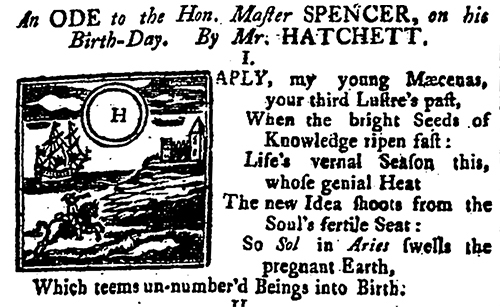
The following Ode is addressed to Lord Robert Spencer (1747–1831; above ætat 22), youngest son of Charles Spencer, 3rd Duke of Marlborough (1706–58), on the occasion of his third birthday (8 May 1750). The Ode was written by “Mr. Hatchett”—probably William Hatchett. More on this possibility below, but first the Ode:

An ODE to the Hon. Master SPENCER, on his Birth-Day. By Mr. Hatchett.

I.
HAPLY, my young Mæcenas, your third Lustre’s past,
  When the bright Seeds of Knowledge ripen fast:
  Life’s vernal Season this, whose genial Heat
The new Idea shoots from the Soul’s fertile Seat:
  So Sol in Aries swells the pregnant Earth,
  Which brings unnumber’d Beings into Birth.

II.
While now the blooming Mind, thrice lov’d, important Heir,
  Under the sapient Eye of Guardian Care,
  Is forming unto all that’s Great and Good,
The long inherent Virtues of your lineal Blood;
  So to the Rose succeeds another Rose,
  Which with its native Beauty sweetly blows:

III.
While your learn’d Mentor wins you to the polish’d Arts,
  Each moral, generous Sentiment imparts,
  With anxious Labour teaches to controul
The growing, fierce, contending Passions of the Soul,
  And fires your Heart with God-like Patriot Zeal,
  To shine the Darling of the Common-Weal:

IV.
While oft he sets before you this illustrious Plan,
  That Virtue only can ennoble Man;
  Can make those Gifts, which Fortune may have giv’n,
Be, as they ought, possess’d, approv’d by Earth and Heav’n,
  Be’t mine to sing the glad returning Morn,
  When a Delight and Blessing you were born.

V.
Thrice welcome Task! the tuneful Tribute let me pay,
  Blythe as the Lark that chants the new-born Day;
  In liveliest Strains proclaim the happy Birth,
And with the jocund Muse let all devote to Mirth:
  On pain of Dulness, hear the Muses say,
  Let nought but Wit, and Mirth, be seen to Day.

VI.
Worthy the Subject, me, the fav’rite Nine, inspire!
  Give me to touch for once the Thracian Lyre!
  Let all Creation feel the sprightly Song;
To its gay Force let even lifeless Matter throng:
  Dulness the Penalty, if Grief and Woe,
  On this glad Day, their rueful Faces shew.

VII.
Sacred this Day to Jollity, hence Care and Strife!
  Thou Friend of Health, thou sparkling Zest of Life!
  Come, laughing Joy, exhilarate the Blood,
And cause quick Circulation like a rolling Flood:
  Dulness the Penalty, if Grief and Woe,
  On this glad Day, their rueful Faces shew.

VIII.

Thy chearful Influence shed round from Morn to Night,
  Brighten each Eye, each Stoick Heart make light;
  To Beauty give the dimpling graceful Smile,
In warbling Note, and Attick Step, the Hours beguile:
  Dulness the Penalty, if Grief and Woe,
  On this glad Day, their rueful Faces shew.

IX.

Nor fail to send your warmest Wishes to the Sky,
  Oft as you charge the circling Goblet high;
  A healthful Round of Natal Days the Toast,
To the dear, lovely Youth, Mankind and Nature’s Boast:
  Dull be for ever the unsocial Soul,
  That in gay Chorus join not with the Bowl.

* * * * *

The two earliest appearances of this poem in print (that I can find) are both from December 1750. It seems likely that the poem first appeared in Whitehall Evening Post or London Intelligencer (11 December 1750): 1a, so this is the printing that I have used as my copy text. This printing is more careful with incidentals, such as the use of italics, capitalisation, indentation of lines and so forth, than the (reprints) in The London Magazine, vol. 19 (December 1750): 601a–b (here), and in The Royal Magazine; Or, Quarterly Bee, vol. 2 (March 1751): 445b–446a (here).


Although Hatchett was a relatively uncommon name in the mid-eighteenth century, I am aware of a number of men by that name, so it is by no means certain that the author of this poem was Haywood’s Hatchett. However, William Hatchett is the only one that I know of who capable of this sort of versification, so the odds are certainly in his favour; circumstantial evidence also points to William Hatchett.

It is not clear what personal connection William Hatchett (if it is his work) might have had that would prompt him write this sort of celebratory poem, except in the hope of being well paid for his flattery—as was conventional—by Charles Spencer, the 3rd Duke. In 1750, Spencer was “Lord Steward of the Household”—an office of considerable political importance and carried Cabinet rank at the time—and, apparently, “he had no concept of economy, and was a heavy spender,” which would make him a prime mark.

A more personal connection exists via Eliza Haywood, who dedicated Adventures of Eovaai to Sarah Churchill, Duchess of Marlborough, in 1736 (even though she had previously satirised Churchill as “Marama” in the second volume of Memoirs of a Certain Island Adjacent to the Kingdom of Utopia in 1725). Churchill was prominent for her opposition to Walpole—so, on the same side of politics as Haywood and Hatchett—but she had died in 1744 (having outlived her daughter, mother of the 3rd Duke). It may be that Hatchett tried appealing to the 3rd Duke with this poem, in the hope that he would carry on the support previously offered by his grandmother.

Regarding the Whitehall Evening Post, Kathryn R. King (A Political Biography of Eliza Haywood (2012), 115) considers this newspaper as “authoritative with regard to [Haywood’s] late-career publishing activities”—noting that the proprietor was Charles Corbett, a Fleet Street bookseller who had, in 1749 (when questioned by the authorities about Haywood’s A Letter from H[enry] G[orin]g) “testified that he had known her ‘many years’ and acknowledged having ‘sold several things Wrote & Published by’ her” and that, later, he has published her obituary notice in Whitehall Evening Post, which is the primary source of information supporting many Haywood attributions.

While King also mentions that Corbett published Hatchett’s The Chinese Orphan in 1741, she does not mention that he had published his Rival Father a decade earlier (in 1730) and in the same 12 December 1749 deposition she references in relation to Haywood, he explains that “Mr. Hatchett (who the Examt. has known many years) came to [his] Shop & asked him” about the copies of Haywood’s Henry Goring pamphlet, which had been left “by a porter from a person whose Name the Examt. did not know.”

The appearance of a poem by a “Mr. Hatchett” in a newspaper associated, in this way, with both Haywood and Hatchett, offers considerable support to the attribution of this poem, so I am inclined to treat William as the author.

Thursday, 9 March 2023

Did James Annesley have a son in Pennsylvania?

Haywood’s Memoirs of an Unfortunate Young Nobleman, Return’d from a Thirteen Years Slavery in America where he had been sent by the Wicked Contrivances of his Cruel Uncle (1743) is based on the “extraordinary and improbable” (MYN, 1.29) adventures of James Annesley (1715–60).


Haywood wasn’t the only writer attracted to Annesley’s story—Tobias Smollett gives a lengthy description of the case in The Adventures of Peregrine Pickle (1751); Walter Scott used the story as a plot device in Guy Mannering (1815) as did William Godwin in Cloudesley: A Tale (1830); it was used more transparently by Charles Reade in The Wandering Heir (1872) and, most famously, Robert Louis Stevenson’s Kidnapped (1886).

As Wikipedia explains:

“In 2010 [six years after I established Haywood’s authorship of MYN] A. Roger Ekirch published Birthright: The True Story That Inspired Kidnapped, a biography of James Annesley. Ekirch wrote that, while historians had long dismissed many details of Annesley's story as fiction, he had found a trove of legal documents that show that the story as traditionally told was mostly true.”

John Henley’s review (in the Guardian; here) provides some details from Ekirch’s groundbreaking study:

“The principal source of information on Annesley was a fanciful if much-reprinted volume from 1743, Memoirs of an Unfortunate Young Nobleman …. The events related in the book appear so far-fetched, however, that most of those who have read it, says Ekirch, ‘have tended to dismiss it as merely a sentimental fiction, written during an age when overblown stories of impossible adventures were a popular literary genre’. But … after seven years spent with trial transcripts, family documents, newspaper reports, House of Lords records and a treasure trove of nearly 400 legal depositions unearthed in Dublin and at the National Archives in Kew, it is now clear to Ekirch that those Memoirs are, essentially, true. ‘Annesley wasn’t the author, but he was the source of the information,’ he says. ‘You don't have to dig far to substantiate it’.”

It is a shame that Ekirch’s research did not lead him to my Bibliography, and that I was not able to benefit from any of his research before publishing my own account of Annesley and Haywood’s Memoirs of an Unfortunate Young Nobleman, but others can connect our “dots,” so that a more complete account is now possible.

* * * * *

One aspect of the Annesley story that has always interested me is the question of Annesley’s children. Although he won an improbably legal victory over his Cruel Uncle, said Cruel Uncle spent fifteen years pursuing used every legal method possible to avoid restoring Annesley’s inheritance. Sadly, these delaying tactics paid off: he outlived his nephew by one year, and in the following year Annesley’s only son died.

Annesley’s son is usually only mentioned in passing, as above, to add pathos to his father’s failure to (re)gain his inheritance. A few details of Annesley’s two marriages and five children appeared in 1778, and were reprinted verbatim until Ekirch’s Birthright expanded on them in 2010.

In a note to account of the Annesley trial, Francis Hargrave (here) noted that James:

“was twice married; first, to a Daughter of Mr. Chester, at Staines-Bridge in Middlesex by whom he had one Son and two Daughters. The Son, James Annesley, Esq. died November 1763, S. P. and the eldest Daughter is married to Charles Wheeler, Esq. Son of the late Captain Wheeler in the Guinea Trade: Secondly, to a Daughter of Sir Thomas J’Anson of Bounds near Tunbridge in Kent, Gentleman-Porter of the Tower, by whom he had a Daughter and a Son, who are both dead; the Son, aged about seven Years, died about the Beginning of 1764; and the Daughter, aged about Twelve, died in May 1765.”**

Regarding the second marriage, an “A. M. T.” of Dublin added here (The Gentleman’s Magazine, Vol. 78 (November 1795): 906a):

“Sir Thomas J’Anson … was gentleman-porter at the Tower, and resided near Tunbridge, in Kent. He died several years since without male issue (as I believe), but had two daughters; one, a most amiable young lady, married to Mr. James Annesley, who {unsuccessfully at least} contended in the year 1743, and afterwards, for the honours and estates of the late Earl of Anglesey. Whether the other young lady was married or not, I cannot say.”

* * * * *

Ekirch adds a lot more details concerning these relationships, but does not mention (as far as I can tell) the—admittedly weak—claim of yet another child, a son born in America. The claim for James’s liaison and child appeared in 1890. Not only is the evidence weak, it is likely impossible to corroborate, but intriguing nevertheless.

In an essay about the library of an anonymous “Philadelphia Antiquarian,” E. Powell Buckley notes that

“The library has a large collection of ‘secret memoirs,’ … [including] a complete set of the celebrated Annesley case, or the Memoirs of an Unfortunate Young Nobleman, returned from Thirteen years Slavery in America, 1742, the first volume of which is frequently met with, and is supposed to end the story; but, including the trial account, comprises three volumes. Connected with these are divers pamphlets on the subject.

There was a few years ago, in possession of a physician in Lancaster county, [Pennsylvania] a portion of a woman’s skull, the daughter of an early settler, who, but for the untimely death of her lover, would have been the wife of this same “young nobleman.” She was the mother of his child, and on his departure from Philadelphia to establish his claim as Lord Altham, he promised an early return to marry her. He died suddenly in London, and the sad event unbalanced the girl’s mind, and three years later she also died, a hopeless maniac. The boy grew up and was killed in a frontier Indian battle.
”

It is not certain that “the daughter of an early settler” is Maria, “a very amiable creature of about fourteen or fifteen” (MYN, 1.90; here), daughter of his second master, who “possest a Passion for him more violent that is ordinarily found in Persons of tender Age” (MYN, 1.91), but this seems very likely.

Maria’s violent passion is briefly described in an account of “The True History of James Annesley,” which appeared in an 1873 review-essay in Harper’s Weekly. (Here; the essay was prompted by the first US publication of Reade’s Wandering Heir, in 1873). The anonymous essayist writes that

“James ran away from his master [Duncan Drummond, at New Castle on the Delaware River, who] … recovered him, and kept him three years longer, and then sold him to another planter, who was rather more humane. Here he became unintentionally the object of affection of two women—his master’s daughter, Maria, and a young Indian girl. They persecuted him with addresses which were distasteful to him, and the Indian, in a rage at his obduracy, drowned herself in an adjacent river. The parents of Maria discovered the infatuation of their daughter by the stratagem related in the novel [eavesdropping], and James was transferred to a planter in Sussex County, who dying, he was again sold to a neighbor of | his late master.

It was while in the service of the latter that, being convalescent from a wound received from the vengeful brothers of his Indian admirer, he was lying under a hedge, and overheard his master’s wife (not daughter) arranging with a slave (who appears to have been a white, not a mulatto) to rob her husband and fly from the country. He had the courage to remonstrate with her, and thus incurred her hatred, though for the time she dissembled, and pretended to transfer her regard to him. But after she had made an attempt to kill him with poison he resolved to escape, and accordingly did so in the most expeditious manner at hand. He found a ship on the coast, which took him to the island of Jamaica, and there he enlisted on board of Admiral Vernon’s vessel as a common sailor.
”

Ekirch largely passes over the period that James spent with his second master; in Ch. 4 he mentions “the evidence [of his mistreatment by his first master] was strong enough to prompt his sale to a new master [not named], though conditions remained harsh during the succeeding three years. Then with just twelve months remaining, Annesley, now twenty-one, boarded a ship … only to be apprehended and punished with four additional years of servitude” (Ekirch, p. 90; here)

Ekirch dismissed the “Several dramatic incidents described” in MYN as “at best implausible” (Ekirch, p. 90)—saying of the one (concerning Maria and an Iroquois girl named Turquois), that events “were likely less titillating” than MYN suggest; and that another (concerning the unfaithful wife, neighbor to his second master) was “almost certainly … inspired by” a sensational (but unrelated) murder that occurred at the time (Ekirch, p. 91).

Haywood claims that Maria “had made all the Advances Modesty would permit” (MYN, 1.96; here), but that Annesley “had not the least Spark of Inclination” for her (MYN, 1.97). However, as Ekirch says, James was Haywood’s “source of the information” (Ekirch, p. 70; here)—and he had very good reason to conceal this relationship (abandoning a pregnant teenager in the Colonies would have, at the very least, not have helped him build the support he needed to prosecute his case). One later writer suggested that Maria “show[ed] her affection in a manner which could not be mistaken” [Celebrated Claimants (London, 1874), 76–77; here]—an ambiguous statement, which could support either Haywood’s or Buckley’s account.

* * * * *

Buckley refers to James’ death as “sudden” and “untimely,” suggesting that he died young, soon after he reached London, but James died at the age of forty-five, which is certainly young), but it was still twenty years after regaining his freedom. If Maria died, “a hopeless maniac” only three years after James (1763)—then she had been holding out the hope of reuniting with him for a long time, longer than Buckley seems to be implying. However, these details are not so far from the known facts as to flatly contradict them.

It is possible that further research might either corroborate one or more facts in Buckley’s account, or locate a parallel that might have inspired the story—just as Ekirch was able to locate a parallel story of the “attempt to kill [James] with poison” (Ekirch, p. 91). Certainly, according to Ekirch, James’s widow, Margaret Annesley (née I’Anson) “spent her last years in a madhouse”—perhaps, as a “hopeless maniac.” However, the chances that a portion of Margaret’s skull ended up in the possession of “a physician in Lancaster county” seems very remote indeed, so it is unclear how all the elements in this story can be accounted for.

Whatever the truth may be, the fact that even this putative (eldest) son of James “was killed in a frontier Indian battle”—thus missing out on the inheritance his mother hoped for him, via James—would be, sadly, quite fitting.

PS: for my post on the various versions of the above portrait of James Annesley, see here.