Showing posts with label Bibliography. Show all posts

Monday, 17 August 2026

Eliza Haywood's Henry Goring Identified

The subject of Eliza Haywood's "Jacobite literary fabrication," A Letter from H---- G----g, Esq; One of the Gentlemen of the Bed-chamber to the Young Chevalier (1749), is Charles Edward Stuart (1720–88), son of James Francis Edward Stuart (1688–1766), son of James II (ruled 1685–88), who was overthrown as King of England because of his Catholicism in the “Glorious Revolution” of 1688.
In my Bibliography of Eliza Haywood (2004), I opened my entry on this 64-page pamphlet almost exactly as stated above. Although I filled in the dashes ("H[enry] G[orin]g") whenever I used the full title of the pamphlet, and titled my entry (actually, entries) for it A Letter from Henry Goring, and cross-referenced both "'G—g, H—' (i.e. Goring, Henry)" and "Goring, Henry" to my entries for "A Letter from H[enry] G[orin]g (Ab.66, Da.9)," I nowhere say anything whatsoever about the putative author of Haywood's Letter.

The reason for this silence is because I was unable—up until (*looks at watch*) today(!)—to identify the Goring concerned. It occurred to me this morning that I might now—with the amount of material online, and AI-powered searches now able to sift almost all of this material—make more progress than I did using the resources at my disposal in the pre-internet era. I was right. Although Google’s Gemini struggled, ChatGPT bought home the gold.

Henry Goring (1707–1755)

It seems that the Gorings were an old Catholic-leaning Sussex family. According to The Westminster School archive (**), Henry Goring was born 11 April 1707, the son of Sir Henry Goring, 4th Baronet (1679–1731; Wikipedia entry here) and Elizabeth Mathew. The archive identifies him specifically as the Henry Goring who became a Gentleman of the Bedchamber to the Young Pretender.

Henry’s elder brother, Charles Mathew Goring, inherited the baronetcy to become Sir Charles Mathew Goring, 5th Baronet (1706–1769; details here).

Henry pursued a military career on the Continent. He appears to have joined Charles Edward's circle in the 1730s, being with the Prince in Italy around 1737. He subsequently served in the Austrian army, and this military background was probably one reason he was useful to Charles. Later, Goring became one of the Prince's most trusted personal attendants and accompanied him during his clandestine wanderings after the collapse of the 1745 enterprise.

Haywood’s pamphlet pretends to be a genuine account of Goring accompanying Charles from Avignon through Germany and elsewhere. By 1752–54, Charles's private life and increasingly erratic behaviour were causing serious alarm among his remaining supporters. One particularly damaging episode involved Charles’s mistress Clementina Walkinshaw (1720–1802) (below).
Charles sent Goring to Dunkirk to bring Clementina to him. Goring apparently regarded her very unfavourably and bitterly complained that Charles was treating him as little more than a pimp! Although there is no entry for “our” Henry Goring on Wikipedia, an account of this incident does appear under the entry for Clementina (here).

The never-failing Andrew Lang offers an historical account of Goring, partly based on genuine contemporary reports from a government spy—"Pickle" (the traitor Alastair MacDonnell, ca. 1725–1761)—as being the Prince's loyal servant who eventually abandoned his service. (See, Pickle the Spy: Or, The Incognito of Prince Charles (1897) and the sequel The Companions of Pickle (1898).) Goring was concerned about Charles's mistress, his treatment of loyal adherents, his increasing suspiciousness, his financial difficulties, and what Goring regarded as his ingratitude and political irresponsibility.
Charles effectively dismissed Goring at Liège in May 1754. Goring then went to Berlin, where he entered Prussian service. According to Lang, in Pickle the Spy, he "went to Berlin, and presently died in Prussian service" (here) and in The Companions of Pickle, "The Earl [George Keith, 10th Earl Marischal] left Paris in the end of June (carrying with him to Berlin poor Henry Goring, who was near death)" (here).

What happened next is unclear. The Westminster School archive (based on a 1928 publication) claims that—although Lang represents Goring as being near death in 1754—he went on to become a General in the Prussian Army and that, in 1755, he married a Susan, daughter of Prince Stanever, Transylvania.

I suspect this last claim is an error, and possibly a confusion of Goring with Earl Marischal, who joined the Prussian Army, became a close confidant of Frederick the Great, and served as the Prussian ambassador to Spain, France and Great Britain. Unfortunately, I have been unable to find anything definitive regarding this since the evidence points in all directions.

* * * * *
A Prince Stanever is mentioned in an early nineteenth-century historical and genealogical work. In James Dallaway's A History of the Western Division of the County of Sussex, Vol. 2, Pt 2 (1830), 133, on the Goring family tree, Dallaway notes (as seen, at right, above) that "Henry, a general in the Prussian service" married "Susan, dau[ghter]. of … [sic, elipsis] Stanever, a prince of Transylvania, living in London in 1781" (here).

From 1711, Transylvania was under the direct rule of the Austrian Habsburgs, meaning that a title of Prince of Transylvania only might apply to a Habsburg prince in 1755 (when Susan and Henry are supposed to have married), or 1781 (when the prince was supposedly in London), but there were no Habsburg princes of this name. Likewise, none of the pre-1711 princes of Transylvanian have this name.

The only Prince named in the London newspapers between 1745 and 1781 in relation to Transylvania is Prince Sulkowski, seemingly a member of the Sułkowski family of Poland (see here), who was campaigning on the boarder of Transylvania, and is an unlikely candidate for a "Prince Stanever."

In a strange hallucination (I think!) ChatGPT claims that "Prince Stanever of Transylvania" appears as a character name in a 1755 Westminster School Archive theatrical play, but I am unable to find any such play.

It did occur to me that, since Earl Marischal really did join the Prussian Army and achieve some seniority, there might be some confusion of Goring with the Earl, but Earl Marischal did not marry (it seems), and I find nothing to link him to either a Susan or a Prince Stanever of Transylvania.

(**) the Westminster School archive is based on material concerning Goring, including his marriage to Susan etc., that was first printed in The Record of Old Westminsters: A Biographical List of All Those who are Known to Have Been Educated at Westminster School from the Earliest Times to 1927, vol. 1 (1928), 386 (here).

Saturday, 9 May 2026

George Frisbie Whicher, 1889–1954, a bio-bibliography

George Frisbie Whicher, whose Columbia University thesis on Eliza Haywood was foundational to Haywood studies (i.e., The Life and Romances of Mrs. Eliza Haywood (1915)), has long been an enigma to me. Although his Columbia thesis was so important to Haywood studies, it seems that he never revisited the subject. At all. In forty-one years of academic life. In the circumstances, a meme something like this seems appropriate:


I have made multiple attempts in the past to peer into Whicher’s life, but never got very far. My most recent attempt was in January of 2018. Improvements in AI have vastly simplified this task, as has Anna’s Archive, so I have finally finished the following brief biography and bibliography.

* * * * *
George Frisbie Whicher (1889–1954) was the son of Lillian Hope and George Meason Whicher (1860–1937), a noted classics professor and poet. GMW seems to have been (appropriately) peripatetic: moving from Hastings College, Nebraska (1883–88), to Packer Collegiate Institute, Brooklyn Heights, New York (1892–1900), then to Hunter College, Manhattan, New York (ca. 1900–1924), and finally—after GFW completed his own studies—to the Classical School in Rome (1921).

George Frisbie Whicher received his B.A. in 1910 from Amherst College, in Massachusetts, where he taught from 1915 to 1954, having received his PhD from Columbia in 1913, and having been an instructor in English at the University of Illinois from 1913 to 1915. As noted, his Columbia thesis was foundational to Haywood studies, but his most influential work may have been This Was a Poet: A Critical Biography of Emily Dickinson (1938), which is credited with establishing Dickinson as a major figure in American literature. Whicher’s other notable works include: The Goliard Poets (1949), a collection of translations of medieval Latin songs and satires, Walden Revisited (1945), a centennial tribute to Henry David Thoreau, and Poetry and Civilization (1955); a posthumously published collection of his essays, edited by his wife. It is this collection which provides the basis of the bibliography below.

Whicher was married to Professor Harriet Fox Whicher (1890–1966) of Mount Holyoke. Born Harriet Fox, she earned her Bachelor of Arts from Barnard College and went on to have a distinguished academic career as a Professor of English in the English Department at Mount Holyoke. It seems that George and Harriet were close friends of the novelist Willa Cather (1873–1947).

The son of George and Harriet, Stephen Emerson Whicher (1915–61) was an influential American literary critic, biographer, and professor, best known as one of the leading scholars on Ralph Waldo Emerson. SEW earned degrees from Amherst College and Harvard University. He taught at Swarthmore College for a decade (1947–57) before becoming a Professor of English at Cornell University in 1957. His tenure there was short; SEW committed suicide at the age of 46—having been "upset by the prospect of continued world tension" (according to the NYT article, here)—leaving behind his mother Harriet, "his wife, Elizabeth, and four children, Susan, Nancy, Stephen and John." It is probably relevant that SEW served in the Navy during WW2 and received two combat stars during his service, so it is certainly possible he had something like PTSD.

An obituary for GWF: James Woodress and Robert P. Falk. "In Memoriam: George Frisbie Whicher, 1889-1954." American Literature, Vol. 26, No. 2 (1954): 255–56, starts: "The American Literature Group lost one of its most distinguished members when George Frisbie Whicher of Amherst College died on March 7. Few men have brought more honor to their profession through their lives and their writings than George Whicher did in his forty-one years of academic life."

* * * * *

A Bibliography of the works of George Frisbie Whicher

Books [5]
The Life and Romances of Mrs. Eliza Haywood (New York: Columbia University Press, 1915).
This Was a Poet: A Critical Biography of Emily Dickinson (New York: Charles Scribner's Sons, 1938).
Alas, All's Vanity, or, A Leaf from the First American Edition of Several Poems by Anne Bradstreet (New York: Collectors' Bookshop, 1942). ¶ a biblioclastic "leaf book"; contains a leaf from Anne Bradstreet's Several Poems compiled with great variety of wit and learning, full of delight (Boston, 1678) [ESTC: R22624; Wing B4166].
Walden Revisited: A Centennial Tribute to Henry David Thoreau (Chicago: Packard and Co., 1945).
Mornings at 8:50: Brief Evocations of the Past for a College Audience (Northampton, MA: The Hampshire Bookshop, 1950).

Works edited, with Introductions [8]
—George Borrow, Lavengro, ed. George F. Whicher (New York: Macmillan, 1927).
—W. G. Hammond, Remembrance of Amherst, ed. George F. Whicher (New York: Columbia University Press, 1946).
—Henry D. Thoreau, Walden and Selected Essays, Intro. by George F. Whicher (Chicago: Packard and Co., 1947).
—Horace, Selected Poems of Horace (New York: D. Van Nostrand Co. Inc., 1947).
The Transcendentalist Revolt against Materialism, ed. George F. Whicher (Boston: D. C. Heath and Co., 1949). Problems in American Civilization Series.
Poetry of the New England Renaissance, 1790-1890, ed. and Intro. George F. Whicher (New York: Rinehart and Company, 1950).
—Virgil, Translated into English Verse by John Dryden, Intro. George F. Whicher, ill. Bruno Bramanti (New York: The Heritage Press, 1953).
William Jennings Bryan and the Campaign of 1896, ed. George F. Whicher (Boston, 1953). Problems in American Civilization Series.

Translations [2]
On the Tibur Road: A Freshman's Horace. With George Meason Whicher (Princeton, NJ: Princeton University Press, 1911).
The Goliard Poets: Medieval Songs and Satires, with verse Translations by George F. Whicher (New York: New Directions, 1949).

Contributions [22]
—"Early Essayists" and "Minor Humorists" in The Cambridge History of American Literature, ed. William Peterfield Trent et al. (New York, 1917–21).
—[Seventeen articles] in Dictionary of American Biography, ed. Allen Johnson and Dumas Malone (New York, 1943).
—"Chapter 34: Literature and Conflict." in The Literature of the American People, ed. Arthur Hobson Quinn (New York, 1951).
—"Part IV: The Twentieth Century." in A Literary History of the United States, ed. Robert E. Spiller et al. (New York, 1948).
—"Introduction," in Publius Virgilius Maro, The Georgics, trs. Jolın Dryden. With an Introduction by George F. Whicher and Illustrations by Bruno Bramanti (Verona, Italy, 1952; rpt. New York, 1953).

Articles, poems, and reviews for various periodicals [not enumerated; I will add these as I find them]
—"The Present Status of the Bibliography of English Prose Fiction between 1660 and 1800" PMLA, Vol. 36, Appendix (1921), pp. c-cvi.
¶ This essay "rehearse[s] the tale of existing bibliographies of fiction, both published [Charlotte E. Morgan (1911), Arundell Esdaile (1912)] and unpublished [Chester N. Greenough, John M. Clapp]." In it, Whicher notes that "Upon his retirement from teaching a few years ago, Mr. Clapp bequeathed his [mauscript bibliography of 18C fiction] cards to me. I have as yet done nothing to improve my inheritance" (civ) and that "In 1913 I had occasion to go through the files of three newspapers in the Burney Collection from 1720 to 1730, noting all titles of fiction with the date of the first 'This day published' advertisement." (cv) I discuss Whicher's essay and the manuscript collections he mentions in my post "Knitting for Bibliographers, by Professor Greenough" (here).
—"Shakespeare for America" [reprinted from the Atlantic Monthly, Boston (June 1931).
—"Notes on a Wordsworth Collection," The Colophon, n.s. Vol. 11 (Summer 1937): 367-80.
¶ In this essay, Whicher seriously questions the authenticity of what became known as the 'Wise cancel' in Wordsworth and Coleridge's Lyrical Ballads, concluding that 'These considerations are not direct evidence that the cancel leaf in question is spurious. Only an examination of paper and type can determine that. But they are sufficient to cast grave doubts on its authenticity. Mr. Wise's account of the normal make-up of both issues of the first edition of Lyrical Ballads is regrettably far from accurate" (373).
—"Stories of an Old Man Mad About Writing: Wherein Ford Madox Ford Talks Temperamentally of the Lost Art of Reading" [a review of Ford Madox Ford, The March of Literature (New York: Dial Press, 1938)], New York Herald Tribune Books (Sunday 23 October 1938): 7. NEW
¶ This (very largely) positive review is, I am informed, just one of hundreds(!) of reviews by Whicher to appear in the New York Herald Tribune Books. For me, the highlight of the review is this parenthetic quip, regarding Ford's chronology: "(when by happy accident he gets his dates right)." It is beyond the scope of the present list to account for all of these hundreds of reviews, but if I can work out if I ever get access to the relevant ProQuest Historical Newspaper database, I will see if any mention Haywood, or her contemporaries, and related questions of bibliography. Those I will have to account for!
—"The Susceptible Bluestocking: Miss Stern's Skillful And Intimate Life of Margaret Fuller The Emotional Growth of a Brook Farm Intellectual" [a review of Madeleine Stern, The Life of Margaret Fuller (New York: Dutton, 1942)], The Washington Post (18 January 1942): L11. NEW
¶ This is the only revelevant review I can find in the ProQuest Historical Newspaper database I have access to at Monash. Amusingly, by a happy accident perhaps, Whicher repeats his "happy accident" phrase from his 1938 review.

[2026.08.18 UPDATE: feedback on this post from JL (thanks!) has enabled me to add one of over 400 reviews Whicher contributed to New York Tribune/Herald Tribune, plus one I found as a result of following this up.]

Sunday, 5 April 2026

The Half-forgotten Books series, 1903–1907

The "Half-forgotten Books" series, edited by E. A. Baker, M.A., and published by Routledge, 1903–1907, contained at least twenty-six titles. Above and below are a few survivors, in the distinctive series binding—which is the primary focus of the only scholarship I could locate on the series. In his 2014 essay on "Neo-Victorian Book Design," Chris Louttit writes (here, on p. 122):

The Half-Forgotten Books collection … reprinted neglected works of literature from the previous two hundred years or so in affordable but handsome volumes. [It] … includes Ann Radcliffe's The Mysteries of Udolpho, but ranges more widely into the annals of forgotten Victorian popular fiction to include novels by, amongst others, George Alfred Lawrence, George Herbert Rodwell and Edmund Yates. What is most pertinent about the Half-Forgotten Books in this context, however, is the way in which the neglected texts are presented. Each volume sports the same rather unexciting cover illustration of a collection of solid-looking books; all that differentiates them is the author and title.
* * * * *

Ernest A. Baker (1869–1941; on Wikipedia here) was, as a 1911 advertisement for this series explains, the author of A Descriptive Guide to the Best Fiction, British and American (1903; on IA), a book which offers brief descriptions, plot summaries, and critical analysis on roughly 4500 fiction titles. He was also, later—and far more importantly—the author of the ten-volume opus The History of the English Novel (1924-39) and, as I only discovered recently, A Guide to Historical Fiction (1914; on IA here).

(I initially, and rather optimistically, mis-read this latter title as being a guide to fiction published in the past, rather than a guide to fiction set in the past. Now that the Guide is 112 years old, I guess both apply, but it was a bit of a mix even when new. The book is surprisingly useful and fun guide, if you want to pair books published in—say—1718, with those set in 1718. If I ever see a copy, I’ll happily snap it up, even though Eliza Haywood does not get a mention.)

Baker seems to have been Routledge's go-to guy, being a prolific series and volume editor, for a prolific series publisher. In addition to this series, he was also series and volume editor for the fifteen-volume "Library of Early Novelists" Series (1904–1907), which I am still researching, but will do a separate post on.

My interest in both series was prompted by the discovery that Baker included in each of them a handful of curious and uncommon novels, gothic novels, and novels by women writers from the long eighteenth century. I only have his edition of Matthew Lewis' The Monk, but now I want his editions of Thomas Amory, Alain-René Lesage, Aphra Behn, Ann Radcliffe and Jane Porter.

For volumes in the Library of Early Novelists series, it might take a bit of patience for me to find decent and affordable copies of the titles that I want. But I have already given up on finding any similar volumes in the "Half-forgotten Books" series: volumes such as Sarah Fielding's The Adventures of David Simple, Ann Radcliffe's The Romance of the Forest and Le Sage's Asmodeus; or, The Devil on Two Sticks. I have given up because—although (according to Louttit) the British Library seems to hold eighteen volumes—I have only been able to confirm the existence of four volumes from the entire series, i.e., with images available online, and can only find—after a pretty comprehensive search—only two copies for sale (see links below).

* * * * *

Early advertisements (to 1905) list the volumes in the "Half-forgotten Books" series in publication order, but these advertisements only list the first eighteen or nineteen volumes (see below for the uncertainty); while the longer list (from Black Sheep, in 1911) is both alphabetical (by title) and numbered. All (?) of the volumes added to the 1911 list are marked as either "In Press" (one title) or "Ready" to be published—meaning, presumably, they were not yet published.

It is not clear how many of these "Ready" volumes were actually published in this series, and whether any novels were added later. The 1911 advertisement concludes with the claim that "Subsequent volumes will be selected from the following amongst other authors" (i.e., "…the following authors, amongst others"). The list that follows this statement enumerates thirty-eight authors, has a suspicious overlap with the "Library of Early Novelists" series.

In any event, since it seems to be impossible to accurately date either the seven unpublished, "Ready" volumes in the 1911 list, or to confirm the order of all of the first nineteen volumes, so I have transcribed below the 1911 alphabetical list and retained its numbering.

The list pretty accurately reproduced the published advertisement, except in my list below the author's name precedes rather than follows the book title, I have returned / re-arranged book titles to their natural order (thereby disrupting the alphabetical-by title arrangement), and I have dropped the all-caps. This means that "SUSAN HOPLEY (The Adventures of). Mrs. CROWE." becomes "Mrs. Crowe, The Adventures of Susan Hopley" etc.

1. A. R. Lesage, Asmodeus; Or, The Devil on Two Sticks
2. Captain Chamier, Ben Brace; Or, The Last of Nelson's Agamemnons
3. G. A. Lawrence, Breakspeare; Or, The Fortunes of a Free Lance
4. William Godwin, Caleb Williams [Ready]
5. R. M. Roche, Children of the Abbey
6. Thos. Cooper, Family Feud
7. C. Dickens, Memoirs of Grimaldi the Clown. With Introduction by Percy Fitzgerald and Plates by G. Cruikshank [Ready]
8. G. A. Lawrence, Guy Livingstone
9. Captain Morier, Hajji Baba in Isfahan
10. Harriet Martineau, Hour and the Man
11. Mrs. Radcliffe, Mysteries of Udolpho. With An Introduction by D. Murray Rose [Ready]
12. R. M. Bird, Nick of the Woods; Or, The Fighting Quaker
13. Mrs. Crowe, Nightside of Nature [1904; on IA]
14. G. A. Rodwell, Old London Bridge [Ready] [1904; on IA NEW]
15. Albert Smith, The Pottleton Legacy [In Press] [1904; on IA NEW]
16. Mrs. Radcliffe, Romance of The Forest
17. Samuel Lover, Rory O'More
18. Judge Haliburton, Sam Slick the Clockmaker [Ready] [1904; on IA]
19. W. H. Maxwell, Stories of Waterloo
20. Mrs. Crowe, The Adventures of Susan Hopley
21. Jane Porter, Thaddeus of Warsaw
22. Captain Chamier, Tom Bowling
23. R. Mounteney Jephson, Tom Bullkley of Lissington. With An Introduction By E. A. Baker, M.A. [Ready]
24. Amélie Rives, Virginia of Virginia
25. Emma Robinson, Whitefriars; Or, The Court of Charles II [Ready] [1903; copy listed here (sold)]
26. W. Carleton, Willy Reilly

* * * * *

Below are the thirty-eight authors, listed in 1911 as potential additions to the "Library of Early Novelists" series. I have expanded the thirty-five names that appear by surname only in this alphabetical list.

Ainsworth (i.e., William Harrison Ainsworth)
Amory (i.e., Thomas Amory)
About (i.e., Edmond About)
Aleman (i.e., Mateo Alemán)
Auerbach (i.e., Berthold Auerbach)
Banim (i.e., John Banim)
Mrs. Behn (i.e., Aphra Behn)
Carleton (i.e., William Carleton)
Craven (i.e., Pauline Craven or Mrs. Augustus Craven)
Conscience (i.e., Hendrik Conscience)
Feuillet (i.e., Octave Feuillet)
Sarah Fielding
Jessie Fothergill
Galt (i.e., John Galt)
Gleig (i.e., George Robert Gleig)
Gerstacker (i.e., Friedrich Gerstäcker)
Gerald Griffin
Gogol (i.e., Nikolai Gogol)
Mrs. Gore (i.e., Catherine Gore, or Mrs. Catherine Frances Gore)
General Hamley (i.e., General Sir Edward Hamley)
M. C. Hay (i.e., Mary Cecil Hay)
W. S. Hayward (i.e., William Stephens Hayward)
Heyse (i.e., Paul Heyse)
Holcroft (i.e., Thomas Holcroft)
Hook (i.e., Theodore Hook)
Mrs. Inchbald (i.e., Elizabeth Inchbald)
H. Kingsley (i.e., Henry Kingsley)
M. G. Lewis (i.e., Matthew Gregory Lewis)
Lever (i.e., Charles Lever)
Miss Manning (i.e., Anne Manning)
Mayo (i.e., William Starbuck Mayo)
Thos. Nash (i.e., Thomas Nashe)
Neale (i.e., W. Johnson Neale)
Mrs. Opie (i.e., Amelia Opie)
Mrs. Parr (i.e., Louisa Parr)
Praed (i.e., Winthrop Mackworth Praed)
Trollope (probably Anthony Trollope)
Yates (i.e., Edmund Yates)

* * * * *

Missing from both the twenty-six titles in the first list (whether published, "Ready" or "In Press") and the thirty-eight authors in the second, is Henry Brooke, The Fool of Quality, which appeared in this 1904 advertisement, only to be replaced by no. 16 in this 1911 advertisement (in The Heptameron).

Also missing from these lists is the volme below: Thomas Miller, Gideon Giles the Roper ([n.d.]), a copy of which is for sale here (and, possibly, here).
In a footnote to Louttit’s essay, quoted above, the author notes that "According to the British Library Catalogue, eighteen volumes of the series were produced between 1903 and 1906” but that "advertisements I have consulted in the individual volumes give as many as twenty-five titles" (125n14).

Given the existence of volumes not listed in advertisements, and the uncertainty concerning which of the works advertised as "Ready" or "In Press" were actually published, it may be safest (for now) to say of the series only that "between twenty and thirty volumes" were published.

Finally, if and as I can confirm the existence of volumes, and imprint dates, I will update the list(s) above with links etc.

[UPDATE 10 April 2026: I have added a few extra Internet Archive links (to nos. 14, 15) and dates of publication for all copies with links]

Sunday, 5 March 2023

Leonora Meadowson in Sams's Royal Subscription Library, 1826

Haywood’s The History of Miss Leonora Meadowson (London: Francis Noble, 1788) is a two-volume collection of four, short works, only the first of which is by Haywood—this being the titular “Leonora Meadowson,” which is a lightly-revised reprint of Haywood’s Cleomelia: Or, The Generous Mistress (1726).

In addition to a 1997 conference paper and a long entry in my 2004 Bibliography, I have published two essays on Leonora Meadowson: “Eliza Haywood’s last (‘lost’) work: The History of Miss Leonora Meadowson (1788)” (BSANZ Bulletin, 1999)—which announced my 1997 (re-)discovery of a copy at the Fales Library in New York—and “Twice-Told Tales in Eliza Haywood’s Leonora Meadowson” (Notes and Queries, 2016)—which corrects my mistaken attribution to Haywood of the three shortest works in this anthology.

In my 1997 conference paper and 1999 essay, I explained how rare it is to find any reference at all to Haywood’s long-lost work. After a prolonged and extensive search, diligently pursued, I had found practically nothing. The “puny discovery” (1999:43) of a single advertisement, in another book issued by Noble, was all the reward I had for my efforts—until I accidently discovered a copy of the book at the Fales library in 1997.


Above is one of the blurry, ye-olde-tech photos I took of my discovery in 1997:

Over twenty-five years later, it is obviously very quick and easy to repeat and extend my previous, broad-scale searches for “some record, even if only a trace, of the fleeting existence of this ‘lost’ book” (1999:43)—and I am pleased to say that I found something more.

What I found is only another trace—but the location of that trace is interesting. In the essay I wrote on my search for, and discovery of a copy of Leonora Meadowson, I explain that:

the main outlet for [the Noble bothers’] new publications was through wholesale distribution to other circulating libraries and to retail outlets. Leonora Meadowson appears never to have made it to this stage of distribution, or to have barely started it. If the book had been distributed, we would find it listed in the catalogues of dozens of the circulating libraries that the Nobles supplied; but, as I have shown above, it is not to be found in any of them. ” (1999:40)

I can now replace “not to be found in any of them” with “only to be found in one of them”—in the Catalogue of Sams’s Royal Subscription Library, No. 1 St James Street London (London: Joseph Sams, [1826]), 168 (no. 6658): “History of Miss Leonora Meadowson. a Novel, 2 vols. 12mo. 6s” (available here)


This “puny discovery” doesn’t change my original analysis, since finding just one entry in a circulating library catalogue supports my interpretation that the process of distribution can have only “barely started” for the book to disappear so comprehensively since. If anything, it offers more support for my interpretation, which is nice.


I will keep searching for traces of Leonora Meadowson. As more ephemeral publications (like the Catalogue of Sams’s Royal Subscription Library) are scanned and published online, it is possible that I will find yet more traces, but as I approach nearly thirty years of searching (!), my expectations are very modest indeed.

Sunday, 27 March 2022

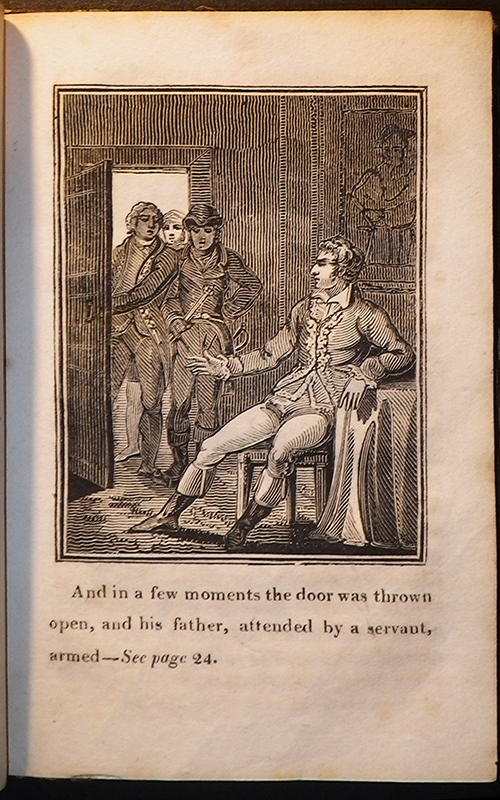
The Unfortunate Young Nobleman, 1820

The following chapbook came to my attention only because of the similarity of the title to Haywood's Memoirs of an Unfortunate Young Nobleman.* For a happy moment, I thought that this might have been a previously-unknown chapbook reprint of Haywood's Annesley biography, but the full title suggested a different work altogether.


Haywood's work is "A Story founded on Truth," concerning a Nobleman who had Return’d from a Thirteen Years Slavery in America where he had been sent by the Wicked Contrivances of his Cruel Uncle; however, this "tale of sympathy, founded on fact" depicts the unprecedented sufferings of an affectionate husband, and the forlorn state of an amiable mother, and her infant child. So, close, but no cigar.


There appears to be only five copies of The Unfortunate Young Nobleman; a tale of sympathy, founded on fact in institutional collections. These are held at British Library, Oxford University, Victoria and Albert Museum (x2), and UCLA. None of these eminent instutitions identify the source-text, which I quickly discovered after only a little hunting online (since it is discussed by a few critics): Helen Maria Williams (1759–1827), Letters Written in France, 8 vols. (1790–96); primarily, the first volume, which: contain[s] various anecdotes relative to the French revolution; and memoirs of Mons. and Madame du F----.


Like The Unfortunate Young Nobleman, the Letters Written in France tell the story of an unfortunate couple, whose names are dashed out in the form "F----". The "Mons. and Madame" indicated here were Augustin-François Thomas du Fossé (1750–1834) and Monique du Fossé (née Coquerel).


As the 18th Century Online Encyclopedia explains.

Throughout 1789 Williams befriended Monique Coquerel, a French woman exiled to London—the young wife of Augustin du Fossé, son of the Baron du Fossé who disapproved of Coquerel’s humble birth. Following the Baron’s death, his young son refused his title and thus embraced the basic tenets of the French Revolution. As an act of friendship, du Fossé invited Williams to France for the summer of 1790. Williams wrote copious letters describing her observations. These letters were later made public under the title of Letters Written in France in the Summer of 1790. This manuscript was but the first of eight volumes of letters devoted to Williams' observations of the events in France during and following the Revolution. The letters—Williams most popular work—are now known simply as Letters from France. For Williams, the persecution of the Fossés stood for the abuses associated with the ancien régime, and the Fossé’s ability to live in peace under the post-Revolutionary government demonstrated the freedoms associated with the Revolution.


The story of Mons. and Madame du Fossé was described as a "charming little nouvelle" by the Critical Review (in January 1791: here), so it is not surprising that it should have been the focus of at least two separate publications, the present chapbook, plus an earlier one: Memoirs of Mons. and Madame du F. In a Series of Letters, by Helen Maria Williams. Extracted from her Letters of the French Revolution (Boston, 1794)—a copy of which is available from James Cummins for USD850 here.


The Unfortunate Young Nobleman was published by Robert Harrild, who was at the London address given ("20, Great Eastcheap") only from 1814–24. I have taken my estimated date of publication (1820) from the most comprehensively catalogued copies, which are at the Victoria and Albert Museum; both in the "Renier Collection of Historic and Contemporary Children's Books". An impossibly early date of publication is offered by one of the few people to discuss the text—Mary A. Favret—who lists The Unfortunate Young Nobleman under the works of Williams, but dates the chapbook "1790"—not "ca.1790" or "[1790]"—in both The Idea of Correspondence in British Romantic Literature (PhD thesis, Stanford University, 1988), 136, 412 and her Romantic Correspondence: Women, Politics and the Fiction of Letters (1993), 263 [here]. Although the date was probably adopted from the title of the source text (Letters Written in France in the Summer of 1790), it may also, possibly, be a result of misinterpreting a footnote in a French monograph on Willians.**


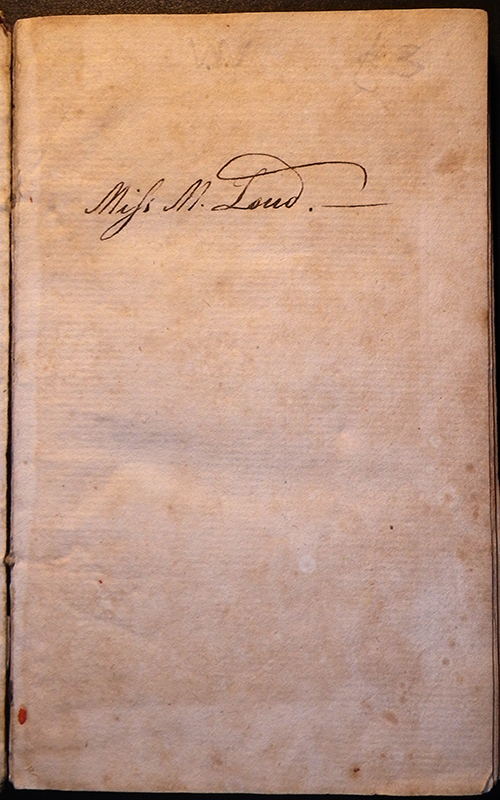
As you can see above, like both the Renier copies, mine is in a "Trade binding of quarter … sheepskin with … paper boards" (mine being red and blue rather than green and brown). Like the Bodleian copy, it also has a name penned onto the ffep (as can be seen below): "Miss M. Laud." (The inscription on the Bodleian copy reads "Eliza Buxton, Old Kent Road".)


The price that is faintly visible on the ffep (£3) is not the price I paid. If that is what the vendor paid, then they multiplied their investment ten-fold, which still seemed like a bargain to me—but I have recently paid much more than that in postage for a piece of paper smaller than an address label, so my sense of scale may still be off.

* * * * *

* For a more "piquant" example of a Haywoodian title-chime, which has been responsible for at least two false attributions, see here.

** Lionel Douglas Woodward, Une anglaise amie de la révolution francaise: Hélène-Maria Williams et ses amis (1930), 32n72: "Voir: Lettres écrites de France pendant l'élé de 1790, dernière lettre. L'histoire des malheurs des du Fossé fut publiée seule, aussi bien que dans les Lettres, sous ce titre: The unfortunate young Nobleman …" [See: Letters written from France during the year of 1790, last letter. The history of the misfortunes of the du Fossé was published alone, as well as in the Letters, under this title: The unfortunate young Nobleman …]. Favret's error is repeated on the SIEFAR page for Williams here.

BTW: I have inserted above all the illustrations in this chapbook, because I love this style of woodcut and, in the correct order pretty-much tell the whole story; the illustrations are in the correct text sequence, illustrating passages on pp. 8, 20, 24, 42, and 52 (of the 71 pages).

Sunday, 6 February 2022

Slip cancellation in 1904

Below are some images of one of my books with a cancelled imprint—The Letter of Petrus Peregrinus on the Magnet A.D. 1269, translated by Brother Arnold, and with an Introductory Note by Brother Potamian (New York, 1904).* (For my previous posts concerning cancellation, see here.)


There are three copies of this edition of The Letter of Petrus Peregrinus available to buy at present: all record the imprint as “McGraw-Hill.” As you can see, however, the printed imprint is “McGraw Publishing Company.”


But you can also see that my copy (and, I assume, the ones for sale) have a nicely printed slip bound in that covers the imprint, which states that the book was published by the “McGraw-Hill Book Company … successors to Book Departments of the McGraw Publishing Company [and the] Hill Publishing Company.”


There is a copy on the Internet Archive (here https://archive.org/details/letterofpetrusp00pieriala) that does not have this printed cancellation slip, so it is unclear whether all copies have the slip-cancel. Which raises an interesting question: how should the imprint be recorded: “McGraw Publishing Company” or “McGraw-Hill Book Company”?**


While looking at this book again I noticed something else—which the astute reader may also have noticed—it has a page number on the title-page! It also has one on the verso of the title leaf, on the imprint page, as well as the half-title, part-titles etc.

Conventionally, these pages do not have page numbers on them. It would be interesting to know whether other publications by McGraw consistently included printed pagination in this way, or whether this was a one-off—an accidental oversight effecting just this book, bought on by the disruption of amalgamation.


*BTW: Wikipedia informs me (here) that the AKAs for Petrus Peregrinus, Brother Arnold and Brother Potamian are: Pierre Pelerin de Maricourt, Joseph Charles Mertens and M. F. O’Reilly.

**The answer from WorldCat (here)—or the overwhelming majority of its subscriber-libraries—is “Norderstedt Hansebooks GmbH 2018”! The main entry for The Letter of Petrus Peregrinus (with 171 copies in “all 9 editions”) has this imprint. Under this main entry you can insist on only seeing “just this [print-on-demand] edition,” but not just one of the other 8 editions, one or two of which are the real one. A secondary WorldCat entry with the imprint as I gave it at the head of this post (“New York, 1904”) has only one holding in Denmark. Three cheers for the Danes, for getting it right.

Sunday, 23 January 2022

Teaching English in Utrecht, using The Female Spectator

My Bibliography of Eliza Haywood (2004) includes two sections given over to reprints of sections of works by Haywood before 1850: "Ac. Reprints in monographs" and "Ad. Reprints in periodicals."

Referring to these two sections in my Introduction, I stated that "It is likely that more Haywood items will be identified as critical interest in the contents of eighteenth-century periodicals increases and as a greater number of electronic resources become available that make it easier to conduct searches of these periodicals." When I wrote this I had in mind E. W. Pitcher's 1995 identification of over a dozen reprints "of Eliza Haywood’s Stories in The Weekly Entertainer," which was published in Notes and Queries.

Well, there hasn't exactly been a flood of articles like Pitcher's, but I have identified so many reprints myself that I have had to give up trying to incorporate them into the numbering scheme I used in 2004. I haven't have time to establish precise word-counts and provide detailed references to the source text reprinted. And, because I could neither number the items, or knew exactly what details to record, I pretty much stopped collecting any information about reprints.

Having recently discovered a pretty nice example of a reprint from The Female Spectator—detailed below—I have decided that I will start (soon) to keep some sort of list of reprints here. If I ever publish a second edition of my Bibliography I will simply omit these sections.

* * * * *

When I was updating my post Eliza Haywood Links, which the lists eighteenth- and nineteenth-century editions of works by Eliza Haywood, I stumbled upon a reprint of a lengthy story taken (with acknowledgement, which is unusual) from The Female Spectator. The reprinted story appears in James Low's The Winter Evening Or, A Collection of English Prose and Verse, 2 vols. (1780), 1.142–87. The copy of volume one, on Google Books here, is reproduced from the incomplete set in Tilburg University Library (but digitised by the National Library of the Netherlands).


The editor of this anthology, James Low (1759–1817), was a "Teacher of the English Language in Utrecht," where he studied divinity at the university. He seems to have arrived in Utrecht in 1779, married in 1780, and as ordained at Flushing in 1783. According to William Steven, who gives a biography of Low in his History of the Scottish Church, Rotterdam (1833), 232–34 (here), "his constitution, by nature healthy and vigorous, rapidly gave way" after the death of his son (at 26) and—soon after—of his wife. "He was a high Calvinist; and he was most punctual in his attendance at church courts, in whose debates, from his perfect knowledge of Dutch, he was enabled to take a part."


Low published his anthology of English verse and prose soon after he started teaching English. It was reviewed in a number of Dutch journals (here and here), and at least one German periodical (here). Copies occasionally appeared for sale in bookseller's catalogues up to the 1840s (here). After that, The Winter Evening dissapeared from view, almost completely.


Low's Winter Evening is not on ESTC, and it appears that there is no other copy in an institutional library. There was, however, a copy for sale, so I bought it. I gather it had been for sale for a considerable period, since the vendor had increased the price in some online catalogues, but not others. When I asked about this I was told that the lower price was "very outdated". The change was minimal and the book is obviously very uncommon, so I made no complaint; and once it arrived I felt I had got a screaming bargain anyway: as you can see, it is a beautiful example of Dutch paper wrappers.


The reference that Low provides for his excerpt from The Female Spectator is interesting: "Female Spectator. vol. V. p. 290—312." The "vol. V." is an error for "vol. III"; the page reference narrows down the edition that Low used for his reprint. Of the ten editions of The Female Spectator in English, only three have the story excerpted on pages "290—312": the 4th, 5th and 6th editions of 1750, 1755 and 1766 [i.e., Ab.60.6, Ab.60.7 and Ab.60.8]. Even the most recent of these appeared when Low was a child, so I am guessing he had taken his own (second-hand) copy with him, when he went to Utrecht.


Above and below are the pages where the text appears in eight of the first nine editions. Above are Ab.60.1—Ab.60.2 did not get to volume 3—Ab.60.3, Ab.60.4, Ab.60.5; below are Ab.60.6, Ab.60.7, Ab.60.8, and Ab.60.9.

Sunday, 22 August 2021

Works Falsely Attributed to Eliza Haywood

Below are links to original editions online of works falsely attributed to Eliza Haywood. These Haywood attributions are ones that I believe to be—and have previously explained at length why I believe them to be—false attributions (explanations I might add here at a later date).

In my Bibliography of Eliza Haywood (2004) I listed these items in section "Ca. REJECTED ATTRIBUTIONS"—explaining why the arguments that have been proposed for including them in the Haywood canon are suspect (a few are plausible, but unproven; many were made by accident; others are simply ridiculous or idiotic).

I have added this post to my blog for much the same reason as I added posts that include links to genuine works by Haywood (here) and William Hatchett (here): it is actually convenient for me—and I hope for others—to have these links all in one place.

All author attributions below are tentative or conventional, and are included only to help readers find more information about each title. (My interest being not so much in who wrote these works, but whether there is compelling evidence that Haywood wrote them.)

Item numbers are from my Bibliography (2004).

In the case of two false attributions made since 2004, new item numbers have been created in the appropriate alphabetical position, in the form Ca.19A for The Lady’s Drawing Room and Ca.32A Nunnery Tales, written by a Young Nobleman.

In the case of popular works, such as Ca.1 Penelope Aubin's The Adventures of the Prince of Clermont, I only listed the first edition of the work in my Bibliography, and so there is no "Spedding-number" for the later editions linked below. Rather than attemption to create a consistent series of new numbers, I simply use a lower-case "x" (in the form Ca.1.x) for all such editions.

For now, links are only to copies on Google Books, but I will add links to copies on The Internet Archive, etc. as I find them.

* * * * *

Ca.1.x [Penelope Aubin], The Adventures of the Prince of Clermont, 2nd ed. (1728) [British Library copy here]

Ca.2.3 The Busy-Body; or, The Adventures of Monieur Bigand, vol. 1 (Dublin, 1768) [University of California copy here]
Ca.2.3 The Busy-Body; or, The Adventures of Monieur Bigand, vol. 2 (Dublin, 1768) [University of California copy here]

Ca.7.3 A Present for Women Addicted to Drinking (1750) [British Library copy here]

Ca.10 The Fair Concubine, 2nd ed. (1732) [British Library copy here]
Ca.10 The Fair Concubine, 4th ed. (1732) [British Library copy here]
Ca.10 The Fair Concubine, 4th ed. (1732) [University of Michigan copy here]

Ca.15 [Bonnell Thornton, ed.], Have at You All: or, The Drury-Lane Journal (1752) [Oxford University Library copy here]

Ca.17 [Sarah Robinson Scott], The History of Cornelia (1750). [British Library copy here]

Ca.18.2a [William Bond], The History of the Life and Adventures of Mr. Duncan Campbell, 2nd ed. corrected (1720) [Oxford University Library copy here; University of Michigan copy here]
Ca.18.2c The Supernatural Philosopher: Or, The Mysteries of Magick [i.e. The History of the Life and Adventures of Mr. Duncan Campbell, 2nd ed. corrected] (1728) [New York Public Library copy here]
Ca.18.3 The Supernatural Philosopher [i.e. The History of the Life and Adventures of Mr. Duncan Campbell] trs. as Der übernatürliche Philosoph (Berlin, 1742) [University of Lausanne copy here]

Ca.19A.1b The Lady’s Drawing Room, 2nd ed. (1748). [British Library copy here]

Ca.22 Leonora: Or, Characters Drawn from Real Life (1745), vol. 1 [Oxford University Library copy here]

Ca.23 Letters from Sophia to Mira (1763) [British Library copy here]

Ca.24 [John Shebbeare], Letters on the English Nation (1755) [University of Michigan copy here]

Ca.26.x [Edward (‘Ned’) Ward], The London-Spy Compleat (1718) [British Library copy here]

Ca.28.3 [John Shebbeare], Lydia, or Filial Piety, vol. 1 (Dublin, 1763) [University of Michigan copy here]
Ca.28.3 [John Shebbeare], Lydia, or Filial Piety, vol. 3 (Dublin, 1763) [University of Michigan copy here]

Ca.29.1 [John Shebbeare], The Marriage Act. A Novel, vol. 2 (1754). [Ohio State University copy here]

Ca.30.1c Memoirs of The Court of Lilliput (Dublin, 1727) [British Library copy here]

Ca.32.2 [Dr. John Hill], [Translation: French] Caractères Modernes tirés des divers états de la vie civile, vol. 1 (Londres, 1770). [Austrian National Library copy here]
Ca.32.2 [Dr. John Hill], [Translation: French] Caractères Modernes tirés des divers états de la vie civile, vol. 2 (Londres, 1770). [Austrian National Library copy here; Bavarian State Library copy here]

Ca.32A Nunnery Tales, written by a Young Nobleman (1727) [British Library copy here]

Ca.35.1 [Joseph Mitchell], Poems on Several Occasions, vol. 1 (1729) [National Library of the Netherlands copy here]

Ca.38.3 [Samuel Croxall, ed.], A Select Collection of Novels and Histories. In Six Volumes, 2nd ed., vol. 1 (1729) [New York Public Library copy here]
Ca.38.3 [Samuel Croxall, ed.], A Select Collection of Novels and Histories. In Six Volumes, 2nd ed., vol. 3 (1729) [New York Public Library copy here]

Ca.40.2 Some Memiors of the Amours and Intrigues of a Certain Irish Dean [Part 1], 3rd ed. (1730) [Oxford University Library copy here]

Ca.41 The Spring-garden journal, by Miss Priscilla Termagant (1752). [Oxford University copy here] NEW

Ca.44.1 A Treatise on the Dismal Effects of Low-Spiritedness (ca. 1751). [British Library copy here]

Ca.45.1 Vanelia (1732). [British Library copy here]

[Updated 26 March 2022]

Sunday, 18 July 2021

Chapbook Illustration and the History of Dr. Faustus

Thanks to Giles Bergel et al., bibliographers of the (very) long eighteenth-century have a valuable new widget for image-matching woodblocks. The widget was developed by Bergel et al. to search of woodblock illustrations in Scottish chapbooks held in the National Library of Scotland.

Importantly, said widget—"NLS Chapbooks"—has an external search function, allowing you to "Search using your own image" (see here) in much the same way you can conduct image searches using Google Images (here) etc.

As I have said recently (here), that the lack of a "Search using your own image" function, is the largest (remaining) limit on the utility of Hazel Wilkinson's otherwise outstanding "Compositor" (aka Fleuron 2.0).

Knowing this—and my interest in this subject generally—David Levy kindly sent me the details of the "NLS Chapbooks" search engine and a link to a very informative video of Bergel's NLS talk "Exploring Chapbooks Printed in Scotland with Machine Vision" (here).

* * * * *


Conveniently, I had the perfect candidate to test the "NLS Chapbooks" search function: the image above that appears on a chapbook History of Dr. Faustus, which I blogged about in 2010 (here). The result of my search was extremely gratifying. As you can see, it matched the image to seven items (listed below)—one of them from my copy of the History of Dr. Faustus—before the algorithm failed.


Something that should be immediately obvious, even in the small images above, is that the block has been intentionally altered—or "diminished" as Bergel explains in his talk (starting at 35.00). A halberd, a late eighteenth century version of the pole-axe-spear-weapon, is present in five of the seven images, but is missing from the two issues of the History of Dr. Faustus.

A closer examination of the seven images reveals two much more subtle changes: a very small chip in the hat (which seems to be some sort of French military bicorn hat), that becomes progressively less small, and a very small crack adjacent to that chip, which becomes progressively larger.


Above, we see the four distinct states or forms of this block represented by the NLS images, with the changes mentioned: [1] undamaged; and [2] tiny chip to hat (1st image below); [3] small chip and second tiny crack; and [4] large chip and small crack (2nd image below). The last of these corresponds with the block's de-halberdising.

Looking just at the just the top of the hat, this progression is a bit clearer—despite the pixilation at the magnification necessary.


* * * * *

The pixilation is a clear indication of the path to further progress. The excellent work by Bergel and his team may not be reproducible by Wilkinson (using images from ECCO), because the images she is working with are at a lower resolution that the NLS images. (NLS Chapbooks download at approximately 350dpi, ECCO images at 72dpi.)

Like decent OCR, matching user-supplied images requires more detailed images to reduce the number of false positives. This suggests the utility of ECCO upgrading at least a proportion of their scans with fresh photography, to improve OCR (which they now supply) as well as this sort of image-searching functionality.

But even when working with better images, such as those in the NLS Chapbooks series, resolution sets limits in identifying the sort of progressive damage to blocks seen above. This, in turn, suggests that the optimal image resolution is probably 600dpi—which has long been the digital archive standard.

* * * * *

One final point to make about the items listed below, with NLS cataloguing links, is that the suggested date of publication for these items at NLS will have to be re-considered. Judging from the ornament damage, the earliest item (Three Scotch songs) cannot be "1850–1860?" if the History of Dr. Faustus is "1840–1850?" etc.

Also, if the History of Dr. Faustus is the final form of this block, then it should also be clear that the person depicted in this block is neither Faustus not Mephistopheles—nor anyone else from the History of Dr. Faustus for that matter. As Edward J. Cowan and Mike Paterson explain:

"It was often felt necessary to ornament the front cover with a picture , and a woodcut usually served this purpose—even if it had been used several times before, was fairly crudely executed and made only an indirect allusion (if any at all) to the content." (Folk in Print: Scotland's Chapbook Heritage, 1750-1850 (2007), 13).

* * * * *

State 1: spear; no chip
Three Scotch songs: Donald Caird. Bundle and go. The Haughs of Crumdel (Glasgow: Printed for the booksellers, [1850–1860?]) [L.C.2845(30)] NLA catalogue entry.

State 2: spear; tiny chip
John Falkirk's cariches: to which is added Tam Merrilees; a capital story (Glasgow: Printed for the booksellers, [1840-1850?]), E [L.C.2852.C(10)] ¶ issue with number NLA catalogue entry; E [L.C.2848(1)]. ¶ issue without number NLA catalogue entry.

State 3: spear; small chip, 2nd tiny chip
Four popular songs: viz. Glasgow fair; Oh what a parish. A beauty I did grow; and The adventures of a shilling (Glasgow: Printed for the booksellers, [1850–1860?]), E [L.C.2845(32)] NLA catalogue entry.

The Haughs of Crumdel: to which is added, It fell upon the Martinmas time. Wilt thou go my bonny lassie? (Glasgow: Printed for the booksellers, [1850–1860?]), E [L.C.2845(5)] NLA catalogue entry.

State 4: no spear; large chip, 2nd small chip
History of Dr. Faustus: shewing his wicked life and horrid death, and how he sold himself to the devil, to have power for 24 years, to do what he pleased, also many strange things done by him with the assistance of Mephostophiles. With an account how the devil came for him at the end of 24 years, and tore him to pieces (Glasgow: Printed for the booksellers, [1840–1850?]), [L.C.2852.E(24)] NLA catalogue entry; L.C.2847(6)] ¶ issue without number NLA catalogue entry.

[UPDATED 2021.07.19]

Thursday, 8 April 2021

Slip cancellation in 1980

As Sarah Werner and Mitch Fraas observe (in a Folger library blog post, here) "Pasting in slips of paper to correct errors was not unusual practice in the hand-press period." Sarah went on to give a lot of examples of a variety of slip cancels from the hand-press period (here), with lots of fabulous photos.

Even after 1800, slip cancellation was not uncommon, and anyone who has handled a lot of old books will probably have seen quite a few imprints from the machine-press period that have been updated via little printed pieces of paper pasted over an old imprint—sometimes, half torn off again by curious readers. Most of the slip-cancells I have seen, or remember seeing, are from the late ninteenth and early twentieth century, but I have seen a few from the 70s and 80s too.

The present example is such a good one, since it is not just an imprint update, and such a late one, that I thought it might be worth posting. And, having looked online and found that there are almost no other "recent" examples, I decided to go ahead. I might even post a few more of these as I notice them (again) among my books.

Today's slip cancel is from Mariel Dewey, 12 Months Harvest (Edinburgh: John Bartholomew and Son Ltd., 1980), first published in 1975 by Ortho Books, San Francisco as A Guide to Preserving Food for a 12 Months Harvest: Canning, Freezing, Smoking, and Drying; Making Cheese, Cider, Soap and Grinding Grain; Getting the Most from Your Garden (the sort of comprehensive title that was popular in the 18C.).


I have had my copy of Dewey's 12 Months Harvest for thirty years, so I have often seen the cancel, and been struck by just how good an example it is of slip-cancellation.

As well as shortening the title, John Bartholomew and Son messed up the index. Probably, this was because—after they had compilied the Index—they made some late changes to the text and layout, which resulted in changes to the pagination, though it may be because they simply reprinted the American index without twigging that their own setting was different, and that this would result in changes to layout, index etc.


In any event, having printed the book with a faulty index, and realised that they had done so, they needed to either reprint the final gathering or paste in a slip explaining the error. Obviously the latter is cheaper and easier and so, as you can see, they opted for it (as printers have for hundreds of years).


As you can also see, by the shadow in the above photo, because the slip is pasted over the start of the index, it is attached by one edge only. You have to lift the left-hand side of the slip to see the index entries underneath for anything starting with an "A."

Saturday, 6 March 2021

Compositor: Fleuron 2.0

In March of 2017, I mentioned Fleuron: A Database of Eighteenth-Century Printers' Ornaments as a “new and enticing method for identifying” items printed by Thomas Gardner. (I also mentioned my three articles on the Gardner printing business, and have since used the post to aggregate newly-identified Gardner items.)

The woman behind Fleuron, Hazel Wilkinson, has continued "developing methods of identifying unknown printers using digital imaging" (i.e., using image-recognition software to identify and match printer’s ornaments). The upshot is Compositor, a site that went live in the middle of 2020—according to its blog and Twitter accounts—unbeknown to me. (Thankfully, David Levy got wind of the new site and recently let me in on the secret.††)

What Compositor enables is a lot closer to what I had hoped might be possible with an image-searching approach, than that provided by Fleuron. Fleuron was very good; Compositor is better. Although there is a lot of unnecessary, mouse-operated, busy work which makes any extensive search a grind, it is now possible to cross-match images of cast-metal Fleurons and carved wooden printers ornaments—Headpieces, Tailpieces, Initials, and Factotums—quickly compare the Compositor-identified image matches (to weed out the more obvious false-positives), and to trace the matches back to the works in which they appear.

So, for instance, I can [1] search Compositor for an item that I know was printed by Gardner, get [2] a full list of his ornaments that appear in that item, and then [3] search Compositor for other instances of each individual ornament, leading me to [4] items that I did not previously know were printed by Gardner—something I am keen to do.**

Likewise, I can [1] search Compositor for an edition of a work written by Eliza Haywood, follow steps [2] and [3], to [4] lead me to other items printed by the same printer as the printer of the Haywood edition. And since I do not know who the printer was of many editions of the works by Haywood, this should help me identify them—something I am keen to do.

Apart from the grind of unnecessary mouse-operated, busy work, which discourages anyone from undertaking the sort of extensive searches I am keen to have the results of, there are some other limitations worth mentioning.

Compositor appears to contain ornament images only from a sub-set of items filmed for The Eighteenth Century microfilm series, and subsequently scanned for ECCO (Eighteenth Century Collections Online). Also, the easiest way of locating an item on Compositor, is via an ESTC number. So, with a list of eighteenth century books in hand, you will be stymied if your candidate for a search

[1] the book isn’t on ESTC
[2] it is on ESTC, but not filmed for ECCO
[3] it is on ESTC, and on ECCO, but not on Compositor (!? I am not sure why this is the case)
[4] it is on ESTC, and on ECCO, and on Compositor, but the images captured by ECCOare so awful, that no match was possible
(*[5] it is on ESTC, and on ECCO, and on Compositor, but it has no ornaments! — obviously this is not the fault of Compositor, but it is easy to forget the basic, limiting, starting point for searches.)

It is a shame that Compositor does not allow you to upload your own images: even if you had to provide black-and-white images, of a certain number pixel density or size, include physical dimensions and so on, it would still be a huge improvement.

Even if Compositor only allowed you to source images from, say, the Internet Archive or Google Books, that would be an improvement, but I want to upload ornaments I have from other sources too, so I can identify the printer of such things as Sodom, or the Gentleman Instructed. A Comedy. By the E. of R. (Hague, Printed in the Year 1000000)—which is not on ESTC or ECCO or the Internet Archive or Google Books. The only known copy sold at Sotheby’s on 16 December 2004 and is now in private ownership.

Still, what Compositor does allow you to do is very impressive, and is a lot closer to what I imagined might be possible with an image-searching approach, when I explored getting such a project off the ground in 2004. If the search interface were to be improved (I might do a separate post on this) and if it were possible to search Compositor for user-sourced images, it would achieve all that I imagined in 2004.

Of course, it both changes were to be made, I would be unlikely to eat, drink or sleep until I had identified the printer of every item that survives from the first half of the eighteenth century. As things stand today, my main risk will be RSI. So, "Careful what you wish for"?

* * * * *

†† David has since done a post about Compositor here, giving an over-view of its use in his search for printers of works by or relating to Edmond Hoyle.

** Soon after writing the above I went ahead and did this search. I am not sure whether this blog is the best place to publish the full list of Gardner publications I have now identified—and my indecision is largely responsible for delaying the publication of the present post (which I wrote in January, about the same time as David was writing his post!).
[UPDATED 9 March 2021]

Monday, 1 February 2021

The Horblit Bibliographical Collation Computer of 1964


According to his Wikipedia entry, Harrison David Horblit (1912–88)—"philanthropist and collector of books, manuscripts, and photographs"—"designed a 'Bibliographical Collation Computer', a 128 x 245mm card in a plastic sleeve which operates much like a slide rule in which the letters of the alphabet are correlated with the pagination values of formats of 1, 2, 4, 6, 8, 10,12, 16, 20, 24, and 32 leaves. The card was copyrighted in 1964 and copies were sold by the Grolier Club."


I recently had the very great fortune to acquire a Horblit "Bibliographical Collation Computer" from the estate of an eminent Melbourne bibliographer who was active in the 60s to the 90s. Having looked online, I can see that some "*EXCITED SCREECHING*" occurred on Twitter after one—marked "Reading Room Desk"—was "found in the bottom of a reading room drawer" at the Lilly Library (see tweets and photos by Liz Hebbard and Joe McManis).


As Joe McManis points out, a misprint on the recto has been hand-corrected—but a further two errors are corrected with an overprint, and the title of the "computer" is—in fact—a cancel: a paste-over. All I can make out of the original title, which was longer than "Bibliographical Collation Computer" is "The" at the start and "Card" at the end, so "The Bibliographical Collation Computer Card"? Although the paste-over is somewhat loose at the edge, I am not willing to trash my "computer" to find out the original title. If only I had a can of Freon! (Which, apparently, turns paper transparent for the short period of time it takes before the gas evaporates, then departs on a mission to tear a Godzilla-sized hole in the Ozone layer.)


As "Incunabula" pointed out in reply to one of these tweets "the Grolier Club still had these for sale as late as 2001"—which turns out to be Fake News: true, but misleading. According to the Wayback Machine, in February of 2001, after "A small cache of these useful and fascinating 'collation computers'—part of the original 1964 print run—[had] recently come to light at the Grolier Club" they were "offer[ed] to anyone with an interest in bibliographical gadgets" at a price of $15 (here; emphasis added). By April, the "collation computers" had sold out (here). If you would like to buy one now, Rootenberg Rare Books & Manuscripts would like you to pay them USD350. (Regarding which, see 1 Timothy 6:10: radix enim omnium malorum est cupiditas [For the love of money is the root of all evil]).


In 1997, G. Thomas Tanselle gave an account of Horblit ("Harrison D. Horblit, Collector," Gazette of the Grolier Club, n.s., Vol. 48 (1997): 5–17; online here), which includes a description of Horblit's "Collation Computer" (11). In his account, Tanselle mentions an advertisement for the computer that appeared in The Antiquarian Bookman for 8 February 1965. The advertisement was so entertaining to the Grolier Club members that it was "for a time posted in the Grolier Clubhouse, where it was recognized as a characteristic bit of Horblitiana."


And so, for your reading pleasure, I give you the Carny pitch for Horblit's "Collation Computer":

* * * * *

THE
BIBLIOGRAPHICAL COLLATION COMPUTER*

A NEW AID TO BIBLIOGRAPHERS, CATALOGUERS, AND COLLECTORS TESTED AND ENDORSED BY FAMOUS LIBRARIANS AND BOOKMEN

Invented by HARRISON D. HORBLIT author of the recently published "100 Books Famous In Science"

Based upon the 23-letter Roman alphabet as used in the signatures of books up into the 19th-century (i.e. A–Z without J, U, and W), and upon the principles of the slide rule, this instrument is the newest, indeed the first, to raise the efficiency of the bibliographer by labor saving and by aiding in the every-day computations in cataloguing, collating, and accessioning rare books.

The BIBLIOGRAPHICAL COLLATION COMPUTER eliminates complicated arithmetic calculations and insures accuracy, with ease, quickly. It indicates immediately, once the collation is known, the proper number of leaves or pages. It quickly calls attention to mis-paginations (hence, issue points), in many 15th–19th century publications. It can also be used for a quick check for accuracy of existing bibliographical descriptions.

An Essential Tool for all Students, Scholars, and Others Engaged in Bibliography.

CAN PAY FOR ITSELF IN ONE DAY—by time and labor saved, and by its accuracy.

DO YOU KNOW THE NUMBER OF LEAVES IN D–X12?

You can solve this on the BIBLIOGRAPHICAL COLLATION COMPUTER in 4 seconds!

*©1964  Size: 9 1/2 by 5 1/2 inches
$7.50 each—Special discount to the trade

SOLE DISTRIBUTOR IN AMERICA: John F. Fleming, Inc. 322 East 57th Street, New York, N.Y. 10022.

* * * * *

PS: although a cache of Horblit computers were on the market in the last two decades, the only other survivor that I can find—beyond those mentioned—is that at Washington University in Series 12, Box 9 of the "Philip Mills Arnold Papers" here.