Showing posts with label Dark Hero. Show all posts

Wednesday, 18 March 2026

Lucifer is a damned fine fellow, and I hope he may win

Phillip Pullman wrote an Introduction for the 2008, Oxford University Press edition of Milton’s Paradise Lost. Pullman starts his Introduction as follows:

A correspondent once told me a story—which I've never been able to trace, and I don't know whether it's true—about a bibulous, semi-literate, ageing country squire two hundred years ago or more, sitting by his fireside listening to Paradise Lost being read aloud. He's never read it himself; he doesn't know the story at all; but as he sits there, perhaps with a pint of port at his side and with a gouty foot propped up on a stool, he finds himself transfixed.
  Suddenly he bangs the arm of his chair, and exclaims 'By God! I know not what the outcome may be, but this Lucifer is a damned fine fellow, and I hope he may win!'
  Which are my sentiments exactly.


Thinking that tracing this story to its source might be a good test for AI, I asked Google’s AI and ChatGPT. Google AI obviously had no idea, and offered up a mix of mild platitudes, plot summary and hallucinations; ChatGPT was somewhat similar, but identified Pullman as the source: it was unable to trace the story any further than Pullman. Having spent an afternoon doing what Pullman was unable to do in 2008, I now have some sympathy for Pullman, Google’s AI and ChatGPT.

Rather than recount in full, step-by-tedious-step process by which I clawed my way back through time, pre-dating one version of the story after another, I will present what I believe to be the first version of the story, and then summarise what seems to have happened to the story afterwards.

The story originates with a work of fiction, Realmah, by Sir Arthur Helps, which first appeared in Macmillan’s Magazine in 1867–68, and was published by Macmillan, in 2 volumes, in 1868.
In Chapter 5 of Realmah (which appeared in December 1867), we get the following scene:

It fell to the lot of a very saintly, good man, to have to travel with [Lord] Thurlow, who was then Attorney General. A journey to the North was a serious thing in those times, and my saintly friend dreaded the long journey, with the blustering Attorney-General, who he was sure would utter many naughty words before they arrived at York.
  They had hardly left London before the good man remarked, "We shall have a long journey, Mr. Attorney, and so I thought I would bring some books to amuse us. I daresay it is a long time since you have read Milton's 'Paradise Lost.' Shall I read some of it to you? It will remind us of our younger days." (In those days men read great works; for there were not so many books of rubbishing fiction, to which the reading energies of the present day are directed.) "Oh, by all means!" said Thurlow, "I have not read a word of Milton for years."
  The good man began to read out his Milton: presently he came to the passage where Satan exclaims, "Better to reign in hell than serve in Heaven." Upon which Thurlow exclaimed, "A d—d fine fellow, and I hope he may win." My saintly friend in horror shut up his "Paradise Lost," and felt that it would be no good reading to the Attorney-General, if he was to be interrupted by such wicked expressions of sentiment.


The Lord Thurlow mentioned here is Edward Thurlow, 1st Baron Thurlow (1731–1806), was Lord High Chancellor of Great Britain for fourteen years and under four Prime Ministers (1778–83, 1783–92). In 1906, this “blustering Attorney-General” was accidently mis-identified as Lord Eldon, i.e.: John Scott, 1st Earl of Eldon (1751–1838), Lord High Chancellor of Great Britain, 1801–6, 1807–27. Other changes to this story occurred in the most colourful lines attributed to Lords Thurlow / Eldon:

"A d—d fine fellow, and I hope he may win." (1867, 1869, 1871)
"D—d fine fellow! I hope he'll win!" (1878, 1884)
"A d—d fine fellow. I hope he may win." (1909)
"A damned fine fellow! I hope he will win." (1925)
"This is a fine fellow. I hope he'll win." (1933)
"A damned fine fellow. I hope he may win" (1984, 1988)


As you can see, the only stable parts here are "fine fellow"; "I hope"; and "win"—the ellipsis of "damned" making it impossible to search for, and the change from "Lord Thurlow" to "Lord Eldon" eliminating all the pre-1909 examples.

Returning to Pullman’s version of the story, it is clear that his characterisation of the Lord High Chancellor of Great Britain, being entertained in a post-chaise to York with a reading of Milton, as a "bibulous, semi-literate, ageing country squire … with a pint of port at his side and with a gouty foot propped up on a stool" is very wide of the mark.

Note also that Realmah is a utopian novel, set in a made-up prehistoric empire called ‘Sheviri,’ featuring detailed accounts of its government and religion. That is—much like Haywood’s Memoirs of Utopia—it related anecdotes about real British public figures in the form of "utopian" fiction.

Since Lord Thurlow died in 1806, and had last been Lord High Chancellor in 1792, this anecdote was generations old by 1867. It is possible that it was recorded earlier than 1867, but, if so, I haven’t been able to find it—yet. Based on this very unscientific test, it seems that we are still a long way from AI agents being able to duplicate the above research effort, and so we must be even further away from them being able to exceed our research efforts. When we reach the point when AI agents can exceed us, it is likely that many of the "bibulous, semi-literate, ageing country squires" of history, will be recognised as—as is the case with this one—a fiction, built upon a fiction.

Saturday, 21 September 2019

The Devil in Love revisited

In the first of three updates to my Halloween 2011 post on Cazotte’s The Devil in Love (here), I mentioned that I had discovered there were a number of American editions of this novel. In that post, I provided details of four original editions (representing four different translations: 1791, 1793, 1798, 1810), and three modern editions (1925, 1991 and 1993).

The three American editions I discovered in 2012 were those of 1810 (New York), 1828 and 1830 (Boston). Not having access to any of these online, I suggested at that time, that “it seems most likely that they are all reprints of no.2—the 1793 edition.”


Since writing the above, I have acquired a copy of The Devil in Love that was printed in Boston in 1828.


As you can see above, this edition has a charming frontispiece of “Biondetta Playing On The Harp”; and as you can see below, the Boston text matches—as I suspected it would—no.2 in my previous post, the 1793 edition. This edition starts “At five and twenty I was a Captain of the Guards in the service of the King of Naples, and lived in gay society …”


The two Boston editions are somewhat similar in size and length, suggesting one may be a reprint of the other. It is likely that Peaslee's the Boston edition is itself a reprint of Van Winkle's New York edition, but this is something I will only be able to establish in the unlikely event that I end up with a copy to compare my Boston edition to.


Below is my updated list of editions of The Devil in Love. Since 2011, three of the early editions have been added to Google Books, so I have added links to these. I have also passed on my copy of Biondetta, or the Enamoured Spirit, which illustrates my previous post, to Monash University, and have updated the holdings accordingly.

* * * * *

[1] Alvarez, Or, Irresistible Seduction; A Spanish Tale (London: W. Richardson, 1791). ¶ On Google Books (here). ESTC: t226198 (recording 2 copies); “When I was five-and-twenty years old, I was a captain in the the King of Naples’ guards: we lived very sociably among ourselves …”

[2] The Devil in Love, Translated from the French (London: Hookham and Carpenter, 1793). ¶ ESTC: t71529 (4 copies); on ECCO; “At five and twenty I was a Captain of the Guards in the service of the King of Naples, and lived in gay society …”

[3] The Enamoured Spirit (London: Lee and Hurst, Bell, Millar and J. Wright, 1798). ¶ On Google Books (here). ESTC: t210676 (2 copies); “At the age of five-and-twenty I was Captain in the Guards of His Majesty the King of Naples, and kept constant company with my brother officers”

[4] Biondetta, or the Enamoured Spirit (London: J. Miller, 1810). ¶ On Google Books (here). I have located nine copies: L [1458.d.16] and O [Fic. 27524 e.164]; CaSRU [PQ 1961 C5 A6413 1810]; CtY [Hfd29 151N], DLC [PZ3.C3197 B FT MEADE], MH-H [*EC8 L5875 Y810c], PSt [PQ1961.C5A65 1810], ViU [PZ2.C39 B 1810]; VMoU [840.5 C386 A6/B]; “At the age of five and twenty I was a captain in the guards of the King of Naples.”

[4A] The Devil in Love (New York: C. S. Van Winkle, 1810). pp: 178: i–viii 9-178; 17cm ¶ One copy: NNYSL [Ham C3865 D3].

[4B] The Devil in Love (Boston: J. P. Peaslee, 1828). ¶ pp. 102: i–vi 7–102; illus.; 12cm. ¶ One copy: AuPC-PS [lacking i–ii?]; also recorded here as having being in the “Library of the Hasty-Pudding Club in Harvard” in 1841. “At the age of five and twenty I was a captain in the guards of the King of Naples.”

[4C] The Devil in Love (Boston: N. H. Whitaker, 1830). pp. 110; illus.; 12cm ¶ Three copies: DeU [PQ1961 .C5 A6413 1830], MH-H [GEN 40516.6.2*], InU-Li [PQ1961.C5 D513 1830].

[5] The Devil in Love (London: Heinemann; Boston and New York: Houghton Mifflin Company, 1925). Limited edition (UK: 75 copies; US: 365 copies) ¶ Reprints translation no. 2; available online on Europeana, courtesy of the Bodleian Library (direct link to PDF here)

[6] The Devil in Love, translated by Judith Landry (Dedalus, 1991; 2nd ed. 2011). ¶ “At the age of twenty-five I was a captain of the king's Guards at Naples; we kept our own company much of the time …”

[7] The Devil in Love. Followed by Jacques Cazotte: His Life, Trial, Prophecies, and Revelations by Gerard de Nerval, translated by Stephen Sartarelli (Marsilio, 1993). ¶ “At the age of twenty-five I was a Captain of the Guards in the service of the King of Naples. We lived much of our time …”

Tuesday, 1 January 2013

The Monk [aka Le moine] (2011)

When I was preparing my Dark Hero unit (here) in 2010 I went looking for film versions of the books I included, like Christopher Marlowe’s Faustus, Emily Brontë’s Wuthering Heights and Matthew Lewis's The Monk (1796). I found a few versions of Faustus (I review one here) and The Monk, and lots of Wuthering Heights.

Unfortunately, none of the film versions of The Monk were available in 2010. The 1972 version directed by Ado Kyrou (Le Moine, aka The Monk) was issued on DVD in Spain in 2005 (here), but is "Currently unavailable" on Amazon. While the 1990 version directed by Francisco Lara Polop, The Monk, aka The Final Temptation or The Seduction of a Priest, is not on DVD at all. VHS tapes are “mega rarität” and expensive (see here for £46.25 and here for 36.99 Euros—in German).

Having another look now, I see that there are few vendors of the 1972 film on eBay, so I have just ordered one. According to "housefulofpaper" here, the 1972 film "was shown on UK terrestrial TV some time in the last ten years … whilst the 1990 version starring Paul McGann was on satellite TV (Rupert Murdoch's Sky) around 2005"—so it is surprising, and a bit disappointing, that neither are available on DVD-R from archival film services like Videoscreams.com.

Anyway, as soon as I discovered that a new film version of The Monk was available, I bought it (along with another film version of Wuthering Heights—the first to represent Heathcliffe as dark-skinned, as he is described in the book). I watched the film last week and loved it.


* * * * *


Dominik Moll is credited with the direction, screenplay, adaptation and dialogue. According to Rottentomatoes.com, reviews have been mixed, but average 5.6/10.

The Guardian: "this feverishly intense movie has a tablespoon of 1970s art-porn … not a story of great depth or passion, but there are intriguing and unsettling moments"; The Financial Times: a "super-fruity adaptation … a silly film—1970s soft-porny—but not without a certain ominousness."

I am not sure how a feverishly intense movie can not be a story of great depth or passion… and I didn’t get the 1970s "art-porn" or "soft-porny" vibe that Peter Bradshaw and Antonia Quirke detected. At all. And I have to admit to watching a lot of dodgy 70s films (including, I think, everything made in 1972), so I am a bit of an expert on the subject!

The Daily Mail is closer to the mark, but still exaggerates by describing it as "a lethally slow, stylistically confused tale … negligible character development means he fails to hold our interest." Better still, on the merits of the film, is the review of Matthew Turner for ViewLondon (here)

Vincent Cassel is perfectly cast and delivers a superb performance … Deborah Francois is equally good as Valerio (her intriguingly blank face is endlessly fascinating) and there's strong support from both Mouchet and Japy. 

The film is strikingly shot, with gorgeous, sun-bleached photography by Patrick Blossier and some stunning location work, particularly in the dream like final act. Moll also makes strong use of the colour red and creates an intense, cloying atmosphere that's highly effective.

Many of the reviewers are unfamiliar with the book, and offer either misguided or absurd criticisms of the film. The most idiotic review has to be that of Henry Fitzherbert in The Daily Express: "a dull B-movie with ideas above its station."


* * * * *


Dominik Moll has simplified the story—as a film must—focussing on Ambrosio, and attempting to build sympathy for him. Moll does this by spending time on Ambrosio’s back-story (abandoned, raised as an orphan), his intelligence, his development into a skilled preacher, his suffering (blinding headaches) and his isolation in the monastery, his close friendship with the abbot of his order and grief over his death. Rather than being proud, austere and judgemental, Ambrosio is devout and sincere. 

More importantly, Moll mitigates or removes Ambrosio’s responsibility for his "fall." When Valerio/Matilda sucks the poison from his wound, she rapes him—he is barely conscious at the time—and there is only the briefest montage to suggest that the sexual relationship continues. The audience does not see anything to suggest the extent of Ambrosio’s libidinous urges or that he takes an interest in Antonia only when he has tired of constant sex with Matilda. Ambrosio (and the audience) does not see any of Matilda’s dealings with infernal powers, eliding his indirect dealings with the devil. And the audience does not see how long he plots to abduct and rape Antonia.

Also, rather than murder Elvire, then abduct her grieving daughter (Antonia), rape her (while she is wide awake) in a crypt, and subsequently murder her to escape capture (as occurs in the book), Ambrosio rapes the sleeping Antonia, then murders her mother (Elvire) when she finds him. He is identified by Elvire as her son as he is stabbing her, and is paralysed with remorse and horror immediately afterward, allowing himself to be captured by Antonia’s fiancé. Finally, when Matilda and the devil confront Ambrosio in prison (and offer him a pact), he sacrifices his soul to restore Antonia to sanity and health, rather than (as occurs in the book) selling his soul to evade punishment.

 Moll seems to think that, shorn of his pride, lust and violence, Ambrosio can be a sympathetic character. But to build sympathy for Ambrosio as a latter-day St Anthony tempted by the devil, we need to see more of the devil and his agent, more of Ambrosio’s temptation and fall into lust, and more of his descent from lust into every other species of sin if his "fall" is going to have any meaning.

 There are a number of ways Moll could have done this: he makes nothing of the resemblance of Valerio/Matilda to Ambrosio’s beloved Virgin Mary (specifically her portrait, which he adores), and by hiding the face of Valerio/Matilda—and by eliding the growing companionship, friendship and open adoration of Valerio/Matilda—there is no chance for his/her disturbing beauty and emotional bond to begin the work of seduction.

 (A low-brow comparison would be Zapp Brannigan, who becomes increasingly infatuated with "Leela Man" when Leela disguises herself as a man to join the military in Futurama (season 2, ep.17: War Is the H-Word). When the big reveal comes Zapp exclaims: "So it's you I've been attracted to! Oh, God, I've never been so happy to be beaten up by a woman!")

 He also does not suggest how trapped Ambrosio is once his senses and his passions have woken.

 What Moll does do—or rather, what Emmanuelle Prévost does, who deserves full credit for the casting—is make Ambrosio’s two female temptations (Deborah Francois as Valerio/Matilda and Josephine Japy as Antonia) gorgeous enough to truly test the celibacy of a saint (as Chris Tookey observes). Superb acting, fabulous costumes, sets, lighting and photography combine to accentuate the beauty of Japy, but the same could be said of a number of actors and the presentation of the film as a whole.

 So, while the film is a little slow to get started, and it is a little confused in its presentation of Ambrosio, whose character does not "develop" (descend into debauchery as we might expect) it is not "soft-porny" or "stylistically confused"!

Saturday, 12 May 2012

The Prodigal Daughter; Or, Anna Taylor's Warning


The Prodigal Daughter; Or, A Strange and Wonderful Relation (or, indeed, The Disobedient Lady Reclaimed) is an eighteenth-century chapbook story about a "proud and disobedient daughter" who, at the instigation of the devil, attempts to poison her parents.

None of the early editions of this 248-line poem are dated, and the date-ranges suggested for the seventeen editions on ESTC are fairy wide, but a copy held by the American Antiquarian Society appears to be the earliest. It can be dated to "between 1742 and 1754" by the woodcut ornaments that appear before and after the text.

It is not possible to establish an exact sequence for the following sixteen editions on ESTC, but my copy—the 1799 edition printed in Hartford—is the last listed. Three copies of this edition are listed on ESTC, which is more than almost every other edition of the story. So, definitely a rare book.


When I went looking online for information about this story I pretty-much drew a blank. No copies of the text, no discussion of the story, and only a few brief mentions (and a few short quotes) appear in any of the books scanned by Google. I thought this was pretty odd, given the nature of the story, which I will summarise here:

The "fair" daughter of a Bristol merchant—guilty of disobedience, "Swearing and whoring, sabbath breaking too"—responds to her father's attempt to humble her pride by vowing to sell her soul for the money he has threatened to withhold. When he "strip[s] her of her rich array," said daughter calls upon the devil who advises her to poison her parents, which she promptly does.

But, the parents are tipped off by a meddling angel, and so they feed the poisoned meal to their dog! What the dog did to deserve to be knowingly-poisoned in this way, and what punishment the parents face for murdering their innocent dog, is not explained.

The daughter is confronted with her crime, swoons, and as the title-page says "lay in a trance four days; and when she was put into the grave, she came to life again, and related the wonderful things she saw in the other world." (That is, how she was denied entrance into Heaven, argued with the gate-keeper, is shown "the burning lake of misery", repents etc.)


The story is predicable, but fun. You have to wonder whether the story was bought and read by adults and children alike for its no-nonsense heroine and supernatural silliness (i.e, for fun), or if it was only bought by dour parents, who forced their children to read the tale in the vain hope that said long-suffering children would repent from [insert insignificant moral infraction] before trying their hand at poisoning.


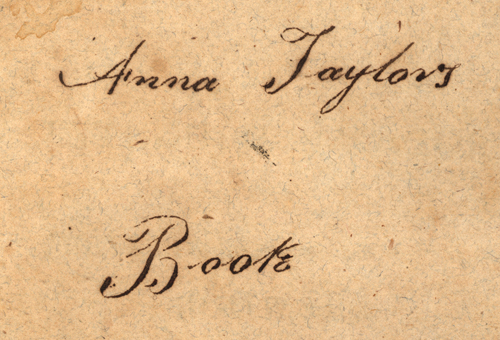
Interestingly, this copy is inscribed "Anna Taylor's Book" in a contemporary hand. So perhaps, this didactic tale was Anna Taylor's warning from her parents: give up your disobedience, sabbath breaking, swearing and whoring(!), before you are dragged off to hell.

And, on that happy thought, here is the text of the 1799 edition [ESTC: w26926; Evans, 36166].

* * * * *

The Prodigal Daughter; Or, A Strange and Wonderful Relation. Shewing, how a Gentleman of great estate in Bristol, had a proud and disobedient daughter, who, because her parents would not support her in all her extravagance, bargained with the devil to poison them. How an angel informed them of her design. How she lay in a trance four days; and when she was put into the grave, she came to life again, and related the wonderful things she saw in the other world (Hartford: Printed for the Travelling Booksellers, 1799).

The Prodigal Daughter; Or, The Disobedient Lady Reclaimed.

LET every wicked graceless child attend,
And listen to these lines that here are penn'd;
God grant it may to all a warning be,
To love their parents and shun bad company.
  No further off than Bristol, now of late,
A gentleman lived of a vast estate,
And he had but one only daughter fair,
Whom he most tenderly did love so dear.
  They kept her clothed in costly rich array,
And as the child grew up, for truth they say,
Her heart with pride was lifted up so high,
She fix'd her whole delight in vanity.
  Each sinful course did to her pleasant seem,
And of the holy scriptures made a game,
At length her patents did begin to see,
Their tender kindness would her ruin be.
  Her mother thus to her began to speak,
My child, the course you run my heart will break,
The tender love which we to you have shown,
I fear will cause our tender hearts to groan.
  Come, come, my child, this course in time refrain,
And serve the LORD now in your youthful prime,
For if in this your wicked course you run,
Your soul and body both will be undone.
  Laughing and scoffing at her mother, she
Said, Pray now trouble not yourself with me,
Why do you talk to me of heaven's joy?
My youthful pleasures all for to destroy?
  I am not certain what I shall possess,
After that I've resign'd my vital breath,
I nothing for another world do care,
Therefore I'll take my pleasure while I'm here.
  The mother said, my child, how do you know
How soon your pride into the dust may go?
For young as well as old to death bow down,
And you must die God only knows how soon.
  She from her mother in a passion went,
Filling her aged heart with discontent;
She wrung her hands and to her husband said,
She's ruin'd, soul and body, I'm afraid.
  Her father said, her pride I will pull down,
Money to spend no more, I'll give her none,
I'll make her humble before I have done,
Or else forever I will her disown.
  All night she from her father's house did stray,
Next morning she came home by break of day,
Her father he did ask her where she'd been?
She straightway answer'd What was that to him.
  He said your haughty pride I will pull down,
Money to spend of me you shall have none,
She said, if you deny me what I crave,
I'll fell my foul, for money I will have.
  Her father stripped her of her rich array,
And then he drest her in a russet grey,
And to her chamber he did her confine,
With bread and water fed her for some time.
  Altho' their hearts did ache for her full sore,
This course they took her soul for to restore,
But all in vain, she wanted heaven's grace,
And sin within her heart had taken place.
  One night as in her room she musing were,
The devil in her room did then appear,
In shape and person like a gentleman,
And seemingly he took her by the hand.
  He said, fair creature, why do you lament?
Why is your heart thus fill'd with discontent?
She said, my parents cruel are to me,
And keep me here to starve in misery.
  The devil said, if you'll be rul'd by me,
Reveng'd on them you certainly shall be.
Seem to be humble, tell them you repent,
And soon you'll find their hearts for to relent.
  And when your father he doth use you kind,
An opportunity you soon will find,
Poison your father and your mother too,
There's none will know who 'twas the fact did do.
  This wicked wretch quite void of grace and shame,
Seemed to be well pleased at the same,
She said, your counsel I'm resolv'd to take,
And be reveng'd for what they've done of late.
  Where do you live? pray tell me where to come,
That I may tell you when the job is done.
He said, my name is Satan, and I dwell
In the dark regions of the burning hell.
  At first she seem'd to be something surpriz'd,
But want of grace so blinded had her eyes,
She said, well sir, if you the devil be,
I'll take the counsel which you gave to me.
  But mind what wonders God does every hour,
His mercies are above the devil's power,
He will his servants keep both night and day,
From the devouring subtle serpent's prey.
  Next day, when she her father's face did see,
She instantly did fall upon her knee,
Saying; father now my wicked heart relents,
And for my sins I heartily repent.
  Her father then with tears did her embrace,
Saying, I'm blest for this small spark of grace,
That heaven hath my, child bestow'd on thee;
No more I'll use you with such cruelty.
  Unto her mother then straightway he goes,
And told to her the blest and happy news.
Her mother was rejoic'd then for her part,
Not knowing of the mischief in her heart.
  But the Almighty her designs did know,
And 'twas his blessed will it should be so,
That other graceless children they might see,
All things are done by heaven's great decree.
  The poison strong she privately had bought,
And only then the fatal time she sought,
To work the fall of these her parents dear,
Who'd brought her up with tender love and care,
  One night her parents sleeping were in bed,
Nothing but troubled dreams run in their head;
At length an angel did to them appear,
Saying, awake, and unto me give ear.
  A messenger I'm sent by heaven kind,
To let you know your deaths are both design'd,
Your graceless child whom you do love so dear,
She for your precious lives hath laid a snare.
  To poison you, the devil tempts her so,
She hath no power from the snare to go;
But God such care doth of his servants take,
Those that believe on him he'll not forsake.
  You must not use her cruel and severe,
For tho' to you these things I do declare,
It is to shew you what the Lord can do,
He soon can turn her heart, you'll find it so.
  Pray to the Lord his grace for to send down,
And like the prodigal she will return;
The fatted calf with joy you'll kill that day,
The angels shall rejoice in heaven high,
  Because a wretched sinner doth repent,
Who in vice and sin her time hath spent.
This pious couple then awoke we hear,
And soon the angel he did disappear.
  They to each other did the vision tell,
And from this time we'll mark her actions well,
And if this vision unto pass does come,
We'll praise the Lord for such great favors done.
  Next morning she rose early, as we hear,
And for her parents' breakfast did prepare,
And in the fame she put the poison strong,
And brought it unto them when she had done.
  Her father took the victuals which she bro't,
And down the same unto the dog he set,
Who ate the food and instantly did die;
The case was plain, she could not it deny.
  They call'd her there the sight for to behold,
Which when she saw, her spirits soon ran cold,
She cry'd, the devil hath me now deceiv'd,
I've miss'd my aim, for which I'm sorely griev'd.
  Her mother said, hard is the fate of me,
I've been a tender mother unto thee,
And can you seek to take my life away?
Oh graceless child! what will become of thee?
  With bitter pains my child, I did you bear,
I taught you how the Lord of life to fear,
Whole days and nights I did in labor spend,
To bring you up, now to my discontent.
  Quite void of grace you in your sins do run,
You flight my counsel after all I've done,
Instead of obedience which you ought to pay,
Your parents' lives you seek to take away.
  When thus she heard her tender mother speak,
She in a swoon did drop down at her feet,
With all the arts that e'er they could contrive,
They could not bring her spirit to revive.
  Four days they kept her, when they did prepare,
To lay her body in the dust we hear,
At her funeral a sermon then was preach'd,
All other wicked children for to teach,
  How they should fear their tender parents kind,
Their words observe their counsel for to mind,
And then their days will long be in this land,
All things will prosper which they take in hand.
  So close the Reverend Divine did lay
This charge, that many wept that there did stay
To hear the sermon, and her parents dear
Were overwhelm'd with sorrow, grief and care.
  The sermon being over and quite done,
To lay her body in the dust they come,
But suddenly they bitter groans did hear,
Which much surprized all that then were there.
  At length they did perceive the dismal sound
Come from the body just laid under ground;
The coffin then they did draw up again,
And in a fright they opened the same,
  When soon they found that she was yet alive,
Her mother seeing that the did survive,
Did praise the Lord, in hopes she would have time
And would repent of all her heinous crimes.
  She in her coffin then was carried home,
And when unto her father's house she come,
She in her coffin sat and did admire
Her winding sheet, and thus she did desire
  The worthy minister for to sit down,
And she would tell the wonders which were shown
Unto her, since her soul had took its flight:
She'd seen the regions of eternal night.
  She said, when first my soul did hence depart,
For to relate the story grieves my heart,
I handed was to lonesome wild desarts,
And briery woods, which dismal were and dark.
  The briars tore my flesh, the gore did run,
I call'd for mercy but I could find none;
But I at length a glimpse of light did spy,
And heard a voice which unto me did cry,
  Now sinful soul observe and you shall see
How precious does that light appear to thee?
But in the regions of eternal night
You never must expect for to see light.
  Now hasten to that light which does appear,
And there your sentence you shall quickly hear.
I hearing this did hasten then along,
At length unto a spacious gate I come.
  I knock'd aloud, but no one answer made;
At length one did appear to me and said,
"What want you here?" I answered to come in,
He ask'd my name then shut the gate again.
  He staid awhile then to the door did come,
He said be gone, for you there is no room,
For we have no such graceless wretches here,
That disobey their tender parents dear.
  I sorely wept, and to the man thus said,
Am I the first that parents disobey'd?
If all be cast in hell who thus do sin,
Few at this gate I fear will enter in.
  He said but you have been a sinner wild,
In things besides a disobedient child,
Swearing and whoring, sabbath breaking too,
Therefore be gone, for here's no rest for you.
  I said, Sir, hear me, and remember pray,
How holy David he did run astray,
A man whose heart once with the Lord did join,
Adultery and murder was his crime.
  He said, like David you did not return,
For he in ashes for his sins did mourn,
And God is merciful you well do know,
Free to forgive all those that humble so.
  I still my case with him pursu'd to plead,
And told him, Sir, in scripture I did read,
How Mary Magdalen, who here doth rest,
At once by many devils was possest.
  Go silly woman, he did answer then,
Had you so much lamented for your sin,
And mercy at your Saviour's feet implor'd,
For all your fins, he had your soul restor'd.
  I said in prison she her Saviour saw:
He said, you may behold him every day,
He ne'er leaves those that in his mercy trust,
He's always with the pious and the just.
  In holy scripture there he doth appear,
Read the apostles, and you'll find him there;
You mull believe, if that you sav'd will be,
That Christ for sinners died upon a tree.
  Then save me Lord, I to him did reply,
For I believe that Christ for me did die;
Lord let my soul return from whence it came,
And I will honour thy most holy name.
  A voice I heard, which said to me return,
But first behold the wretched place of doom,
Where the reward of sin is justly paid.
I turn'd about, but sadly was dismay'd.
  I saw the burning lake of misery,
I saw the man there that first tempted me,
My loving tender parents for to slay,
And he both fierce and grim did look at me.
  He told me he at last was sure of me.
I said, my Saviour's blood has set me free.
Then in a hideous manner he did roar,
When God my senses did to me restore.
  When thus the story she to them had told,
She said, put me to bed for I am cold,
And then these my tender parents dear,
Whom I will always honour while I'm here.
  To them the sacrament she did require,
They gave it her then as she did desire,
And now she is a Christian just and true,
No more her wicked vices doth pursue.
  I hope this will a good example be,
Children your parents honour and obey,
And then the Lord will bless you here on earth,
And give you crowns of glory after death.

FINIS.

[UPDATE: 2 July 2016: After all my pictures disappeared from this site (again) I decided to give up on external hosts for large versions (1000px) of my image files and, for now on, will stick with the smaller images (500px), which Blogger is prepared to host.]

Monday, 31 October 2011

Cazotte's The Devil in Love


Halloween seems like a good time to do a post on Jacques Cazotte's Le diable amoureux, Nouvelle Espagnole (Naples, 1772), which I am considering including in my Dark Hero unit next time it runs. There have been a few recent editions, one of which has just been reissued, so there should be no difficulty getting the text.

There were four separate translations of this work into English during the high Romantic period. These are:

[1] Alvarez, Or, Irresistible Seduction; A Spanish Tale (London: W. Richardson, 1791). ¶ ESTC: t226198 (recording 2 copies); on ECCO; “When I was five-and-twenty years old, I was a captain in the the King of Naples’ guards: we lived very sociably among ourselves …”

[2] The Devil in Love, Translated from the French (London: Hookham and Carpenter, 1793). ¶ ESTC: t71529 (4 copies); on ECCO; “At five and twenty I was a Captain of the Guards in the service of the King of Naples, and lived in gay society …”

[3] The Enamoured Spirit (London: Lee and Hurst, Bell, Millar and J. Wright, 1798). ¶ ESTC: t210676 (2 copies); not on ECCO; “At the age of five-and-twenty I was Captain in the Guards of His Majesty the King of Naples, and kept constant company with my brother officers”

[4] Biondetta, or the Enamoured Spirit (London: J. Miller, 1810). ¶ COPAC and WorldCat record 8 copies: L [1458.d.16] and O [Fic. 27524 e.164]; CaSRU [PQ 1961 C5 A6413 1810]; CtY [Hfd29 151N], DLC [PZ3.C3197 B FT MEADE], MH-H [*EC8 L5875 Y810c], PSt [PQ1961.C5A65 1810], ViU [PZ2.C39 B 1810]; “At the age of five and twenty I was a captain in the guards of the King of Naples.”

As you can see, most of these editions are quite rare.


In addition to these four translations between 1791 and 1810, there have been three modern editions, two of which are new translations:

[5] The Devil in Love (London: Heinemann; Boston and New York: Houghton Mifflin Company, 1925). Limited edition (UK: 75 copies; US: 365 copies) ¶ Reprints translation no. 2; available online on Europeana, courtesy of the Bodleian Library (direct link to PDF here)

[6] The Devil in Love, translated by Judith Landry (Dedalus, 1991; 2nd ed. 2011). ¶ “At the age of twenty-five I was a captain of the king's Guards at Naples; we kept our own company much of the time …”

[7] The Devil in Love. Followed by Jacques Cazotte: His Life, Trial, Prophecies, and Revelations by Gerard de Nerval, translated by Stephen Sartarelli (Marsilio, 1993). ¶ “At the age of twenty-five I was a Captain of the Guards in the service of the King of Naples. We lived much of our time …”


Unlike the English, the French have been producing beautifully-illustrated editions of Le diable amoureux since the start (the first edition is illustrated). I will have to get myself a copy of the poetic adaptation by "Gerard de Nerval" [Gérard Labrunie]:

Le diable amoureux, roman fantastique par J. Cazotte, Précédé de sa vie, de son procès, et de ses prophéties et révélations par Gerard de Nerval. Illustré de 200 dessins par Edouard de Beaumont (Paris, Léon Canivet, 1845).

The Beaumont illustrations were reprinted in 1871 by H. Plon and copies of that reprint are fairly common. But there are some stunning private-press editions from the twentieth century that I would like to get too, with illustrations by Paul-Émile Bécat (1936), Maurice Leroy (1946), André Michel (1950), Michel Jamar (1960), Jean Traynier (1966) and—undoubtedly—others.

According to Joseph Andriano, the most reliable edition of the French text is in Romanciers du XVIIIe siecle, edited by Etiemble et Marguerite du Cheyron, vol. 2 (Paris: Gallimard, Pleiade, 1965), 303–78. However, there are two other modern editions of the French text: those edited by Max Milner (Paris: Garnier-Flammarion, 1979) and Georges Décote (Paris: Gallimard, 1981).

* * * * *

As for why I would consider this novel for the Dark Hero unit … well, I was persuaded to do so by the chapter in Andriano's Our Ladies of Darkness: Feminine Daemonology in Male Gothic Fiction (1993), 10, which mounts a strong argument for The Devil in Love as the first conte fantastique: the first fantasy.

Nothing quite like Cazotte's work had appeared before, even though its temptation plot, with its prototype in the life of St. Anthony, was familiar to all Catholics. The text seems a curious hybrid of several popular genres of the time—contes licencieux, contes morales, contes defees—but it has long had the reputation of being the first of a new genre—le conte fantastique, not only in Todorov's narrow sense of reader hesitation but in a broader one: Cazotte simply added the mimetic techniques of realism, already apparent in some fabliaux and contes, to the marvelous. The result was an exquisitely ambiguous work in which a fairly ordinary young man is confronted with both the supernatural and the perfectly natural "realistic" problem of choosing a mate. Le Diable amoureux may also be considered Gothic in that term's broadest sense. It has the trappings—ruins, diabolism, sexual pursuit—and it gives a little frisson.
  With elements of all these genres Le Diable amoureux had something to please almost everyone: humor, light titillation, periodic chills, and moral messages. Only a thoroughly ambiguous work could provide such conflicting needs.


 UPDATE 13 December 2012: while searching through the New York Society Library's Hammond Collection I stumbled upon a New York edition of The Devil in Love from 1810. A search on WorldCat shows that I also missed Boston editions of 1828 and 1830. These three editions should have appeared above as nos.5–7, pushing the total number of editions to nine.

Although some of these American editions are available in microformat—the 1810 edition is on microopaque—I have not been able to look at any of them yet. Once I have, I will update the above list identifying the translations used in America. (Given the choice of title for the 1810 edition, it seems most likely that they are all reprints of no.2—the 1793 edition.)

[UPDATE 10 December 2014: added ESTC numbers, availability on ECCO, etext of no. 5, and call numbers of no. 4.]

[UPDATE: 2 July 2016: After all my pictures disappeared again I decided to give up on external hosts for large versions (1000px) of my image files and, for now on, will stick with the smaller images (500px), which Blogger is prepared to host.]

Sunday, 13 March 2011

Editions of Doctor Faustus

Now that the three copies of Marlowe's Doctor Faustus have arrived that I ordered a few weeks back I thought I'd do a post on them, and on all of the other editions that I have. As you can see, there are ten of them! (Just ignore Tydeman's Doctor Faustus: Text and Performance for now.) I will add a few details about each of them as I go through them.


Top row, from left:

[1] The Tragical History of Doctor Faustus, edited by Frederick S. Boas (London: Methuen and Co., 1932). From The Works and Life of Christopher Marlowe series.

[2] Marlowe, Tragical history of Doctor Faustus Greene, Honourable History of Friar Bacon and Friar Bungay, ed. Adolphus William Ward, 4th ed. (Oxford: Clarendon Press, 1901). ¶ Amazing introduction, excellent notes and contextualising primary material, obviously the criticism and bibliography are very dated; based on the A text, sensibly edited (except, apparently, it is silently bowdlerised!).

[3] Marlowe, The Plays and Poems (London: Simpkin, Marshall, Hamilton, Kent & Co., [1905]). Simpkin's Thin Paper Classics series. I only have this because I love these thin-paper editions.

Middle row, from left:

[4] Doctor Faustus: A 1604-version edition, ed. Michael Keefer (Peterborough, Ontario: Broadview, 1991).

[5] Doctor Faustus: The A-text, ed. David Ormerod and Christopher Wortham (Perth: University of Western Australia Press, 1985).

[6] Doctor Faustus, ed. John D. Jump (1962; rpr. London: Methuen, 1965). Revels Plays series.

[*] William Tydeman, Doctor Faustus: Text and Performance (Basingstoke, Hampshire: Macmillan, 1984).

Bottom row, from left:

[7] Doctor Faustus and Other Plays, ed. David Bevington and Eric Rasmussen (1995; rpr. Oxford: Oxford University Press, 2008).

[8] Doctor Faustus [Based on the A Text], ed. Roma Gill, rev. Ros King (2nd ed. 1989; rpr. London: Methuen, 2008). New Mermaids Series

[9] Doctor Faustus: A-and B-texts (1604, 1616), David Bevington and Eric Rasmussen (1993; rpr. Manchester: Manchester University Press, 1995). Revels Plays series.

[10] Doctor Faustus: A Norton Critical Edition, ed. David Scott Kastan (New York: W. W. Norton, 2005). ¶ Excellent on criticism, a useful bibliography; text and notes sensible; brief introduction.

I have been looking at the newbies (bottom row) in order to select a text for my Dark Hero course, but I have been progressively re-examining the others too. The only one that I haven't had a very close look at is the new Revels Plays edition [9], but it would have to be a lot more impressive than both the old Revels Plays edition [6] and the World's Classics edition edited by the same editors [7], in order to come close to the front-runner for my Dark Hero course: the Norton Critical Edition [10].

I prefer the text and introduction to the Ormerod and Wortham edition, though the actual notes to the text are not as extensive as most other editions. I also like the fact that the notes are on facing pages to the text. It is disappointing that more publishers do not adopt this approach, but the reason might be that it does limit what you can say. (Ward [2] has one hundred pages of notes on top of almost two hundred pages of Introduction and there are many places in the new Revels Plays edition [9] where the notes cover more of the page than the text. So, the convenient layout clearly wouldn't have worked for these editors.)

As I said, the Norton Critical Edition is front-runner. The introduction is very brief—a few pages—and the note on the editing of the text is spartan. Both are sensible and workmanlike, as is the editing. The value of this edition is in the convenience of having a sensible, if not ground-breaking version of the A and B texts, with all that ancillary material, including quite a few very important articles.

Any student with this book in hand, has enough to understand the academic debates about the play and could write a well-researched essay. With the best of the other editions, a student might come to understand most of the points of academic debate from one point of view (the view if the editor), and most of the textual issues, but they would have to go and find the articles which are in the Norton edition in order to get a more rounded understanding of the academic debates.

Still, the Norton edition lacks an account of religion and renaissance magic to match either the Ward [2] or Ormerod and Wortham [5] editions. But if, as I hope, some will students will really take to the play, perhaps they will also go looking for other editions until they find one that provides this sort of detail. (Don't tell me if you think I'm living in fantasy land.)

Sunday, 13 February 2011

Dark Hero Texts


I chose the editions—and some of the texts—for my new course, The Dark Hero [ATS2914/ATS3914] on the KISS-principle (i.e., keep it simple). So, they are all from the OUP World's Classics series. The upshot is, as you can see, that they make a very neat and pretty display.


The only problem is, I am already reconsidering this decision because Doctor Faustus and Other Plays (front text above) isn't very good. No doubt I am biased. I wanted to use Doctor Faustus: The A-text, ed. David Ormerod and Christopher Wortham (University of Western Australia Press, 1985), which is an excellent edition, but it is out of print.

Having re-read the play in the Ormerod and Wortham edition yesterday, I turned to the World's Classics edition this morning to see how it compared, and it compared poorly. I chose this edition, edited by David Bevington and Eric Rasmussen, because it contains both the A- and B-text versions of the play, which promised to be great for comparison, and other plays by Marlowe, which might encourage students to read others plays by Marlowe.

The problems is, the editors are pretty cavalier with the text, modernising, moving chunks around and imposing a 5-Act structure on both versions of the play, though there is no textual authority for doing so in any quarto. (See, the "Note on the Text," p. xxv and xxvii (here)). The introduction, to the life and times of Marlowe is wildly inadequate for a student, with gaping omissions, and the introduction to the plays in Marlowe's canon is brief and very uneven (excellent on Tamburlaine I and II, pretty good on The Jew of Malta and Faustus and pretty pathetic on Edward II).

And so, I have now ordered the New Mermaids edition (here), Norton Critical Edition (here) and the Revels Plays, New edition (here). The last of these is edited by Bevington and Rasmussen, but there is supposed to be a substantial introduction in this edition.

These three student editions of Doctor Faustus are all in the same price range as the World's Classics edition, though you get a lot fewer pages for your money. I am hoping that at least one of them is at least as good at the Ormerod and Wortham edition, demonstrating more respect for the text and including an introduction that compensates for the absence of Marlowe's other plays. We'll see …

[UPDATE: 2 July 2016: After all my pictures disappeared again I decided to give up on external hosts for large versions (1000px) of my image files and, for now on, will stick with the smaller images (500px), which Blogger is prepared to host.]

Wednesday, 15 December 2010

The Byronic Heroine

I finished reading Atara Stein's The Byronic Hero in Film, Fiction, and Television last night. And, well, I have to say I was very disappointed in the book. So disappointed I went looking for other reviews and—having not found one—wrote my own for Amazon (here and below). I wanted to be able to direct my students to a recent account of some pop-culture Byronic Heroes, but I am going to have to keep searching.

The main problem with this book is probably the inability of essentialist feminism to deal with characters who disrupt gender stereotypes, but the most obvious problem is the fact that Stein is never clear about who is responsible for either the characters and actions or responses she is making observations about.

Stein tends not to talk about authorial or directorial intention, she criticises characters and plots as if they came into being independent of authors, publishers, producers, studios etc and there is no discussion of genre expectations in cinema even, though the book is about genre expectation in literature. Stein also tends to be silent about reader/viewer response, though the essentialist arguments she quotes depend on this.

If a female character uses violence to protect herself, is she necessarily masculinised/de-feminised? If a character is briefly depicted in her underwear, is she necessarily feminised/sexualised/weakened? The critics quoted here believe, yes necessarily, and that the female character briefly depicted in her underwear is thereby shown to be vulnerable: that a (male) viewer cannot help but have a sexual response to this depiction, and that his response re-inscribes the character's position as object/victim of the viewing male.

The possibility is not considered that a female viewer may have a sexual response, a male may not have one, or that such a response from either a male or a female does not necessarily inscribe the character in a position as object/victim, that the fictional female concerned may be indifferent—in her fictional universe—to the response of others, seeks, welcomes or is empowered by the response or is perfectly capable of defending herself from any form of unwanted attention or aggression. In the context, some of these are even more implausible than the arguments that Stein presents, but the fact is that only one possibility is considered.

If we are not talking about the character's fictional universe, then the argument must be articulated that briefly depicting a female in her underwear cannot help but lead to a sexual response in viewing males, and that this response re-inscribes the position of all real women as object/victim. Again, the possibility is not considered that a female cinema-goer may be indifferent to the response of others, seeks, welcomes or is empowered by the response, or is perfectly capable of defending herself from any form of unwanted attention or aggression.

When I read this sort of criticism I find myself wanting to ask the writer: how is a fictional female to protect herself—as a female and in a way that does not inscribe her in a position as either object/victim or masculinised/de-feminised? In fact, how is a powerful fictional female to be depicted at all?

And how can any sort of feminist criticism value the male response (assumed to be sexual, and assumed to be violent and predatory) over the female one? Do a few seconds of (hetro-male) "fan service" negate the overwhelming Grrl-power message of a film? In the case of the Alien franchise, a Grrl-power message that was enthusiastically embraced and has subsequently reappeared many times over. Is the ultimate argument, that the good these film do over-balanced by the evil that they perpetrate?

Stein's answer seems to be yes, the good is over-balanced. Which brings me to Stein's broader argument: that escapist cinema makes film-viewers into drones who are more obedient and accepting of their lot, that escapist cinema drains our collective bile. That the portrayal of characters like Ripley is intended to re-inscribe conventional gender roles and keep women passive/weakened.

The problem is, this argument really only works if you can establish that characters like Ripley are either intended to be, or are perceived to be, unappealing, or that their fate is either intended to be, or are perceived to be, an object lesson in how not to behave. Since neither the intentions of the film-makers (broadly considered) nor the response of the film goers (broadly considered) are considered at all then Stein's argument simply cannot be successful. She does not even articulated her argument this clearly.

* * * * *

My Amazon review:

First up: this book is *full* of typos, outrageous ones, ones that every text-editing program (like Word) would pick up. This suggests that nobody at SIUP was paying any attention when this book went to press … which may explain how this book got published at all in its present form.

I am intensely interested in this topic, so I found the first couple of chapters useful, even though I disagreed with many of the arguments and claims.

However, I was simply bored by the sections on The Crow and Anne Rice’s vampires, and bored to tears by the sections on Neil Gailmon's Dream and Star Trek's Q. The chapters on these characters do not have a clear over-arching argument and there is no over-view of the characters and plot-lines, just an endless series of observations, some of which are contradictory, some of which are implausible or wrong-headed, and many of which are simply repetitive.

The wost section is undoubtedly the one I was most interested in -- the one I bought the book for -- on the Byronic Heroine. Stein wants to mount a feminist argument against the Terminator and Alien films, but seems unsure how to do it, so she simply attacks the film from every direction and quotes -- approvingly -- some of the asinine arguments I have ever read.

The nadir is reached on pages 199 and 200 where Sarah Connor, from the Terminator films, is criticised because she "emulat[s] her culture's icon of heroic behaviour: the violent male outlaw …. It does not occur to her to adopt a creed of nonviolence." (199) [Well, *that* would be a short action film!] And when Ellen Ripley, from the Alien films, returns to her hyper-sleep-bed-thing at the end of one film, we are informed that this brief glimpse of her in her underwear:

[1] re-feminises her;
[2] makes her “a vulnerable sex object”;
[3] and therefore “a potential victim for men”; a potential realised in the mind of one critic
[4] who fantasises “sexual violence can bring the uppity Ripley down” and therefore concludes
[5] that the scene is intended as “a warning to female viewers.”

That’s right: simply show that you have legs and you inscribe yourself as an inevitable rape victim. Apparently this message is so loud and clear that the simple act of showing Ripley’s legs drowns out the you-go-girl message implicit in depicting a woman who has saved herself (and human kind) by single-handedly annihilating a nest of the most terrifying aliens ever imagined.

Oh, and note that these two films are related (thematically?) to Catherine from Wuthering Heights and Eustacia from The Return of the Native. I believe the phrase is “drawing a long bow.”

Whatever merit some of these arguments have—and as a card-carrying feminist I do agree with some of the observations on inscribing gender—it annoys me to see such sloppy thinking, contradictory, implausible or wrong-headed arguments, masquerading as “feminism.”

I will not be recommending this book to my students.

Saturday, 13 November 2010

The Faust Tradition

Study Guides, Essays and Notes


Faust. This site has it all: sections on the Legend of Faust, Books, Music, Theatre, Art, Film, Games

See also Cummings study guide

Prose Faust Texts, Chapbooks etc. in English

The history of the damnable life, and deserved death of Dr. John Faustus. Newly printed, and in convenient places, impertinent matter amended, according to the true copy, printed at Frankford; and translated into English, by P.R. gent. (London: Printed by C. Brown; for M. Hotham, at the Black Boy on London-bridge, and sold by the booksellers, [ca. 1700]) in Early English Prose Romances, edited by William John Thoms (London: Nattali and Bond, 1858), vol. 1, 151–300. [Wing H2156]

The Second Report of Doctor Iohn Faustus, containing his appearances, and the deedes of Wagner. VVritten by an English gentleman student in VVittenberg an Vniuersity of Germany in Saxony. Published for the delight of all those which desire nouelties by a frend of the same gentleman. (London: Printed by Abell Ieffes, for Cuthbert Burby, and are to be sold at the middle shop at Saint Mildreds Church by the stockes, 1594) in Early English Prose Romances, edited by William John Thoms (London: Nattali and Bond, 1858), vol. 1, 302–414. [STC 10715]

The History of Dr. John Faustus: Shewing how he sold himself to the devil, … Also, strange things done by him, and his servant Mephistopholes. With an account how the devil came for him, and tore him to pieces (Derby: Printed in the year, 1787)

History of DR. FAUSTUS Shewing His wicked Life and horrid Death, and how he sold himself to the devil, to have power for 24 years to do what he pleased, also many strange things done by him with the assistance of MEPHISTOPHELES. With an account how the Devil came for him at the end of 24 years, and tore him to pieces (n.d. [18C?]) in Amusing Prose Chap-Books, Chiefly of Last Century, edited by Robert Hays (London: Hamilton Adams, 1889), 286–98.

Marlowe's Faustus

Christopher Marlowe, The Tragicall History of the Life and Death of Doctor Faustus, [A1, the 1604 quarto text] edited by Alexander Dyce (London, mid-19C).

Christopher Marlowe, The Tragicall History of D. Faustus [A text] ed. Hilary Binda (2010?)

Christopher Marlowe, The Tragical History of the Life and Death of Doctor Faustus, [B1, the 1616 quarto text] edited by Alexander Dyce (London, mid-19C).

Christopher Marlowe, The Tragedie of Doctor Faustus [B text] ed. Hilary Binda (2010?)

Other British Faust texts

William Mountfort, The Life and Death of Doctor Faustus, Made into a Farce, in Six Plays, Written by Mr. Mountfort, 2 vols. (1720)

Goethe's Faustus

Faust, in the original metres, Translated by Bayard Taylor (pre-1878).

Faust Parts I & II (2003). A complete translation by A. S. Kline, with line numbers, and full stage directions.

Other European Faust texts

Historia vnd Geschicht Doctor Johannis Faustj des Zauberers An edition in German (with a translation into English) by Prof. Harry Haile, University of Illinois, based on the Wolfenbüttel Manuscript (1580s).

Das Volksbuch von Dr. Faust (um 1580)

[UPDATED 18 June 2013]

Thursday, 21 October 2010

The Dark Hero, Books, Links etc

This page will be my dumping ground for links and comments as I trawl the net in preparation for my Dark Hero course. A proper web-log = blog!

This page on the The Norton Anthology of English Literature site was my inspiration for the course. Or, at least, it was the one that suggested to me that I might be able to establish a course that focusses on the "Satanic and Byronic Hero": that there were sufficient resources to do it and that it could be justified in academic terms. (Although, I decided it would be best to use the term "Dark Hero" rather than "Satanic Hero": there is no point frightening the horses, is there?) This is how the page begins …

Not until the age of the American and French Revolutions, more than a century after Milton wrote Paradise Lost, did readers begin to sympathize with Satan in the war between Heaven and Hell, admiring him as the archrebel who had taken on no less an antagonist than Omnipotence itself, and even declaring him the true hero of the poem.

* * * * *

This site by Brouke M. Rose-Carpenter for a fifth-year unit (LITR 5535: American Romanticism) at University of Houston-Clear Lake seems like a great starting point.

I like this list of Byronic characteristics:

1. A rebel
2. Does not possess the usual “heroic virtues”
3. Dark Qualities
4. Larger than life
i. Intellectual capacity
ii. Self respect
iii. Hypersensitivity
5. Moody by nature
6. Struggles with integrity
7. Distaste for social institutions and social norms
8. Exiled, outcast, or outlaw
9. Cynical
10. Loner
11. Passionate about a particular issue
12. Emotional
13. Rebels against life itself
14. Arrogant
15. Confident
16. Troubled past
17. Often characterized by some unknown sexual crime
18. Extremely conscious of himself
19. A figure of repulsion, as well as fascination

I also liked the list of Byronic characters she has collected

Cain, Genesis
Odysseus
Romeo, Romeo and Juliet
Satan, Paradise lost
The Flying Dutchman
The Wondering Jew
Rochester, Jane Eyre
Heathcliff, Wuthering Heights
Conrad, The Corsair
Childe Harold
Giaour, The Gaiour
Manfred Astarte,
Ancient Mariner, Rhyme to the Ancient Mariner
George Vavasor, Can you forgive her?
T.J. Swift, Stranger in her Bed

Bruce Wayne, Batman
Gabriel Van Helsing, Van Helsing
Corbin Dallas, The Fifth Element
The League of Extraordinary Gentlemen
Captain Jack Sparrow, Pirates of the Caribbean
Professor Snape, Harry Potter’s
Hell boy, Hellboy
William Wallace, Brave heart
John Smith, Mr. and Mrs. Smith
Any character, X-men
Shrek, Shrek’s
Ranger, The Stephanie Plum series
Lucivar, Saetan, and Daemon, The Black Jewels Trilogy and Dreams Made Flesh

Better still, the Byronic heroine

Nikita, La femme Nikita
Xena, Xena: The Warrior Princess
Lara Croft, Tomb Raider
Jane Smith, Mr. and Mrs. Smith
Surreal, The Black Jewels Trilogy, & Dreams Made Flesh
Domino Harvey, Domino
Le-lo, The Fifth Element

I don't think that Le-lo is a Byronic heroine, and both Lara Croft and Jane Smith seem to be simply action heroes. Still, it is a start.

* * * * *

As for books: it looks like this is the best recent coverage of the Byronic hero-type, although after only six years the focus on Angel and the absence of more recent figures makes the book seem a little dated.

Atara Stein, The Byronic Hero in Film, Fiction, and Television (2004) is a must. Unfortunately, it is not held at Monash (*sigh*) and so I will have to order it … but it looks good on Google books.

* * * * *

Most of the links on this page (The Faust Tradition from Marlowe to Mann) are dead, but I expect most are still somewhere online, so I will try to recreate the live links here soon.

Tuesday, 19 October 2010

A Chapbook History of Dr. Faustus


This chapbook History of Dr. Faustus was published in Glasgow in the 1840s. It was published as a part of a series, along with such classics as The Sleeping Beauty of the Wood, The History of Jack and The Bean-Stalk,, The History of Beauty and the Beast, History of Jack the Giant Killer, The Story of Blue Beard and about 150 others. As you can see above, this is number 119. If I wasn't paying off two rather pricey Haywood items, I would buy either this large collection, or this smaller one.

The full title is:

History of DR. FAUSTUS Shewing His wicked Life and horrid Death, and how he sold himself to the devil, to have power for 24 years to do what he pleased, also many strange things done by him with the assistance of MEPHISTOPHELES. With an account how the Devil came for him at the end of 24 years, and tore him to pieces.


The full text appears in Amusing Prose Chap-Books, Chiefly of Last Century edited by Robert Hays (London: Hamilton Adams, 1889), 286–98. But I read it in John Ashton, Chap-books of the Eighteenth Century with facsimiles, notes, and introduction (London, Chatto and Windus, 1882), which—in typical fashion—has been scanned by Google Books but is not available online. I have given the first three chapters below.


I bought this little chapbook as a prompt to get me started on my reading for the new course I am preparing on the Dark Hero—not that you need an excuse to buy a chapbook like this. The course will start with Marlowe's "Doctor Faustus" and will probably end with Byron's "Cain".

In fact, most of the texts in between simply track a path between these two key texts. I am considering spending more than one week on Faustus. I wanted to read the play as soon as I heard about it, and loved it as soon as I read it, but I also loved the Faustbook and the chapbook version that I have read in Ashton, so I am tempted to include these too. All I have to do is come up with an excuse to include them…

* * * * *

Chapter I. Dr. Faustus’ birth and education, with an account of his falling from the Scriptures.

Dr. John Faustus was born in Germany. His father was a poor labouring man, not able to bring up his son John; but he had a brother in the same country, who was a very rich man, but had never a child, and took a great fancy to his cousin, and he resolved to make a scholar of him; and in order thereunto, put him to the Latin school, where he took his learning extraordinary well. Afterwards he put him to the University to study divinity; but Faustus could in no ways fancy that employment; wherefore he betook himself to the studying of that which his inclination is most for, viz., necromancy and conjuration, and in a little time few or none could outstrip him in the art. He also studied divinity, of which he was made Doctor; but within a short time fell into such deep fancies and cogitations that he resolved to throw the Scriptures from him, and betake himself wholly to the studying of necromancy and conjuration, charms and soothsaying, witchcraft, and the like.

Chapter II. How Dr. Faustus conjured up the Devil, making him appear at his own house.

Faustus, whose mind was to study conjuration, the which he followed night and day, he took the wings of an eagle, and endeavoured to fly over the world, to see and know all the secrets of heaven and earth; so that in a short time he attained power to command the Devil to appear before him when he pleased. One day as Dr. Faustus was walking in a wood near to Wurtemberg, in Germany, he having a friend with him who was desirous to know of the doctor’s art, he desired him to let him see if he could then and there bring Mephistopheles before him; all which the doctor immediately did, and the devil upon the first call made such a noise in the wood as if heaven and earth would have come together; then the devil made such a roaring as if the wood had been full of wild beasts. The doctor made a circle for the devil, the which circle the devil ran round, making a noise as if ten thousand wagons had been running upon paved stones. After this it thundered and lightened, as if the whole world had been on fire. Faustus and his friend, amazed at this noise, and the devil’s long tarrying, thought to leave his circle; whereupon he made him such music, the like was never heard in the world. This so ravished Faustus that he began again to conjure Mephistopheles in the name of the prince of the devils to appear in his own likeness; whereupon in an instant hung over his head a mighty dragon. Faustus calls again after his former manner, after which there was a cry in the wood as if hell had opened, and all the tormented souls had been there. Faustus, in the meanwhile, asked the devil many questions, and commanded him to show many diabolical tricks.

Chapter III, How Mephistopheles came to Dr. Faustus’ house, and what happened between them.

Faustus commanded the spirit to meet him at his house byten of the clock the next day. At the hour appointed he came into his chamber asking Faustus what he would have. Faustus told him it was his will and pleasure to conjure him to be obedient to him in all points of those articles, viz.: —

First, That the spirit should serve him in all things he asked, from that time till his death.

Secondly, Whatsoever he would have, he should bring him.

Thirdly, Whatsoever he desired to know, he should tell him.

The spirit answered him and said he had no such power of himself, until he had acquainted his prince that ruled over him. “For,” said he, “we have rulers over us that send us out, and command us home when they please; and we can act no further than our power is, which we receive from Lucifer, who, you know, for his pride, was thrust out of heaven. But,” saith the spirit, “I am not to tell you any more except you make yourself over to us.”

Whereupon Faustus said, “I will have my request? but yet I will not be damned with you.” Then said the spirit, “You must not, nor shall not have your desire, and yet thou art mine, and all the world cannot save thee out of my hands.” Then said Faustus, “Get thee hence, and I conjure thee that thou come to me at night.” The spirit then vanished. Faustus then began to consider how he might obtain his desire, and not give his soul to the devil.

And while Faustus was in these his devilish cogitations night drew on, and this hellish spirit appeared to Faustus, acquainting him that now he had got orders from his prince to be obedient to him, and to do for him whatsoever he desired, provided he would promise to be his, and withal to acquaint him first what he would have of him? Faustus replied that his desire was to become a spirit, and that Mephistopheles should be always at his command; that whatsoever he called for him, he shall appear invisible to all men, and that he should appear in what shape he pleased, to which the spirit answered that all his desires should be granted if he would sign those articles he should wish or ask for. Whereupon Dr. Faustus withdrew and stabbed his wrist, receiving the blood in a small saucer, which cooled so fast, as if it forewarned him of the hellish act he was going to commit; nevertheless he put it over embers to warm it, and wrote as follows: —

“I, John Faustus, approved doctor of divinity, with my own baud do acknowledge and testify myself to become a servant to Lucifer, Prince of Septentrional and Oriental, and to him I freely and voluntarily give both soul; in consideration for the space of twenty-four years, if I be served in all things which I shall require, or which is reasonable by him to be allowed; at the expiration of which time from the date ensuing, I give to him all power to do with me at his pleasure; to rule to retch and carry me where he pleases body and soul. Hereupon I defy God and Christ, and the hosts of angels and good spirits, all living creatures that bear his shape, or on whom his image is imprinted; and to the better strengthening the validity of this covenant and firm agreement between us, I have writ it with my blood, and subscribe my name to it, calling all the powers and infernal potentates to witness it is my true intent and meaning. JOHN FAUSTUS.”


[UPDATE: 2 July 2016: After all my pictures disappeared again I decided to give up on external hosts for large versions (1000px) of my image files and, for now on, will stick with the smaller images (500px), which Blogger is prepared to host.]

Sunday, 11 July 2010

The Dark Hero: Demonic, Deranged and Cursed

On Thursday I was told that my new unit, The Dark Hero: Demonic, Deranged and Cursed, has been approved to run next year at Monash. It has a new Arts-faculty-wide unit code: ATS2914/ATS3914.

I have wanted to run a course like this for a very long time. One of my favourite honours courses at the University of Tasmania was The Byronic Hero, but the particular type of Byronic-Hero stories that have always attracted my attention are the ones with a supernatural element: Marlow's Faustus, Milton's Satan, Beckford's Vathek, Byron's Cain.

When I was a teenager I lived on a constant diet of fantasy and horror stories, books on witchcraft and the occult, and Hammer Horror films, so I ended up reading Stoker's Dracula and Goethe's Faust as soon as I had enough of my own money to buy them.

From memory, both were second-hand copies from the Dennis Wheatley Library of the Occult series, which were pretty common, and cheap, in op-shops, garage sales and book exchanges at the time.

I had quite a few "Library of the Occult" volumes at one stage, before I went to university and decided I was far too mature for that sort of thing. And, since I always needed more book-money, I decided to sell the lot. I don't remember what I spent the money on, but it is a decision I soon, and have long, regretted!

I recently started buying replacement copies of some of the paperbacks that I sold then, but the books are a lot harder to find and a lot more expensive now. (Which reminds me of that saying "no man is rich enough to buy back his past.") The images below are taken from one such recent—nostalgic—purchase; appropriate, yes?


* * * * *

The type of "Dark Hero" that my new course focusses on is everywhere in modern fiction, film and TV: David Boreanaz as Angel (Buffy the Vampire Slayer (1997–2003) and Angel (1999–2004), Johnny Depp as Dean Corso (The Ninth Gate (1999), the whole League of Extraordinary Gentlemen (2003), Heath Ledger as The Dark Knight (2008) and Ian Somerhalder as Damon Salvatore (The Vampire Diaries (2010), but you could include almost every supernatural romance and romantic vampire hero in this list.

But the focus of my unit is on the ur-texts, the Dark Heroes of the Early Modern, Modern and Romantic periods. The synopsis runs as follows:

The unit is designed to introduce students to the development of the Dark or Satanic Hero in a range of major English texts selected to illustrate the tremendous impact and popularity of this powerful figure in the Romantic Period. Writers such as Marlow, Milton, Beckford, Lewis and Byron created defiant heroes who embody radical individualism, self-sufficiency and ambition, but who are isolated, gloomy and dissatisfied by their revolt against God, government and society. Special attention will be given to the relationship between the Dark and Byronic Heroes in the nineteenth century and the survival and transformation of this figure in the vampires and villains of contemporary culture.

I haven't decided on the final text list yet. There are a few I haven't read that I am considering, like Charlotte Dacre's Zofloya: or The Moor (1806) and Charles Maturin's Melmoth the Wanderer (1820); there is also a lot of poetry to choose from, apart from Byron's “Manfred” (1816–17) and “Cain” (1822), like Bürger’s “Lenore” (1773); Goethe's “The Bride of Corinth” (1797); Coleridge’s “The Rime of the Ancient Mariner” (1798) and “Christabel” (1797–1800), and Keats' “La Belle Dame sans Merci” (1819). Narrowing down the list will be a real challenge. But fun. Lots of fun.

[UPDATE: 2 July 2016: After all my pictures disappeared again I decided to give up on external hosts for large versions (1000px) of my image files and, for now on, will stick with the smaller images (500px), which Blogger is prepared to host.]