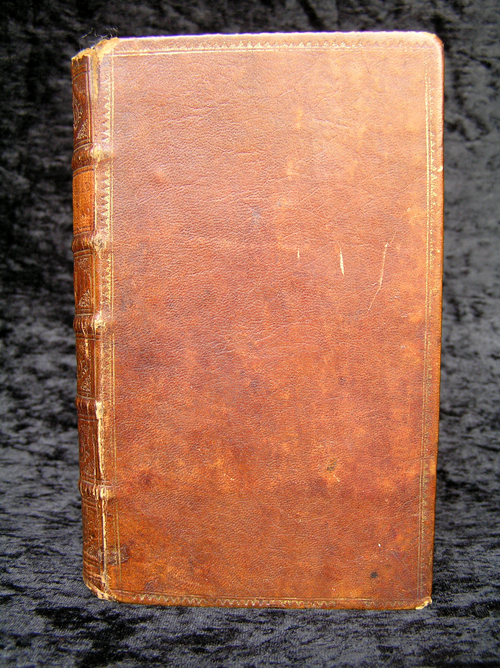
Monday, 17 August 2009

John Buncle, Junior, Gentleman, 1776

The first two chapters of Thomas Cogan's John Buncle, Junior, Gentleman (1776) feature an interview between the fictional author, the hero of the story, and two booksellers. John Buncle takes his manuscript to each in turn. The discussions which follow are an amusing—and revealing—satire on publishing and bookselling in the 1770s.

A copy of this book was digitized by Google from the library of the University of Michigan. I have edited the scrambled OCR against the page-images and converted the text to HTML for publication here. I will publish the second half of this text next week. [I have now done this, see here]

Title Pages, and Editions.

Parva leves capiunt animos
Ovid. Ars. Amor.

——but then
These little things are great to little men.

[Chapter 1] Title Pages.

But what’s your Title, sir, your Title? cries the first dealer in science to whom I applied, the moment the MSS. was put into his hands.
  You see, “John Bungle, junior.”
  With a significant pish, he declared it was too simple, much too simple; it would never take.
  Why not? says I, it will distinguish mine from every other publication; and let its merits do the rest.
  Merits! This is just the stile of a young author! Why, sir, tell me, in the name of common sense, can the merits of a book ooze themselves into the first page, or sweat thro’ the binding? Your’s is a title that says nothing; and therefore cannot possibly display its merits, supposing it possessed any.
  I was going to reply, but he saved me the trouble by continuing his harangue.
  “Is not this an age, Mr. Buncle, in which every man, who would make his way in the world, will take care not to conceal the least shadow of merit that may belong to him? Will a tradesman be contented with having the choicest assortment of goods in his shop, without tempting the eye with an exhibition at the window? Do not our news-papers, and advertisements in every corner of the streets, abound with such descriptions of vendible commodities, as may best allure men to purchase? Are not their advantages, their beauties, their elegancies carefully displayed, from a noble man’s villa, to your patentee blacking-cakes? from your superb hotels at the polite end of the town, to a twopenny lodging in Broad St. Giles’s? from your refined academies, which profess to give human nature its last polish, to a night-school, where reedin and spellin is carfuly taut? In a word, is not every thing upon a large scale? Do you not see great choice of goods promised, where you can scarcely meet with a single sample? The best Coniac, and Wines neat as imported, at every gin-shop? The Warehouse for shoes and boots inscribed upon every cobler’s stall?’ [sic, for ”]
  ‘But Literary productions, sir, are superior to such mean arts.’
  He laughed heartily at my simplicity. “You pretend to describe men and manners, forsooth! Why, sir, they are fully as necessary here, as in any other article put up to sale.” He assured me, that many an excellent treatise, to his knowledge, was sunk down to everlasting oblivion, merely by the dead weight of its title-page: and that as to himself, he had rather be concerned in the worst performance that ever reeked from the brain of a Dunce, artfully set off with a name that possesses some secret grace to attract the public notice, than in the works of the most towering Genius, ushered into the world with a flat, tame, insipid appellation. “When I was green in the businesses, sir, I tried the experiment: I entered into the humour of the author, simply announced the publication to the world, and as simply depended upon its merits for success.—But it would not do.—They were a drug upon my hands; and might have remained so to this day, had I not wiped off their dust, vampt them up with a new title-page, that was either interesting or pleasing, and sent them forth from our ark, never to return, thank heaven. If it was not in their nature to soar high in reputation, or fly to the most distant parts of the earth, I have often lent them wings strong enough to carry them fluttering thro’ an edition or two, in spite of all the sands, bogs, and hillocks, which would otherwise infallibly have stopped their course.”
  This naturally excited my curiosity to know a little more of the secrets of his art: and as he was in a talkative mood, he readily gratified it.
  “In some cases, said he, the merit is entirely our own; in others, the authors themselves shew so much ingenuity in this way, that the whole forte of their book seems to lie in its title.
  “When we publish the works of an author, whose name is up, as we phrase it, then indeed we dress them out in the plainest garb imaginable, prudently reserving our ornaments for those who stand more in need of them. The History of England, by Rapin de Thoïras, Philosophical Essays by David Hume, the Works of Alexander Pope, Dryden, Swift, &c. sufficiently recommend themselves; and in these cases, we love to shew how much we scorn to make use of little puffing arts, in order to impose upon public credulity.
  “Again, if an author has not yet arrived to so great a degree of eminence, why we charitably hope the best, as in your case; and by a spirit of prophesy,—which I confess sometimes fails us—we announce him to the world as the Ingenious, the Learned, the Celebrated, carefully displaying all his titles and offices, down to the chaplainship of a regiment; if they appear either posts of honour or of intelligence.
  “These bays we generally reserve for Historiographers, Biographers, writers of voyages and travels, and the rest of the troops that are in our own pay, Mr. Buncle.
  “In slight summer readings, consisting of cursory remarks, light essays upon trite subjects, private histories, novels, romances, pieces of poetry, &c. address is peculiarly requisite: and here, to confess the truth, authors share the bays with us at least. These publications are to be devoured immediately—like a morning-paper, or a hot-roll—or they are not worth a button. In these cases we take no pains to make the Title of the book agree with its contents—quite the contrary—The less we reveal, the better chance of a sale—Our business is to catch the attention, which alone can be done by exciting curiosity; and this again by keeping people in the dark. We therefore make choice of some quaint but insignificant phrase, or curious antithesis, which, without revealing any thing, is calculated to set your superficial readers alonging. Titles of this sort are admirably adapted to Circulating libraries: every pretty Miss sends for them with impatience, and reads them with avidity. I could give you a list of them as long as my shop.

  Something New.
  Did you ever see such damned Stuff?
  Agreeable Ugliness.
  Beauty put to its Shifts.
  The happy Extravagant.
  Each Sex in their Humour.
  Witty Extravagant.
  Happy Repentance.
  Happy Unfortunate.
  Lucky Disaster.

  “Alliteration again, succeeds incomparably well in fictitious names and titles, and saves an author’s wit for the inside of his book. As for example:

  Adultery Anatomized.
  Benjamin Bernard.
  Betsy Biddle.
  Betty Barnes.
  Country Cousins.
  Devil Dick.
  Female Falsehood.
  Fortunate Foundling.
  Frederic the Forsaken.
  Jemmy Jessamy.
  Merry Medley.
  Sally Sable, &c. &c.

  “Where a performance, on the contrary, is rich in materials, and we are not ashamed of our goods, we generally take care to let the world know it. The title-page now becomes a downright chapter of contents; exhibiting, like a broker’s shop, such a variety of articles to the view of the spectator, that the deuce is in it if none of them will catch him.
  When all these methods fail, and we can not get our ware off our hands”—
  ‘—You curse the author, I suppose, for a blockhead, or the world, for its want of discernment; and sit down contented with your gains upon more fortunate productions.’
  “No, not yet. We have still another card to play: which is such a master-stroke of policy, that the inventor ought to have a statue erected to his memory in Stationer’s Hall.
  “What think you, sir, of reprinting the first page of a book, that has not been asked for a dozen times, and boldly calling it the Second Edition, corrected and improved?[”]
  ‘What think I? that it is a direct falshood, and a gross imposition upon the public.’
  “Hush, hush! take care how you abuse your friends—You may stand in need of the assistance yourself, ere it be long. It is true, we had rather they would save us this trouble: but if they cannot be prevailed upon to read for their edification, it is no fault of ours; and why, in the name of justice, should the loss fall upon us? Besides, sir, if, by this artifice, we make mankind wiser and better, which is the undoubted tendency of all our publications, I think, in my conscience, it is a fib well spent.”
  ‘Were I to allow of this curious casuistry, Mr. Editor, I should still doubt of the efficacy of the means; for if the first edition has nothing in it to engage the public attention, its being called a second or a twentieth, cannot make it a whit the better book.’
  “That’s true, sir, but it makes it appear the better, and this is enough for us. You must know that the generality of purchasers never trust to their own judgment in the books they buy. Some people have no opinion of a work till it has gone through two or three editions: and would scorn to disgrace their shelves with the first impression of a Locke, a Pope, or a Milton. Others again, do not desire to be wiser than their neighbours, and yet hate that their neighbours should be wiser than themselves. The sight of a second edition makes these gentry presently ashamed, and they run to our shops with numberless apologies for their inattention. In a word, sir, there are thousands who would have nothing to do with a book that does not seem to take, though it were written by the pen of inspiration; and if it takes, they will have it at all events, though too plainly penned with a goose quill.”
  ‘But to return, Mr. Editor, to this little production of your humble servant. What name would you advise me to give it?’
  “Why, faith, I don’t know. It is such a heterogeneous performance, that I can scarcely tell what to do with it. There is a share of merit in it, and it is too good for my common-place ones, and yet none of my best will fit it, I fear. However, my catalogue of virgin titles is not quite exhausted, I believe.—We will run it over, and see what we can find.”
  ‘Virgin titles! what do you mean?’
  “Why, sir, a man’s inventive faculties are not always at home; when they are, he ought to use them. I often set myself down, when I am in a happy mood for composition, and invent a set of names, for productions, long before they exist.—They are sure to come into play one time or other—”
  He was turning to the word Sentiment:—but I checked his hand.—‘Though to possess genuine sentiment, said I, be the characteristic of every virtuous and sensible heart, yet at this delicate æra of British refinement, when every Cook-maid talks sentiment, and every Porter boasts of his sensibility, the word is become so wretchedly prostituted to subjects void of sentiment, that it must soon be thrown off amongst the exploded phrases. Positively, it begins to sound as disgusting in my ears as ’tis great, very great, immensely great, applied to Breslaw’s tricks with a leg of mutton; or ’tis clever, amazingly clever, infinitely fine, referring to a boy beating minuets upon his chin.’
  “Well then, let us look amongst the miscellaneous articles. Here is

  The Miscellaneous Traveller.
  Yet another Traveller.
  Something Newer.
  The Mental Don Quixote.
  The Spiritual Light-horse-man.
  The Moral Hussar.
  Truth wrapt up in a Falsehood.
  A regular History of a Roving Mind.
  A Word to the Wise, and a Scourge to the Unwise.

Or, if you like our Alliteration better; what think you of calling yourself,

  Billy Buncle.
  Chearful Chatterer.
  Lively Loiterer.
  Talkative Traveller.
  Prating Philosopher.

  It must absolutely be something in that stile.”
  ‘’Tis hard, quoth I, very hard, that after an author has carefully skimmed the cream of his thoughts to regale the public, he must be obliged to inscribe Asses Milk to be sold on the Postern.’
  This unlucky expression offended my gentleman so greatly, that he turned from me without uttering another word; and wishing him a good day, I departed.

[For Chapter 2, see here]

Tuesday, 11 August 2009

The Other Betsy Thoughtless, Part 2

Rather than providing a detailed analysis of the other Betsy Thoughtless (concerning which, see my first post here), I have have decided to simply make the text available. I have scanned and corrected the OCR-text from the Grove Press reprint. The text is long (4,235 words), but since it is a pain to keep pdf's available online, I am posting it here anyway.

Betsy Thoughtless.

You fleering harlot, I'll have a horse to leap thee, and thy base issue shall carry thee, and thy base issue shall carry sumpters.—Come, lords, bring her along: we’ll to the prince all, where her hellhood shall wait his censure;—and if he spare thee, she-goat, may he lie with thee again! and beside, mayst thou lay upon him some nasty foul disease, that hate still follows, and his end a dry ditch! Lead, you corrupted whore.
  Cupid's Revenge.
    Beaumont and Fletcher.

  I became acquainted with this lovely girl during my visit to Cheltenham. She is the daughter of a rich commoner in the West of England, and we soon formed an intimacy of the sweetest and most agreeable kind. She was in her eighteenth year, with a form and face seldom equalled: her hair was of a lively brown, her skin perfectly white, and her face full of ardour and beauty. I discovered her secrets very soon after my introduction, by the recital of a warm and very libidinous story, which I read in the French, and which I pretended to have witnessed. This won her confidence, and she confessed that she been seduced by a young gentlemen, a protégé of her father’s.
  I lent the beautiful creature some luscious prints, tastefully executed, and which made her almost mad, as she had never seen anything of the kind before. In return for the these, which I afterwards gave her, she promised me, in writing, and memoir of the circumstances and causes of her seduction, and I cannot do better than give it in her own words:

To Miss WILSON.

My dear friend,

'Tis well that I am alone, for I blush to the ears in making a confession, even to you, of the wanton and naughty scenes which led to the first indulgence of my passions;—passions the most ardent and glowing; but which, I am happy to say, have met with a corresponding feeling in those of my lover;—but to my tale.
  A youth had been brought up by my father from infancy. He was called my brother; and though we frequently remarked the want of likeness between us, and other circumstances, no suspicion that he was not my brother ever entered our minds until a few months since. This youth bore our family name; was called Tom Thoughtless; was educated by my father liberally, and a midshipman’s berth was obtained for him. In progress of time he became a lieutenant, and in that capacity, full of life, full of health and beauty, and at the glowing and impetuous age of nineteen, returned from a long station and came to see us.
  Whether Tom had had any intimation of our non-relationship, I know not, but when he took me in his arms, his embrace was impetuous and boisterous, though tender: he dwelt upon my lips with a fervour, that made me thrill all over. He sucked my lips, he grasped my form to his, sighed, breathed short, and seemed full of emotion. Lord! what a tremor and flutter I was in; so new was the character of this embrace. “Oh, Betsy,” said he, full of agitation, “you are the first I woman I have held in my arms for five years.”—“Am I indeed?” I replied, scarcely knowing what I said. I fluttered dreadfully and felt quite overpowered. So new was all this, and so much awakened my passions. I lay back in his arms: he put my ringlets away from my forehead, and kissed my brow, my eyes, and my mouth. Oh! what unhallowed kisses I then thought them; flames wantoned through me and seemed to centre in one spot;—that spot which we keep so sacred, and which had scarcely been visited by my curious touch. “Oh! Betsy,” said he, “that we were not related. Let me at least for a moment indulge the sweet, the blissful idea. “I knew not what he purposed, but he thrust his tongue between my lips—it was in my teeth—upon my tongue. This motion so strange, so unexpected, almost took away my breath. I tried to speak—to cry out. Alas! I could not, my feelings choked me. His right hand had been round my waist; he dropped it to my posteriors; be felt them three or four times through my dress, then carried me to the side of the room, against which he placed me. His body was now against mine; his knee separated my limbs; he stood between them as far as my garments would allow, and began heaving by short tilts his body against mine.
  I cannot describe what I felt; I thought I should faint through excess of delight. This heaving motion continued; it made me mad; I—I—how shall I confess it?—I followed his example, and met his bobs with eager activity, sighing and crying out all the time, “Oh! Tom, Tom, my dear fellow, what are you doing?” But he evidently knew not; he was completely absorbed, and kept wriggling the middle of his person against mine, and I intuitively followed his example—so seductive is passion. In the midst of this I felt him gradually lifting up my clothes: a cold shudder communicated this to me; the next moment a looking-glass, that stood in a recess opposite to where we stood, revealed to me our shaking clothes and agitated persons. In this I saw that my legs were uncovered and part of my thighs!
  This alarmed me dreadfully, and I immediately seized his hands, full of blushes and confusion, and burning with passion, exclaimed: “Tom, what are you doing? The servants will come in, we shall be discovered.” I slipped from before him, and at the same moment heard my father's voice, giving some directions. He very shortly after entered the apartment.
  I will pass over the emotions this interview occasioned, though I dreamt that Tom was my husband, and was happy in my arms. My waking thoughts were of this dear fellow, and so impassioned were they, that I kicked down the bed-clothes, and pulling up my shift, all the lower beauties of my limbs lay open. I said to myself, "Ah? here is a pair of legs handsome enough, and a couple of round plump thighs; there is a good sprinkling of curl about this mount; but what an unmeaning thing is this slit! Can this be what the men hunt us poor women for? I can easily imagine that man has something divine for us: something delightful to feel, to grasp, to handle, to look at. Oh! that I had it now—that it was just dividing these glowing, but opening lips. Tom, look at me—you want to deflower me—I know you do. Cone then, I am ready to receive you—put it in—there, I feel it (and I pushed in my finger). Now it entered—Oh I how delicious—push, push—Tom, my dear fellow—Oh! I feel it—there, there.” With such expressions as these, and in working my fingers upon that susceptible spot we all possess, I soon dissolved in a flood of lascivious joy.
  I dressed myself with peculiar care, and was complimented by my dear Tom on my good looks and beauty. After breakfast he proposed a walk, and I eagerly put on my bonnet, and taking his arm, proceeded through the park, in which my father's house stands. “We were both in high spirits, and enjoyed each other's society. In passing a cottage, which belonged to the estate, we heard bustle and cries, and through the broken palings discovered the cottager's wife in pursuit of her daughter, a full grown girl. She caught her near where we were peeping, and putting her left foot on a washing tub, which was reversed, she pulled the girl across her knee, and drew" from under her apron a birch rod; in a moment the girl's clothes were all gathered up, and her legs and limbs sprawling in the air. Her person was beautifully formed, and her skin particularly white, and rendered more so by her having on black worsted stockings. Not a moment was lost by the enraged mother, who began to flog away at the girl's posteriors like a fury, the violence of which might be seen by the redness which followed the strokes. The girl twisted and kicked about, but was obstinately silent, and after having received about twenty severe strokes, her petticoats were put down by her mother, who exclaimed, "There, that will teach you to stay on your errands, and then tell lies to excuse it.” She left the girl; but chancing to turn her head before entering the cottage she observed the girl making faces at her. Roused by this, she darted at the girl, who was in a moment on her knee, and her clothes again flung up. The eagerness of the mother made her drop the rod, and we had time to inspect the glowing bottom of the girl, the cheeks of which were red with the recent punishment. The mother, mad with passion, now began to switch away at the thighs and buttocks of the girl; and it was evident that she made more impression, for the girl began to entreat for forgiveness; but the mother was inexorable: she kept rattling away without mercy, and after whipping her, for I am sure full a minute, till her bottom was the colour of crimson, flung her down and quitted her, saying. “You'll make faces at your mother again, you young harlot, I dare say."
  Oh! how this scene affected me; it roused my passions to a pitch of frenzy, and had we at that moment been in a place of greater privacy, and I had been solicited, I should have fallen a victim to the excitement. I walked with my impassioned companion, who, after some artful interrogatives, drew from me an avowal, that I had not only enjoyed the whole of the scene we had witnessed together, but should dearly like to have been the administrator of the punishment if it had been inflicted on a girl so pretty as Sally Meadows. We returned home. My father was out, and Tom asked me to show him my boudoir, which my father had praised for its taste the evening before. Ah! how pleased was I to do anything to give the dear fellow amusement or delight. He praised my taste in the disposition of the furniture and general arrangement; spoke of my drawings, the beautiful shrubs which adorned the large balcony of the only window in the room. “How beautiful,” he exclaimed, “how elegantly planned!, what ample admirable chairs for courting, and what a voluptuous sopha.” He came to me, and kneeling close by me, pressed me in his arms. A voluptuous languor crept over me; he saw it, and drew down my face to his; he rapturously kissed my mouth, and when I least expected it, his impassioned tongue burst between my lips. What an electric thrill did this produce! I was absolutely filled with passion; but think, my dear Miss Wilson, what was my surprise when he produced from under his coat the identical rod with which the cottager's wife had whipped Sally Meadows. The sight of it made me giddy: I knew not what I did: I felt him lay his body across my thighs, his coat-flaps were thrown up, his trousers were entirely down, and nothing covered his naked posteriors but his shirt. His putting the rod into my hand had brought me to my senses. “Oh! Tom,” said I, “it must not be—I dare not proceed—do not ask me.” He canted up his shirt, so as to leave his naked flesh entirely exposed to my view. “My dear Betsy,” said he, “don't baulk your wishes, you said you should have been glad to change places with the flogger this morning—gratify me—indulge yourself—we are alone—treat me as a truant—think me an idle boy that deserves chastisement.”—“Don’t look at me then," I said. He promised: I took the rod and began to exercise it gently on his white buttocks. Oh! the delightful sawing through the air, the whisking sound as it met his flesh, the knowledge that his breeches were down, that the secret staff of life was lying on my limbs—kept from my naked flesh only by my garments. All this conspired to fill me full of the most unchaste wishes.
  “Do I hurt you, my sweet fellow?” said I, in a voice of extreme tenderness. “No, my love; use more strength—strike with more nerve—Ah! there—that's it—that's it, my sweet Betsy.” He now laid more in front of me, and I felt him falling in between my opening knees. As my clothes were down I did not heed this; indeed, my active strokes of the birch had changed the colour of the flesh cushions, and I entered fully into the spirit of the adventure. He kept jolting his person in front of mine, at every motion of the rod, and I, to hold him more secure, had worked myself nearer to him, and close to the edge of the sopha. One of his arms was round my waist, the other grasped me lower down; my clothes, by his working gradually, got higher, which he seemed to be aware of, for his workings increased, and his long strokes pushed them higher at every heave of his body. My strokes upon his bottom continued, and I found myself cutting him without mercy. Oh I what a delirium I was in: he was now entirely between my open thighs—they expanded to admit him—Oh! I shall never forget the moment—new, intoxicating and delirious. Something hard pressed against my thighs, then against my belly: it kept repeatedly bobbing against the most sensitive part of my body. I thought he was debauching me: I seemed to feel that he was really entering my—I had not power to prevent him; indeed, I found that I was spreading myself out, jutting up my body, and doing everything that I thought would facilitate his purpose.
  I lost all sense of shame and of propriety: I urged him not to delay my happiness, that I was ready, and would bear anything for his sake. This I accompanied by an eager imitation of his motions. I met his thrusts: we went on in regular cadence: the rod fell from my nerveless grasp; my arms intuitively embraced his naked back: I cried, sighed, and fell back in a state of insensibility. I recovered: he was just in the act of getting from off my body. I now felt confused indeed, and jumped up and made my escape in the greatest disorder into my bed-room.
  Ignorant as I then was of man, I really believed that my virginity had been taken, and having bolted the door, I sat in a chair facing the looking-glass. I pulled up my clothes, and was surprised to find a very large portion of my shift completely wetted in front. This indeed, had saved me. I looked at the wet-with amazement and exclaimed, “What a quantity—I am quite flooded—what an inundation—Heavens! if this had been deposited within my person!” This thought, which at first alarmed me, inflamed me more on consideration; and amid a thousand extravagancies, I eagerly proceeded to obtain all the gratification within my own reach. When my intoxication had ceased, I found it necessary to change my linen, and I accordingly dressed for dinner, taking as much pains with my person as possible, for which I was again rewarded by the extravagant encomiums of the young sailor. When we were alone, he took occasion to remark that my father had informed him that he wished to have a conference with him before dinner on the morrow, as he had something of importance to communicate.
  The morrow arrived; my dear fellow was at my side, and he again led me blushing and trembling to the boudoir. I had reassured myself into the supposition that he would not proceed to extremities with me, from fear of consequence, our fancied relationship, and from his pausing yesterday on the very threshold of happiness, and this made me bold, though excess of passion kept me weak and trembling. He again produced the rod; I tried to persuade him not to proceed. He heeded me not, but put down his trousers. He [w]as kneeling on the sopha where I was sitting. He brought both my legs upon the sopha, against which proceeding I remonstrated, but could not prevent him. He now drew off his trousers, and kneeling between my legs, leaned forward to kiss me. It was impossible for me not to see his shirt bolstering out in front of him, and my imagination was instantly at work. His soul-thrilling kiss set me in a blaze. He seemed to wish to uncover my neck: the removal of my neckerchief and half-a-dozen buttons undone behind, not only enabled him to lay my bosom entirely bare, but my shoulders also. He made the most wanton observations on their whiteness, size and beauty; called them a most charming pair of pouting bubbies, and said, he had no doubt my hidden beauties were equally voluptuous and desirable; but what could exceed my surprise and admiration, when he pulled up his shirt, and discovered to me that monstrous thing, about which I had so often dreamt and agitated myself, of a thickness and length perfectly frightful, as it stood in all its pride and stiffness. I devoured its shape, head and appendages, as it started in convulsive throbs before me. He then tumbled me backwards—I had not the power to resist him, though I fell that he was lifting up all my garments and exposing my most secret parts. An exclamation of joyful surprise broke from him, as he caught a view of my person. My native modesty had made me close my limbs, which were now perfectly naked, but his hands opened them to their fullest extent, in spite of entreaties. “How can you now, Tom, use me so? It’s quite a shame to expose my person in this way.”—“I must, my dear, dear sister,” said he. “What a bright, transparent skin! What beautiful legs! what round, white, soft, fleshy and voluptuous thighs! what a rough and hairy concern you have got here!”—“Really, Tom, you are too bad; you make my face burn like scarlet,” and I put both my hands over the spot he had named. They were soon, however, pulled off, and I found his fingers busily opening the hot and fiery cell of my virginity. I could not prevent him—I lay fluttering like a wounded partridge—the victim of lust. If I looked up, the truncheon of love was throbbing before me, and rendered me perfectly reckless of any consequences. Enjoyment I wanted; and I facilitated all his endeavours for that purpose, He placed a cushion under me—I was completely exposed to his touch:-he opened the lips of the virgin slit; he touched the sensitive nerve; he laid down upon my body, and dividing the lips of my moss-rose, lodged the head of his capacious instrument between them. I still thought he meant to go no further; he put his arms round me—I clung eagerly to him, and abandoned myself to the transports of the moment. We kissed each other with fervour unceasingly. “Have you ever been enjoyed, my sweet girl?” said he. “Oh! never,” said I. “Why cannot we give each other pleasure?—you are ready for the amorous conflict—I am maddening for it. My instrument is throbbing against your eager avenue. Let me enter, my sweet girl—let me push it in but a short way.”—“Ah, no, no,” I exclaimed, “cannot you be satisfied to do as yesterday?”—“Oh! Betsy,” said he, “can I witness your impassioned look?—Can I look at these throbbing breasts heaving with desire, and not feel emotion?—Can I know that I am now standing stiffly, ready for the encounter, placed at the very entrance of the portal of love, and that portal a virginity?—no, no, impossible. I must—I must, by heavens—must put it in!” A gentle movement of his bottom sent the instrument lip deep; another, and the head was in; a third, I found opening the rose leaves of my pucelage. He was on the high way to happiness; I felt him every instant making more way, penetrating by inches. He hurt me, but I heeded it not—I was maddened, intoxicated, and felt ready for sacrifice. He had placed me so advantageously for his purposes that his most trifling movement told. I felt distinctly the fibres of his instrument as he advanced and drew back. He kept up a short and steady rocking motion, which provoked passion, and made me, in spite of myself, reply to his movements. Oh I with what rapture did I meet his thrusts! How loud were my sighs! how ardent my expressions of delight! “Oh, heavens!” I exclaimed, “what pleasure. This is beyond my hopes—beyond my expectations. Oh! Tom, my dearest Tom, I will ever love you; do you love me, are you gratified?” Kisses long and ardent followed these expressions, whilst the mighty engine kept working its way within me. I felt that the narrow limit was filled: I felt the head of the instrument distinctly: I still kept up, working my loins to meet him, and had flung my head back and shut my eyes, to enjoy the full swing of the imagination. “Are you fainting, my sweet?” said he, “are you dissolving?”—“No, my dear Tom,” I returned, hiding my face in his shoulder, “but I think I soon shall” He began to move faster—I kept pace with him—our movements were violent. I cried, laughed and sighed by turns, as I fell the intoxicating moment coming with furious haste upon me. “Oh!” said he, “my love—Betsy—my queen-sister—love—I am coming—I am coming—Oh! there!” At this instant I found shot into my very vitals that hot liquid, so maddening to the female—so exquisite in its administration; but so fatal in its consequences to the unmarried. I shrieked as the boiling juice was spouted into me: another followed; but before I had received a third, I had lost all remembrance of the scene in an hysterie.
  Upon my recovering, I found myself silting upright in the arms of Tom. My clothes were down certainly, but my bosom was entirely bare, and my hair, having got loose from the comb, hung over my naked shoulders, and I was in dreadful disorder. I threw my arms round the dear fellow’s neck, and sobbed upon his bosom, for my heart was full of the tenderest love for him. I wished him to leave me alone, and he kindly complied, kissing me with a fervour that re-kindled my desires; had he pressed it, I should again have yielded—I feel I could refuse him nothing.
  I went to my bedroom, and there found it would be necessary to change my chemise—lord! lord! how it was marked—the whole story of my virginity might be read upon its tail.
  When I had dressed I went down to dinner, and learned with sorrow that Tom had been sent by my father to a neighbouring town, to bring some papers from his lawyer. This evening I passed in a feverish impatience, for he came not. He returned to breakfast in the morning. We met like lovers after a long separation. During the morning I was in my boudoir, when my father entered, leading in my sweet ravisher. I could perceive from the countenance of each that something of importance had passed between them, and my father undertook to explain the cause to me. “My sweet child,” said he, “you are now come to years of discretion, and I ought to explain a secret which, for motives not now necessary to give you, I have kept from your knowledge. Tom is not my son; but the child of an old college friend, whose finances were exhausted by play. You have hitherto looked upon him as your brother; perhaps, in a year or two you could prevail upon yourself to accept him as a husband, for I mean to share my fortune between you.” I could hear no more—I sunk into the extended arms of Tom, who kissed me again to life. When I came to myself, I turned my eyes on my fascinating seducer. “Did I hear aright? are we, indeed, strangers in blood?” A long kiss that half recovered me was the reply. We reeled to the couch—we both sunk upon it. I drew up my clothes (think how shocking that was!) to be ready. He was in the act of unbuttoning his trousers, when it occurred to me that the door was not fastened, and that papa might return. I told Tom of it; he hastened to bolt it, when he luckily heard some one coming: he gave me the signal; I jumped up, adjusted my clothes, and with a pair of old scissors began to trim the flowers in the balcony. My father entered, and was delighted to see me so completely recovered: the rest of the day he spent with us. what need I say more. My dear Miss Wilson? but during the happy fortnight or his stay, every moment we could pass in secret was devoted to passion. He left me only for a short time; he is to return next month, when I am to be a bride, and Tom is to go to sea no more. Think, my dear friend, how my young heart beats for that moment:—think of my impassioned dreams. I go over repeatedly all we have done together, and feel that I must love this dear fellow for ever.

I remain, my dear friend,
  Yours very faithfully,
    Elizabeth Thoughtless.

March, 1839.

Friday, 7 August 2009

Catalogue of a Circulating Library, 1760

George Colman's imaginary "Catalogue of a Circulating Library" is prefixed to his satirical attack on novel-reading: Polly Honeycombe, A Dramatick Novel of One Act. As it is Now Acted at the Theatre-Royal in Drury-Lane (London: T. Becket and T. Davies, 1760), ix-xiii; ESTC: t44027 (not online; but see here for the 3rd ed. (1762).

While Colman's "Catalogue" of 182 novels is imaginary, the books listed are not (contrary to the claims of the only two people* who have discussed the list). It includes six works by Haywood (nos. 30, 46, 73, 109, 120, 148, 173), and seventeen works that I list in my Checklist of Eighteenth-Century Erotica.

It is a shame that the "Catalogue" hasn't attracted more attention; perhaps the problem is that the text is hard to find. At one time I was planning an edition of the play and an annotated list of the books mentioned. Instead I am simply going to publish it below with a challenge to anyone to identify a novel that is not real (that is, cannot be found on ESTC, ECCO or in the Burney collection of 18C newspapers). I have even added numbers to make it easier for you.

* The two people are Austin Dobson, "Polly Honeycombe" in Eighteenth Century Vignettes (1896), 83–103 [raw OCR text here]; first published in National and English Review 25 (1895): 623–31. The second person—who really only mentions it in passing—is Paula R. Backscheider, "Fashioning Novels, Novelizing Fashions" in Eighteenth-Century Genre and Culture: Serious Reflections on Occasional Forms; Essays in Honor of J. Paul Hunter (Newark: University of Delaware Press, 2001). [See also Update note at the foot of this entry]

BTW: Colman writes, “I shall … conclude my preface with an Extract from the catalogue of one of our most popular circulating libraries; from which extract the reader may, without any great degree of shrewdness, strain the moral of this performance …" (viii). The “Extract” is in two columns, starting ix, col.a. For ease of reference I include page and collum divisions.

1. Accomplished Rake, or the Modern Fine Gentleman.
2. Adventures of Miss Polly B—ch—rd and Sam. Tyrrel, Esq.
3. Adventures of Jerry Buck.
4. Adventures of Dick Hazard.
5. Adventures of Jack Smart.
6. Adventures of Lindamira, a Lady of Quality.
7. Adventures of David Simple.
8. Adventures of a Turk.
9. Adventures of Daphnis and Chloe.
10. Adventures of Prince Cleremont and Mad. de Ravezan.
11. Adventures of Mr. Loveil.
12. Adventures of Joseph Andrews.
13. Adventures of Hamilton Murray. [ix, col.b]
14. Adventures of a Rake.
15. Adventures of a Cat.
16. Adventures of a Black Coat.
17. Adventures of Frank Hammond.
18. Adventures of Mr. George Edwards, a Creole.
19. Adventures of a Valet.
20. Adventures of Capt. Greenland.
21. Adventures of Roderick Random.
22. Adventures of Peregrine Pickle.
23. Adventurei of Ferdinand Count Fathom.
24. Agenor and Ismeaa, or the War of the Tender Passions.
25. Amelia, by Mr. Fielding.
26. Amelia, or the Distressed Wife.
27. Amours of Philander and Sylvia, or Love-Letters between a Nobleman and his Sister. [x, col.a]
28. Amorous Friars, or the Intrigues of a Convent.
29. Antigallican, or History and Adventures of Harry Cobham.
30. Anti-Pamela, or Feigned Innocence Detected.
31. Apparition, or Female Cavalier; a Story founded on Facts.
32. Auction.
33. Beauty put to its Shifts, or the Young Virgin's Rambles, being several Years’ Adventures of Miss * * * * in England and Portugal.
34. Bracelet, or the Fortunate Discovery; being the History of Miss Polly * * *.
35. Brothers.
36. Bubbled Knights, or Successful Contrivances; plainly evincing, in two Familiar Instances lately transacted in this Metropolis, the Folly and Unreasonableness of Parents Laying a Restraint upon their Children’s Inclinations in the Affairs of Love and Marriage.
37. Card.
38. Chiron, or the Mental Optician.
39. Chit-chat, or a Series of Interesting Adventures.
40. Chrysal, or the Adventures of a Guinea, with curious Anecdotes.
41. Clarissa, or the History of a Young Lady; comprehending the most Important Concerns of Private Life, and particularly shewing the Distresses that may Attend the Misconduft both of Parents and Children in Relation to Marriage. [x, col.b]
42. Cleora, or the Fair Inconstant: An Authentick History of the Life and Adventures of a Lady, lately very Eminent in High Life.
43. Clidanor and Cecilia, a Novel, designed as a Specimen of a Collection, adapted to form the Mind to a just way if thinking, and a proper Manner of behaving in Life.
44. Clio, or a Secret History of the Amours of Mrs. S—n—m.
45. Cry, a Dramatick Fable.
46. Dalinda, or the Double Marriage.
47. Devil upon Crutches in England, or Night Scenes in London.
48. Emily, or the History of a Natural Daughter.
49. Fair Adultress.
50. Fair Moralist.
51. Fair Citizen, or the Adventures of Charlotte Belimour.
52. Fanny, or the Amours of a West Country Young Lady.
53. Female Foundling; shewing the Happy Success of Constant Love, in the Life of Mademoiselle D— R—.
54. Female Rambler, or Adventures of Madam Janeton de ***.
55. Female Banishment, or the Woman Hater.
56. Female Falsehood.
57. Fortunate Villager, or Memoirs of Sir Andrew Thompfon.
58. Fortune-Teller, or the Footman Innobled.
59. Friends, a Sentimental History.
60. Gentleman and Lady of Pleasure's Amusement, in Eighty-eight Questions, with their Answers, on Love and Gallantry. To which are added, the Adventures of Sophia, with the History of Frederick and Caroline. [xi, col.a]
61. Henrietta.
62. Hillory of Charlotte Villars.
63. History of Miss Kitty N—, containing her Amours and Adventures in Scotland, Ireland, Jamaica, and England.
64. History of Barbarossa and Pollyane.
65. History of Two Persons of Quality.
66. History of Lavinia Rawlins.
67. History of two Orphans, by W. Toldervy.
68. History of Henry Dumont, Esq. and Miss Charlotte Evelyn; with some Critical Remarks on Comic Actors, by Mrs. Charke.
69. History of Benjamin St. Martin, a Fortunate Foundling.
70. History of the Life and Adventures of Mr. Anderson.
71. History of Honoria, or the Adventures of a Young Lady; interspersed with the History of Emilia, Julia, and others.
72. History of Betty Barnes.
73. History of Jemmy and Jenny Jessamy.
74. History of Dicky Gotham and Doll Clod.
75. History of Fanny Seymour.
76. History of Sophia Shakespeare.
77. History of Sir Charles Grandison.
78. History of a Young Lady of Distinction.
79. History and Adventures of Frank Hammond.
80. History of Jasper Banks.
81. History of J. Trueman, Esq. and Miss Peggy Williams. [xi, col.b]
82. History of Sir Harry Herald and Sir Edw. Haunch.
83. History of Will Ramble, a Libertine.
84. History of Miss Polly Willis.
85. History of my Own Life.
86. History of Lucy Welleri.
87. History of a Fair Greek who was taken out of a Seraglio at Constantinople.
88. History of Hai Ebor Yokdhan, an Indian Prince.
89. History of the Human Heart, or Adventures of a Young Gentleman.
90. History of Charlotte Summers.
91. History of Cornelia.
92. History of Tom Jones, a Foundling.
93. History of Tom Jones in his Married State.
94. History of two Modem Adventurers.
95. History of Sir Roger, and his Son Joe.
96. History of Miss Sally Sable.
97. History of Mira, Daughter of Marcio.
98. History of Amanda, by a Young Lady.
99. History of a Woman of Quality, or the Adventures of Lady Frail.
100. History of Pompey the Little, or Adventures of a Lap-Dog.
101. History of Wilheimina Susannah Dormer.
102. History of Porcia.
103. History of the Countess of Dellwyn.
104. History of Ophelia.
105. History of the Marchioness de Pompadour, Mistress to the French King, and first Lady of Honour to the Queen. [xii, col.a]
106. History of Tom Fool.
107. History of the Intrigues and Gallantries of Christiana, Queen of Sweden.
108. History of Jack Connor.
109. History of Miss Betsy Thoughtless.
110. Histories of some of the Penitents in the Magdalen-House.
111. Jilts, or Female Fortune Hunters.
112. Impetuous Lover, or the Guiltless Parracide; shewing to what Lengths Love may run, and the Extreme Folly of Forming Schemes for Futurity.
113. Intriguing Coxcomb.
114. Journey through every Stage of Life.
115. Juvenile Adventures of David Ranger, Esq.
116. Juvenile Adventures of Miss Kitty Fisher.
117. Lady’s Advocate, or Wit and Beauty a Match for Treachery and Inconstancy; containing a Series of Gallantries, Intrigues, and Amours, Fortunate and Sinister; Quarrels and Reconciliations between Lovers; Conjugal Plagues and Comforts, Vexations, and Endearments; with many Remarkable Incidents and Adventures, the Effects of Love and Jealousy, Fidelity and Inconstancy.
118. Ladies’ Tales.
119. Life and Adventures of Miranda.
120. Life’s Progress, or the Adventures of Natura.
121. Life and Adventures of Joe Thompson. [xii, col.b]
122. Life of Harriot Stuart.
123. Life of Patty Saunders.
124. Life and History of a Pilgrim.
125. Life and Adventures of Sobrina.
126. Life of Corporal Bates, a Broken-hearted Soldier.
127. Life Life and Adventures of Coll. Jack.
128. Life and Adventures of James Ramble, Esq.
129. Life of Charles Osborn, Esq.
130. Life of Mr. John Van.
131. Life and Opinions of Miss Sukey Shandy, of Bow-Street, Gentlewoman.
132. Love and Friendship, or the Fugitive.
133. Lydia.
134. Marriage Act.
135. Memoirs of the Countess of Berci.
136. Memoirs of Fanny Hill.
137. Memoirs of a Man of Quality.
138. Memoirs of the Life of John Medley, Esq.
139. Memoirs of a Coxcomb.
140. Memoirs of the Shakespeare’s Head Tavern.
141. Memoirs of the Celebrated Miss Fanny M—.
142. Memoirs of B— Tracey.
143. Memoirs of Fidelio and Harriot.
144. Memoirs of Sir Tho. Houghson and Mr. Joseph Williams.
145. Memoirs of an Oxford Scholar.
146. Memoirs of a Young Lady of Quality.
147. Memoirs of the Noted Buckhorse.
148. Memoirs of a Certain Island. [xiii, col.a]
149. Memoirs of a Man of Pleasure.
150. Memoirs of a Young Lady of Family.
151. Memoirs of Sir Charles Goodville.
152. Modern Characters Illustrated by Histories.
153. Modern Lovers.
154. Modern Story-teller.
155. Mother.
156. Mother-in-Law.
157. Nominal Husband.
158. New Atalantis for the Year One Thousand Seven Hundred and Fifty-eight.
159. New Atalantis for the Year One Thousand Seven Hundred and Fifty-nine.
160. New Atalantis for the Year One Thousand Seven Hundred and Sixty.
161. Pamela.
162. Polydore and Julia.
163. Prostitutes of Quality, or Adultery a la Mode; being Authentic and Genuine Memoirs of Several Persons of the Highest Quality.
164. Reformed Coquet.
165. Revolutions of Modesty. [xiii, col.b]
166. Rival Mother.
167. Rosalinda.
168. Roxana.
169. School of Woman, or Memoirs of Constantia.
170. Sedan, in which many New and Entertaining Characters are introduced.
171. Sisters.
172. Skimmer.
173. Sopha.
174. Spy on Mother Midnight, or F—’s Adventures.
175. Stage Coach.
176. Temple-Beau, or the Town-Rakes.
177. Theatre of Love, a Collection of Novels.
178. True Anti Pamela.
179. Widow of the Wood.
180. Zadig, or the Book of Fate.
181. Zara and the Zarazians.
182. Zulima, or Pure Love.

[UPDATED 21 October 2017: since 2009, Polly Honeycombe has been briefly noticed by David A. Brewer, "Print, Performance, Personhood, Polly Honeycombe," Studies in Eighteenth-Century Culture, 41, no. 1 (2012): 185–94; and by Amelia Dale, in her University of Sydney Beauchamp Literary Prize essay "Dramatic extraction and Polly Honeycombe's &c. (2012), a revised version of which appeared as "'Acting It as She Reads': Affective Impressions in Polly Honeycombe," in Passions, Sympathy and Print Culture, edited by H. Kerr, D. Lemmings and R. Phiddian (London: Palgrave Macmillan, 2016), 165–82.]

Wednesday, 5 August 2009

Edmund Curll in The Grub Street Journal

The Grub Street Journal, or Memoirs of the Society of Grub-Street, “operated as a kind of serialized Dunciad” (Paul Baines, Pat Rogers, Edmund Curll, Bookseller (2008), 216). It repeatedly, and amusingly, attacked Edmund Curll for publishing smut: Issue no. 4 (29 January 1730) contains a fictional application from “Kirleus” for the position of Bookseller to the Society of Grub-Street, the election is discussed in no. 15 (16 April 1730) and in no. 24 (18 June 1730) it is reported that “Kirleus,” dissapointed at missing out on this post, has attached the Society in the Daily Journal on 23 May.

The election in no. 15 is debated in three speeches, by Orthodoxo, Pruriento and Pamphleteero. The best of these, the arguments of Pruriento, are supposed to be self-evidently sophistical; but they are, perhaps, too clever by half, because some of the arguments appear perfectly reasonable to a modern eye! Since this essay isn’t available online I have corrected the OCR of the Google Books reprint of 1737 for your entertainment.

No 15. Thursday, April 16. [1730]

Faciet lucrum bibliopola Tryphon. Mart. Epig. L. xiii. Ep. 3.
Die Mercurii, Ap. 15, 1730.

THIS day having been appointed for the election of a book-seller, there was a very numerous appearance at the Pegasus. Many letters from book-sellers in all parts of the town were read; which, being written in a very different stile, and spelt after a different manner, yielded great variety of diversion to the society. As the Letter of the great Curlus, published in our 4th Journal, was much superior to all the rest; so the party which appeared for him seemed to be so: who thought they had secured his election, by putting up against him a person, who, tho’ very famous in the world, yet made no great figure in the trade, having been but newly set up. This person was captain L. Gulliver; who by the advice of some friends at Dublin, and with the incouragement of some copies sent from thence, had lately removed from Redriff, and opened a shop near Temple-bar.
  The friends of Mr. Curlus, not doubting that they should carry the election, were very eager for putting it to the vote: when, to their great surprize. Orthodoxo stood up, and made the following speech.

Gentlemen; Tho’ it be certain, that some or other of this society, as writeing upon all learned subjects, are frequently publishing books in opposition to revealed religion, and in favour of immorality; yet, since the name of the author is seldom put to any such pieces, they can no otherwise be known to belong to our members, than by the stile and manner of them. And therefore, as the society can not fix them upon any particular persons, they can not pass so effectual a censure upon those persons, as they design, whenever the authors have the impudence to put their names in the title-page. Of this they gave an instance in their censure of a reverend renegade, in their Journal, numb. 13. and the same day, Ap. 1. they passed a resolution, to discountenance all their members who endeavour to promote the cause of infidelity and immorality. With this resolution, I imagine, it will not seem at all consistent, to chuse a person for our book-seller, who has been very instrumental in corrupting the manners of the age. Mr. Curlus has not only reprinted all the lewd books he could collect, written in English; but likewise taken care to get a great number to be translated out of foreign languages: of which several gentlemen here present, if they think proper, can give, I believe, the most convincing proof. In this sort of trade he became so eminent, as to give occasion to the enriching of our language with a new term; filthy discourse having now for several years been called, by the polite part of the world, Curlism. Of which elegant word I wonder that our laborious and learned brother N. Bailey, φιλολογοσ, has taken no notice: who, tho’ in his Etymological Dictionary (dedicated first to the royal family, and now very lately to the earl of Pembroke) he has taken the pains to collect and explain most of the obscene words, frequently used by the dregs of the people, has yet omitted this less vulgar term, which comprehends all manner of obscenity.

To this Pruriento made the following answer.

Tho’ what you have urged against my worthy friend cannot be denied; yet a good deal may be sayed, not only in excuse, but even in vindication of him. It is a maxim, which, tho’ not openly avowed, is yet generally followed, by most people in the way of trade, That the same action may be lawful, or unlawful, according as it is done by a person, either in, or out of his proper business. Thus, if a book-seller should tell me, that Col. Francisco was a very honest and chaste person, that all which had been sworn and sayed against him was false, and consequently that I might safely trust him with my money and my wife; this might be justly accounted a lie. But if the same person should assure me, that the bishop of Bangor wrote The Tryal of the witnesses, in order to promote the sale of it; this, tho’ perhaps no truer than the other, yet would not properly come under the notion of lying, The reason is: because in the former case, the book-seller acting out of his sphere, ought to speak the truth, his interest not being concerned; whereas in the latter, his right to promote his own interest in his own proper business, is antecedent, and consequently superior, to my right to true information. The falshood in this case is of the same nature with that, which even religious, if well-bred, persons oblige their servants to tell almost every hour in the day, viz. that they are not at home: which none but vulgar people, bred in a mean, low way, count to be lying. All such expressions therefore as, It was written by such a person; It sells extremtly well; I have but so many left; I never sell it for less; &. tho’ they all contain falshoods, yet they are falshoods of such a nature, as the ignorance, avarice, and impertinence of buyers have rendered necesary; in-so-much, that without them it is morally impossible to carrie on a trade to any considerable advantage.
  This, being premised, naturally prepares the way for a just vindication of the book-sellers in general, and of my friend in particular, as to the printing and publishing of such books, as are commonly called smutty or bawdy: as to which there is a great difference. For the design of some of them is to give a true historical account of former transactions, which may serve as precedents in determining the like cases which may happen, such as Cases of impotence end divorce, &c. Others are designed to promote natural knowledge, as The use of flogging; Art of kissing; Art of getting pretty cbildren; Mysteries of conjugal love; &c. which all tend very much to the good of the public, by inciting to the propagation of a sound and vigorous off-spring. And books of novels, if the events are unfortunate, are useful to deter young persons from following the like lascivious courses. Now, if the abuse of writings of this kind be an argument against the use of them; it will hold equally strong against books of Anatomy, Surgery, Midwifery, &c. which are all perverted by the natural corruption of some readers to the promoting of lewdness and debauchery.
  Nay, even as to those books, which, having been written solely with a design to corrupt the minds of persons, contain lewd descriptions of scenes of lust, and therefore may justly be called bawdy by way of eminence; even these have often an effect contrary to that which was originally intended. For, according to the late duke of Buckingham’s just observation, —Obscene words, too gross to move desire, Like heaps of fewel do but choke the fire. So that possibly some well-disposed book-sellers may sell them, as (what they really are to persons of an elegant taste) antidotes against lechery. And with this view, perhaps, the choicest pieces collected out of Rochester’s poems, and printed under the title of The Cabinet of Love, are publicly exposed to sale at a low price, like peny sermons, for the benefit of the poor.
  But setting aside all these favourable constructions, supposing even that these books in all probability will have a very bad effect; yet a book-seller may lawfully publish and sell them, in order to provide a comfortable subsistence for his family. If, indeed, a shoe-maker should pretend to do this, it would be altogether unlawful; because it would be going beyond his last, and acting out of his proper calling. But to publish and sell books being the proper business of a book-seller; he may do it, without inquiring concerning their contents, any farther than whether they are likely to sell or not: and he is no more answerable for the ill effects which may be produced by them, than a cutler or a gun-smith, for the murders committed with swords or pistols.
  This, I am well assured, is current doctrine among the generality of the trade; and their practice every day verifies their firm belief of the truth of it. And this is further confirmed by a remarkable account given me by my worthy friend; which, at the same time that it sets him upon the level, in one respect, with the rest of his fraternity, in another raises him to a superiority above them all. He tells me, that when he began to be eminent for books in this kind of literature, some of his preciser brethren, who did not care to put their names to such books, have given him a valuable consideration for the use of his; under which whole impressions have appeared printed at their charge. He assured me likewise. that several grave persons, who now deal much in religious books, have formerly dealt in the other sort; and that it has been no unusual thing, for a man to appear very devout and religious on a sunday, after having sold obscene books all the preceding week. The names of these cautious traders may one day appear: but at present this affair is only just mentioned, to shew that Mr. Curlus is full as innocent, and much more illustrious, than the generality of his brethren; and therefore may justly. claim a preference in your favour.

After a short silence, Pamphleteero stood up and sayed.

  Tho’ what the gentleman who spoke last has sayed is a full vindication of Mr. Curlus, as a book-seller; yet I must declare I can not, approve of his election, for reasons, both honourable to him, and such as, I believe, will induce him to decline the office of his own accord. As he has distinguished himself by writeing, and imitated the stile of some of our most celebrated brethren, both in prose and verse, I think he ought to be chosen a member of our society.
  There are two or three resolutions have been passed by the society, with which it is morally certain he will not complie, and therefore can not be chosen our book-seller. It has been resolved, that whoever has that place shall not be an author for the future, nor publish any thing of his own composeing, except a title-page, or an advertisement; and that he shall not vend any obscene or irreligous book. As it would be great pity to deprive the world of the ingenious lucubrations of Mr. Curlus, by his confining himself to the employment of a book-seller; so I am very certain, that he will never consent to do it much less to deprive himself of the annual profit arising from the sale of diverting books. There are three branches of literature, in which he has distinguished himself; natural history, and philosophy (called by fome obscenity) and antiquities. In labours relating to the two former he spent the vigour of his years: to the last he has applied himself in his more advanced age, as a subject more suitable to his maturer judgment. The testimony of a learned antiquarian, relating only to his collections in one of these sciences, may be justly applied to him in respect of all, That no book-seller in town has been so curious as he. Twenty volumes of Antiquities, and more than twice twenty of natural philosophy, and history, are a noble stock for one book-seller; sufficient to enable him to carrie on in his Literatory a very profitable businefs, with ease and dignity in his old age. All these branches of trade will be left almost entirely to him: for as our book-seller will be obliged not to meddle with the two former; so, tho’ the other consists of several productions of our society, it will be in Mr. Curlus’s own power to keep it to himself. Since therefore our choice of him would only be the occasion of giving us a second trouble, I don’t doubt but you will look upon captain L. Gulliver as the most proper person to fill the place. He has, it is true, been an eminent author, tho’ only in the way of travels: but, as he has resolved neither to travel, nor to write any more, he is duly qualified for the place he desires: and he has delivered into the hands of our secretary many curious Memoirs of literature relating to the state of learning in Laputa and Balnibarbi, which on proper occasions may be communicated to the public.
  They then proceeded to the ballot; and upon casting up the votes, Mr. President declared Capt. L. Gulliver duly elected book-seller to the society.

M. [=John Martyn (1699–1768)]

Monday, 3 August 2009

A More (or Less) Ordinary Book, Part 2


As I said in my last post, I have identified the "Thos Spedding" who signed his name across the title-page of an odd-volume of The Female Spectator that I found recently; he features in The Spedding Family (1909) by Capt. John Carlisle D. Spedding (below). It is the Rev. Thomas Spedding, MA (1722–87).


Thomas was the third of the five children of Carlisle and Sarah Spedding (John, James, Thomas, Jane and Sarah); but he had twelve children of his own (Frances, Sarah, Carlisle, Isabella, Carlisle, Mary, Langton, Anne, Thomas, Jane, Elizabeth, Isabella; the first Carlisle and Isabella dying as infants). JCDS doesn't have much to say about these children beyond their dates of birth and death, but he tells us about Thomas:

b. at Whitehaven, 7 Jan., 1722. Educated at Trinity College, Dublin, which he entered 2 Oct., 1739. A.B., 1744. A.M., 1747. Rector of Distington, co. Cumberland, 1747–1752, and Incumbent of St. James's, Whitehaven, 1753–1783. m. ——1747, at ——, Isabella, dau. of Isaac Langton, of Cocermouth, co. Cumberland, who was b. 17 May, 1725, and d. 29 May, 1787. He d. 24 April, 1783, at ——. The both lie buried at St. James's Church, Whitehaven, co. Cumberland, where a tablet will be found to their memory.

Samuel Jefferson, The History and Antiquities of Allerdale Ward, above Derwent, in the County Cumberland (1842), 392, provides details of this "tablet": in the The Chapel of St. James, "On the east wall, north of the altar-table, is a marble monument, with a head of the deceased in a medallion," bearing the following inscription

In memory of the
Reverend THOMAS SPEDDING, A.M.,
first Minister of this Chapel,
who died April 24th, 1783, Æ. 61 years.
In him were most agreeably united
The tender husband,
The affectionate parent,
The faithful friend,
The worthy Pastor, and
(Reader, if thou requirest yet more)
The honest man.
He was sincerely respected through life, and
In his death, universally lamented,
But by none
More than by his numerous
Admiring Congregation.
ISABELLA, the wife of the
Revd. Thos. Spedding, A.M.
Died May 29th, 1787, aged 62 years

The Whitehaven parish website tells us that "St James Church was built between February 1752 and July 1753 and is a fine example of Georgian architecture. The church build was at a cost of £3400 to a plan by Mr Carlisle Spedding—a mining engineer in charge of the Whitehaven Collieries of Sir James Lowther. The building known as St James' Chapel was consecrated on the feast of St. James on Wednesday 25th July 1753."

So, after four years in a backwater—Distington—Thomas got to become the first incumbent in one of the finest Georgian church's in the county, designed by his father. Nepotism maybe, but nice.

Anyway, moving back a little, Thomas went to Trinity College, Dublin. At the time, as Wikipedia explains, "Parliament, meeting on the other side of College Green [to Trinity], made generous grants for building. The first building of this period was the Old Library building, begun in 1712, followed by the Printing House and the Dining Hall …" So Thomas would have go to see one of the most beautiful libraries in Europe when it was new.


Thomas arrived in October 1739, staying there for eight years, until he received his A.M. (i.e., "Artium Magister," aka "Master of Arts," or MA) in 1747. One day while still a student at Trinity, but after receiving his A.B. (i.e., "Artium Baccalaureus," aka "Bachelor of Arts," or BA), Thomas wandered over to the shop of George and Alexander Ewing at the Angel and Bible in Dame Street, and bought a copy of The Female Spectator.

The Female Spectator was published in parts in London between April 1744 and May 1746. I have not found any advertisements for the Dublin edition by the Ewings, but it was published by subscription and is dated 1746 on the title-page, so I think it is safe to assume that the subscriptions were collected in mid-1746 and it was printed and distributed in late 1746.

There are 346 subscribers listed at the start of volume 1, for a total of 603 sets (twenty subscribers taking 277 sets). Thomas Spedding is not one of the subscribers listed, though there are five Trinity students listed (John Bainbridge, Parker Busted, Will. Collis, Farthing Davis and Dalton Mc. Carthy), two Bishops and twenty-three clergymen.


For the record, the subscribers include the following: Right Honourable Lord Viscount (1), Right Reverend Lord Bishop (1), Right Honourable Viscount (1), Right Honourable Countess (1), Right Honourable Lady (2), Right Honourable Lord (1), Right Reverend Bishop (1), Lady (1), Sir (2), Gent (8), Honourable Mrs (1), Honourable Captain (1), Captain (3), Alderman (2), Doctor (4), Esquire (42), Reverend (23), Mr (112), Miss (69), Mrs (59), bookseller (19) plus one "PN" (whatever that is). Of course, there is some cross over; for instance, the booksellers duplicate Mr (18) and Mrs (1). Put another way this is 469 males and 134 females.

The Ewings probably printed either 750 or 1000 sets and so I presume this means that Thomas went and bought his non-subscriber set from the shop. Since another edition was printed in Dublin in 1747, Thomas must have bought his set late in 1746 or early in 1747, before the new edition appeared. Of the 750 or 1000 copies of Thomas's set printed, only four sets survive. I list them in my Bibliography under Ab.60.3:

Cambridge University Library [Hib.7.746.41–44]
Rice University Library, Texas [WRC PR3506. H94A65 1746]
University of Texas Library [PR1369.F452 1746]
Youngstown State University Library, Ohio [PR3506.H94 A65 1746]

The National Library of Ireland, Dublin, has two odd volumes [IR 6551 Dublin 1746 (7), v.1–2] and the Royal College of Physicians, Dublin has one odd volume [Kirkpatrick Coll. K631, v.2]. I have, now, a mixed set [09.69, v.1; 05.88, v.2–4].

Thomas bought, or had, his set nicely bound: a full burgundy leather, the spine in six compartments, elaborately decorated in gilt, the front and back covers with a gilt decorative rule around the edges, and all the edges gilt (an unusual extravagance, and uncommon except on bibles and prayer-books). The binding is now well-worn, with most of the gilt edging lost, and showing much use, but it is still sound, indicating that it was well bound to begin with.


There are four inscriptions and a bookplate in this volume, but the front free end-paper has been cut away, so it is possible that there were more inscriptions. In fact, it is almost certain there were more because end-papers are usually cut away to remove inscriptions that might embarrass the owner. One of the four inscriptions is the one by Thomas, on the title-page. The other three (below) will have to wait until my next instalment in the history of this 'More (or Less) Ordinary Book'


[UPDATE 22 Feb 2011: for Part 1 of this series of posts see here.]

[UPDATE: 2 July 2016: After all my pictures disappeared (again) I decided to give up on external hosts for large versions (1000px) of my image files and, for now on, will stick with the smaller images (500px), which Blogger is prepared to host.]