Showing posts with label Bookselling. Show all posts

Sunday, 22 November 2026

Australian Bookseller's Labels

Although I have added "Bookseller's labels" as a tag on this site, I thought it might be useful to have a spalsh page for any more posts I might do / plan to do on the subject.

For now, I will only post the following short bibliography of Australian Bookseller's labels / Book seller's labels / Bookseller Labels / Book trade labels / book-labels / Book labels / booksellers' tickets (choose your term!). If anyone has any suggestions for additions, please let me know.

* * * * *

Printed sources

Brodsky, Isadore, "Stickers: A Colophon," Sydney's Phantom Book Shops (Sydney: University Co-operative Bookshop, 1973), 133–36. ¶ Reproduces 113 labels; also on rear panel of dustwrapper.

[Holroyd Collection] Book Labels of Australia: The Holroyd Collection. Catalogue of an exhibition, Queen's Hall, State Library of Victoria, 15 June–31 July 1987. Melbourne: State Library of Victoria, 1987.

[National Library of Australia] Friends Newsletter (Spring [September] 2025): 6–7 (here [NB pdf]). ¶ Reproduces 49 labels in one colour photo.

Reilly, Dianne, "Library Profile: John Holroyd, Bookman," La Trobe Journal, no. 66 (Spring [September] 2000): 54–56 (here).

[RHSV], "Book labels of Australia," Royal Historical Society of Victoria [RHSV]: History news, No.78 (June 1987): 3. ¶ Seemingly, a notice concerning the VSL Holroyd Collection exhibition.

[Setek, John?], An Amateur's Collection of Some Australian Booksellers' Labels (Runaway Bay, QLD: Utility Press, 1993). ¶ This is an 18-page "Spiral binding" publication, recorded only at QSL. John Šetek was the principal behind the Press. See here for details.

Torcasio, Elizabeth June, "What's in a Label?" Margin: Life and Letters of Early Australia, no. 71 (April 2007): 27–33. ¶ Reproduces 18 labels, all from Melbourne; a more detailed article than the following.

Torcasio, Elizabeth June, "Windows into Melbourne Bookshops: Booksellers' Labels," Collectables Trader [magazine], No. 80 (December 2007–February 2008): 68-70. ¶ Reproduces seven labels, all from Melbourne.

Wegner, J. P., Bookseller's labels (Eastwood [Sydney]: at the Blackdawn Press, 2022). ¶ "A handful of printed copies [i.e., 25] of Bookseller's Labels has been produced May 2022 for private circulation only to friends and supporters of the Brandywine Archive project by J. Wegner." ANL catalogue notes "Includes a list of the 'more interesting' bookseller labels held within the Brandywine Archive collection"; see here for details.

* * * * *

Online sources

Bede, Amanda ("MBEDE"), "Read all about reading ephemera" [Blog post] Ephemera Society of Australia Inc., 2 February 2018 (original post Archived here: republished, with a Postscript, here). ¶ Reproduces eight labels; the post mentions a planned exhibition, during Rare Book Week [2018], to be run by The Ephemera Society.

Doig, James. "Australian book seller labels" [Blog post] Wormwoodiana, 2 November 2014 (here). ¶ Reproduces 26 labels.

Kindall, Greg, "Australia" [Gallery of Book Trade Labels] Seven Roads, [3 July 2008] (here). ¶ Reproduces 71 labels; publication date from the Wayback Machine.

* * * * *

Primary collections [6]

Albert Jeffrey Bidgood Collection, State Library of New South Wales [PXA 2172]. ¶ Contains three folders with 3358 Australian booksellers labels from 1767 booksellers, plus an unknown number of the undifferentiated 350 duplicate "labels and bookplates." See here for the over-all collection entry, here for the 3358 labels, and here for duplicates.

Edmonds Book Gallery Collection of Sydney booksellers' labels, State Library of New South Wales [Q741.6920994/1]. ¶ Edmonds Book Gallery was in Unley, SA; 187 labels are tipped onto nine sheets, representing 54 book sellers. See here.

John Holroyd Collection of Book Labels of Australia, State Library Victoria, Melbourne [PCEPHEMERA BOOK LABELS]. ¶ The VSL exhibited the collection in 1987, but did not purchase it until 1999; John Holroyd died in 2000. The collection appears only as an un-named collection of 1105 "Book labels of Australia" in VSL online catalogue; cites the 1987 exhibition, but omits "the Holroyd Collection" from the title of this exhibition (!). See here.

National Library of Australia, "Bookseller Labels" [Ephemera (Formed Collection 40)]. ¶ A collection of 432 labels "arranged in alphabetical order by David McPhee, with a date on the inside cover of 24th June 1955"; the ANL catalogue enumerates vendors in alphabetical groupings, as follows: A: 24; B: 37; C: 33; D: 22; E: 8; F: 13; G: 16; H: 26; J: 7; K: 5; L: 15; M: 57; N: 13; O: 4; P: 27; Q: 1; R: 20; S: 39; T: 23; U: 9; V: 3; W: 30. See here and here.

Neil Swift collection of Australian and New Zealand booksellers tickets, Monash University, Melbourne. ¶ "Album of book-labels … purchased from John Dean 28th June 2004. Neil Swift was a bookseller in Footscray. These are predominately bookseller's labels"; Neil Swift (1890–1960) opperated "Dennis Books," a secondhand bookshop in Footscray. See here. NB In March 2020, TNABS reported a Monash Repository URL (http://hdl.handle.net/1959.1/1300184 [1959.1 is the Monash code; 1300184 is the archive]) for "the complete bound album" containing the both bookplates (101 designs on 19 pp.) and booksellers’ tickets (46 pp.); by 2022, Monash University Research Repository was decommissioned. In a (sadly typical) case of staggering incompetence by Monash IT, this link is now dead ("The handle you requested … cannot be found"), and the album was not migrated to Monash Library's digitised Special Collections platform (here). I managed to find 99 bookplates on the Wayback Machine (here), but not the labels.

Elizabeth June Torcasio Collection, Prahran Mechanics' Institute [now PMI] Victorian History Library. ¶ Although catalogued as "from Melbourne and surrounds," at least some of these labels are from NSW (such as Ells of Newcastle, Anthony Hoderns and The Roycroft); it is unclear if each name represents a single label; the collection contains either 106 labels, or labels from 104 firms (two names are duplicated). See "Bookseller's lables: presentation by Jane Torcasio April 2019—includes extra information and examples of bookseller's labels" here.

Wednesday, 11 November 2026

Isadore Brodsky and Me

At some point in mid-1980s, I decided that I wanted a copy of Isadore Brodsky's Sydney's Phantom Bookshops (Sydney, 1973), but was unable to find one in any of the new and second-hand bookshops that I visited.
Whether I encountered a reference to the book in my reading, or a bookseller had suggested that I read it, or even whether I had found the book myself, while browsing library shelves for Australian books on book-collecting—which I probably did, about the time I was reading A. Edward Newton’s This Book-Collecting Game (Boston, 1928)—I can’t now recall.
What I do recall is that, since I was (fortunately, as it turned out), young and gloriously naïve, I decided to go directly to the Sydney University Co-op bookshop on Broadway in Ultimo—the publisher—and ask for a copy, figuring they should still have one. After a long walk to my local station, a long train journey to Central Station, and a long walk from Central to Broadway, I was told that the book was out of print, that they didn’t have a copy in stock, and may never had carried it.

When I pointed out that Sydney University Co-op bookshop was, in fact, the publisher of the book, and that they must have a copy somewhere, a manager was called over. Fortunately, he recalled the book, disappeared into a storage room to search for stray copies, and emerged, struggling with a heavy-looking box.
"How many do you want?" he asked jokingly. It was an unopened box of copies! I asked the price, and he suggested fifty cents a copy. I made a snap decision—based much more on how much money I had on me, than on how many copies I thought I could easily carry home—and bought twenty copies for ten dollars! It was a very long journey home, longer it seemed than it had been to get from home to Ultimo, with many, many rest stops along the way, but I secured twenty copies of the book.

And here, a sane person might ask, as my family did once I eventually got home: "But why though?" A reasonable question, since you can only read one at a time, and even a brute who rips out each page of a book, once it's been read, would be unlikely to read-and-destroy twenty copies of Sydney's Phantom Bookshops in a row. (See update, below.)
The answer to this very reasonable question is probably to be found in the Diagnostic and Statistical Manual of Mental Disorders, or a combination of genome sequencing and years-long therapy. Alternatively, you could consult Dibdin's Bibliomania (1809) or Halbrook Jackson’s The Anatomy of Bibliomania (1930), or—as mentioned—Newton's This Book-Collecting Game, which I read in December 1986.

My justification, at the time, was that I was going to profit from my bold and exhausting actions by selling nine-tenths of them, which is what I did. I gave one copy to a close friend, and I recall selling a large handful to Peter Tinsley, from ABC (The Antique Bookshop and Curios), then in Spofforth Street, Cremorne, but now on the Pacific Highway in Crows Nest (above Tyrrell's old shop). Other copies were sold in ones or twos to other booksellers in Sydney and Hobart, over many years, until I was left with just the single copy I now have and treasure.
Although, I am sure, almost everything written by Brodsky could now be significantly improved on, my interest in Sydney’s long history of second-hand bookselling was fired up by the book, and in particular the rear panel of the dust jacket (above), which has a photograph of a goodly collection of Sydney bookseller’s labels: 113 by my count. As this website explains: "Back in the good old days, some of your 'better' booksellers, of both new and second-hand tomes, often affixed their own custom-printed labels inside the books they sold." After spending a lot of time staring at Brodsky's picture, and searching through my books, I was able to assemble a modest collection of my own.

(I plan a post or a series of posts on these so I will only say here that, in a weak moment, in a period of penury, I was persuaded to sell my collection of fifty labels to an Austrian collector (Reinhard Öhlberger, of Vienna), who—I only recently discovered—went on to publish one of the few books on the subject: Wenn am Buch der Händler klebt (1999). I have since assembled a second collection, of about three hundred labels, but have not been able to replace many of the ones I had in the 80s. A copy of Wenn am Buch der Händler klebt is on its way to me now and, after it arrives, I will post more on this subject.)
On a recent trip to Sydney, I found copies of two other works by Brodsky in secondhand bookshops: The Streets of Sydney (1962) and The Sydney Press Gang (1974). After leafing through each, I decided against buying them, though they were both cheap. According to his Wikipedia page (here), Brodsky wrote a regular column—"Out of the Past"—for The Sun newspaper, about the history of Sydney. His books are certainly journalistic, which both a good and a bad thing. Although they are a little insubstantial and lack the scholarly exactness that I prefer these days, they are light, easy, and fun to read: perfect for the "young and impressionable creature" (††) I once was.
* * * * *

(**) I bought a lot of books from Peter from the mid-80s through the mid-90s, when he moved to Crows Nest, and I moved to Melbourne, and I learned a lot by reading his catalogues. My copy of Newton's This Book-Collecting Game, from the library of Walter Stone, was bought from Peter. It is the first trade edition; a 1930 reprint is here. Peter has a copy of Sydney's Phantom Bookshops for sale at the moment (here), but it isn’t one he got from me: they would have sold donkey’s years ago!

(††) this phrase seems to date back to about 1840s, so I assume it can be used ironically now. One of the earliest citations I can find is this glorious passage from Mrs. Gordon Smythies' The Matchmaker: A Novel (London, 1842), 130: "… with a woman's rapidity of thought, she in a moment conceived and discarded a suspicion that Julian had wished to excite the interest and win the affection of this young and impressionable creature." (For more on Julian and this young and impressionable creature, see here.)

(‡‡) This whole post is a footnote to my previous post, in which I mention Brodsky's Sydney's Phantom Bookshops.

(§§) Some of the images in this post are taken from this copy, for sale online. I strongly recommend buying this copy—before I do something stupid, like making it my 21st copy.

[UPDATE: 16 November 2026: this is a reference to the "Chaotic Evil" reader, in my post "Bookmarking, and the Moral Alignment of Readers" here.]

Monday, 2 November 2026

Dymock's Book Arcade opens at 142 King Street, 2 April 1887

The above advertising leaflet survives pasted onto the rear board of Illustrations to Goethe's Faust in Twenty-Seven Outline engravings by Moritz Retzsch, a slim, undated, oblong volume, with no publisher’s imprint or printed text (aside from the title)—as you can see below.
I recently acquired this volume from Wal Kirsop, who purchased it in 1961, at the start of his career as an academic. (Having successfully defended his doctoral thesis at the Sorbonne in Paris, he returned in July 1960 to work for approximately two years as a lecturer in French at the University of Sydney, before transferring to Monash University in Melbourne.)
As you can see, it is not an attractive copy, and Wal almost certainly bought it—despite its condition—for the Dymocks Book Arcade advertising leaflet that it preserves.
The leaflet offers an interior view of Dymock's Book Arcade at 142 King Street, Sydney. Interior views of bookshops from this period in Australia are relatively uncommon (**), so I did some research to more-accurately date the image and—as you can be seen above and below—I am reproducing it here, in full, with some close-up images, plus—at the end of this post—some AI-generated mock-ups, to help readers visualise the shop. (** The only other I have at hand is Angus and Robertson's shop at 89 Castlereagh Street, reproduced in James Tyrrell, Old Books, Old Friends, Old Sydney (1952), opp. 88.)
Copies of this leaflet appear to be extremely rare. I can find evidence of only one other example, which is reproduced in one of my favourite books: Isadore Brodsky, Sydney's Phantom Bookshops (Sydney: University Co-operative Bookshop, 1973), 3. (See update, below.) I do not know the source of Brodsky’s leaflet, but his copy is in worse condition that this one. I wonder whether it survived another five decades, and—if it did—where it might be today? I looked on Libraries Australia but was unable to find any record of a copy in any Australian library.
In addition to being unable to find evidence of other surviving copies, I was unable to find any definite record of when Dymock's moved into 142 King Street, Sydney. Wal's own article on William Dymock for the Australian Dictionary of Biography (here), states:

Dymock set up his own business in Sydney in the early 1880s, being at 208 Pitt Street by 1884. The shop was called Dymock's Book Arcade … as the Book Arcade expanded its activities and moved its premises, first to 142 King Street and then in December 1890 to 428 George Street.
The same elision of moving date appears on the Wikipedia entry for William Dymock, the founder of Dymock's, and other online sources (like this one), so I searched Trove for variations on "Dymock's Book Arcade" and "142 King Street" to establish when the move occurred. I did not find much advertising when I searched Trove for variations on "Dymock's Book Arcade" and "142 King Street" alone, so I used some of the phrases in this advertising copy.

The text fragments that surround the image can be read in various ways. My reading is as follows:

Dymocks Book Arcade. Books Bought [and] Exchanged, Libraries Purchased. 142 King Street, Sydney. Two Doors West of Elizabeth Street. 50,000 Volumes at Half Published Price. Twelve Miles of Books Always on View. A large Assortment of Standard Works on Engineering, Law, Fine Arts, History, Poetry, Theology, and Fiction. Latest Books. New Books and Periodicals Received by Every Mail. Finest Exhibition of Books in Sydney.
I tried variations on a the more distinctive phrases above (i.e., "Twelve Miles of Books," "12 miles of books," "12 miles" plus "Dymocks" etc.), until I was able to identify a block of advertisements which announce Dymock's move to 142 King Street. The announcement / advertisement appeared in The Sydney Morning Herald in slightly different form on Monday 28, Tuesday 29 and Thursday 31 March 1887 (here, here and here), for the closure of the Pitt Street shop (on Thursday 31st) and a grand opening—with a brass band, Chinese-lantern "illuminations" and an exhibition—at 7PM on Saturday night, 2 April 1887. The 28 March advertisement reads:

NOTICE OF REMOVAL.—WILLIAM DYMOCK takes this opportunity of thanking his numerous friends and customers for the liberal patronage bestowed upon him for the last three years, and has much pleasure in informing them that he has secured those large and commodious premises situated at 142, King-street, near tram, lately occupied by W. Crane, as auctioneer, where it is his intention to open the same as a Book Arcade on and after the 2nd of next month.
WILLIAM DYMOCK'S ARCADE REMOVED to 142, King-street, near tram.
DYMOCK'S BOOK ARCADE will re-open on SATURDAY, April 2, with upwards of 80,000 Books.
DYMOCK'S Book Arcade, 142, King-street Books bought, sold, or exchanged. Libraries purchased for cash.
DYMOCK'S Exhibition of Books on April 2 will be the largest ever held in Sydney.
LADIES and Gentlemen can wait for the tram at DYMOCK'S BOOK ARCADE.
BOOKS can be bought at DYMOCK'S BOOK ARCADE, from 3d to £300 each.
DYMOCK'S BOOK ARCADE will be the LARGEST BOOKSHOP in Sydney. OPENS April 2nd.
PICTURES.—Second only to the Arts Gallery […] DYMOCK'S EXHIBITION [will] be on opening night.
DYMOCK'S ARCADE will OPEN at 7 o'clock on April 2nd. Come and hear the band.
DYMOCK'S BOOK ARCADE REMOVED to 142, King-street, near tram.
CHEAP Music, cheap Music; 18s worth for 3s. DYMOCK'S BOOK ARCADE, King-street.


The 29 March advertisement omits the opening paragraph, and adds the following at the end:

COME and judge for yourself whether Dymock sells Books cheap on Saturday night.
ILLUMINATIONS at Dymock’s Book Arcade next Saturday, at 7 o'clock. Come one, come all.
CHEAP BOOKS. 20,000 Volumes will be offered at 75 per cent. less than English price.
DYMOCK'S Book Arcade, Removed to 142, King-st., near tram. Books bought, sold, or exchanged.


The 31 March advertisement is different again, swapping in a handful of new lines:

COME one, come all to the OPENING of Dymock's Book Arcade, Saturday, 7 o’clock.
FIFTY TON of BOOKS will be on view at Dymock's Book Arcade, King-street.
ART, LITERATURE, and MUSIC, all to be seen and heard free at Dymock's Arcade.
[…]
BOOK ARCADE in Pitt-street is now CLOSED. Re-open in King-street, on Saturday.
COME and hear the Band, come and see the illuminations. Dymock, Book Arcade, King-street.
[…]
Book Arcade has Removed to 142, King street, near tram. Re-opens on Saturday.
DOES DYMOCK sell books cheap? Come and judge for yourselves on Saturday. Book Arcade.


Dymock must have speed-run the shop-refit and Grand opening. A 19 March public notice by William Crane, Jun., auctioneer (here), states that he has "sold the lease of my Auction Room, 142, King-street, to Mr. W. Dymock, Bookseller, who takes possession on Friday next" (i.e., 25 March). Dymock was advertising for a "Signwriter and Painter" on 28 March—here—three days later, and only five days before opening—was looking for his already-advertised "band" on 29 March (here), and a Ticket-writer on 30 March (here).

A brief account of the opening appeared on Monday 4 April (here), as follows:

THE opening of Mr. Dymock's new book arcade, in King-street, attracted a great deal of attention on Saturday evening. There was a large attendance of the public—indeed, the establishment was thronged during the whole of the evening. The arcade was brightly lit up, and decorated with Chinese lanterns, in addition to which a brass band played a selection of excellent music.

* * * * *

The interior view of the "large and commodious premises situated at 142, King-street," in which William Dymock opened his Book Arcade, depicts twelve customers. If you look closely, you will notice that three of the twelve are carrying umbrellas. The wettest months in Sydney are February–March and June. For me, this is sufficient evidence to suggest that the leaflet was prepared and distributed in late March 1877, for the grand opening on 2 April, and that the leaflet, block advertising, brass band and grand "illuminations" were all part of the promotional activity that were undertaken for what was seem in retrospect, as but a brief stepping-stone on Dymock's path to 428 George Street, where the business remains to this day.

The only wrinkle in this neat interpretation is that I am unable to find advertising copy with the climed "Twelve Miles of Books" (or "12 miles of books") before 21 December 1887 or after 11 August 1888. As you can see above, when the new shop was opening, Dymock characterised "the largest [Exhibition of Books] ever held in Sydney" by number ("upwards of 80,000 Books") and by weight ("fifty ton of books")—not by length: shelf-feet or shelf miles.

As it happens, twelve miles of Books is probably wild hyperbole. Twelve miles of books is 63,360 shelf-feet. Charles C. Soule, How to Plan a Library Building for Library Work (1912), 277, states that "it has been usual to [calculate shelf capacity at] ten volumes to a running foot, a figure which has been verified in some libraries" but that "it is prudent to calculate about eight volumes to a foot for octavos and under"; noting "The English authorities still set the average number of volumes to a linear shelf foot rather higher, eight and a half to nine and a half for lending libraries or fiction shelves" (see here).

At eight to ten volumes per foot, twelve miles of books suggests five to six hundred thousand books (i.e., 506,880 to 633,600 books), massively more than the "upwards of 80,000 Books" Dymock advertised. This significantly-lower figure is also more consistent with Dymock's 31 March advertised claim of holding "fifty ton" of books (i.e., fifty British long ton). When I asked ChatGPT to estimate the weight of eighty thousand books in 1887, it concluded: "I would use approximately 59 British long tons as the central estimate for an ordinary mixed bookshop inventory of 80,000 volumes in 1887, with a provisional range of 39–79 long tons."

Returning to the hyperbole: 63,360 shelf-feet would require 2,347 nine-shelf, three-foot wide bookcases: looking at the 1887 image, my estimate is that approximately forty such bookcases are visible along the walls, and the equivalent of ten more may cover the sides of display tables. Even if this view is only one half of one floor, two or three floors of 142 King Street would need to hold much more densely-packed bookcases to make up twelve miles of shelving.

In 1964, Foyles advertised four acres of floor space, over five floors of 119 Charing Cross Road, containing thirty miles of shelves and four million volumes (Ved Mehta, "Quiet, Beneficent Things," The New Yorker (31 October 1964, 69 here—a great article BTW). But the Foyles building—which I visited in 1995—was infamously an innavigable warren. Dymock might have had twelve miles of shelving over two floors if you were to include warehousing / duplicate-inventory shelving, not open to the public, but I am doubtful he had anything approaching that number.

* * * * *

After I had photographed the leaflet, I wondered whether an AI might be up to the task of generating an image based on the woodcut. Gemini suggested that I formulate a prompt that accurately described the space and the people. This was a fascinating exercise, and one which obliged me to examine it very closely and discover specialist terminology (like "retained wall piers" and "retained wall header"). As a result, I noticed the umbrellas, and realised that two of the people in the image are actually statues! After some experimentation, I found that Gemini was wrong about the detailed prompt and that the less I included in my prompt, the better the results were—although I needed to provide the text of the signboards if I wanted to avoid gobbledygook.
Above and below are the best of the single-prompt images. Note a few details that are wrong in the first image above (the woman at left front holds an open umbrella, the man at left front wears a top-hat, two men on the right face away from the viewer), are generated correctly in second, but the second image makes mistakes, which were not in the first (the man at front left sprouts a beard, the two men on the right now face the camera, the couple browsing mid-field have become two women), while some errors persist (the two men on the right both have bowler hats in image 1, both top hats in image 2, whereas the original has one of each). The more I tried to refine the image, the more new hallucinations and errors would proliferate, forcing me to stop. I am sure that a paid-for, frontier model would have been able to either do a better job at the outset, or allowed me to combine all the best bits of all the images generated.

All considered, Google’s NanoBannana 2.1 did a solid job converting the image to a black and white photograph; albeit there were mistakes or infelicities in every image it generated. Over-all, I was struck by just how much better I can visualise Dymock’s Book Arcade (or "Dymocks Book Arcade") via these images, so I gave into temptation and colourised one of them too. (Notice that, in this third image, both men at right are still in top-hats (!), but at least one is holding the umbrella, which is missing from images 1 and 2—though the woman at left is still without her umbrella, and the man in centre-field still lacks something even more significant than his umbrella.)
I could probably go one step further than colourising, and use AI to generate a short video of the customers browsing, but if I were to try this I might also find that the statues come to life and start throwing books at the customers, or everyone abruptly starts dancing to "Stayin' Alive" (as here), so I will leave the video-generation for someone else.

[UPDATE 11 November 2026: For my post on Brodsky, see here.]

Monday, 27 July 2026

AI is not eating antique books

It seems that the latest injection of disinformation, or "FUD" (Fear, Uncertainty, Doubt), into discussions about AI is that AI companies are "eating" physical copies of rare and antique books in the same way that data-centres are believed to be "drinking" water. (I asked Nano Banana to generate an appropriate image of this imagnined process—using the same starting prompt I used previously—to help my readers visualise this action. Please enjoy the result!)
This, somewhat alarmist, 25 July article by Frank Landymore, for instance, suggests that AI companies are purchasing antique books in large volumes (this is in the article title: "AI Companies Are Buying Antique Books…") to use as high-quality training data, as these texts are free from modern digital AI content. Because it is cheaper, destructive, high-speed automated scanning processes are being used to digitize the books (i.e., book spines are guillotined off, the covers removed, page-stacks are fed into scanner hoppers, then thrown away). The practice is facilitated by book database services that keep the tech company buyers anonymous. Rare booksellers have ethical concerns about selling books to these services, warning that it permanently destroys some of the last surviving copies of historic literature.

The FUD here is the "antique books" and "historic literature" claim. Once you read through the parent and grandparent linked articles (3 April essay by Val Giordano, promoting the practice, here; 25 June [anonymous] essay on the NL Times, reporting concerns of European book dealers, here; a 26 June article by Benj Edwards here; a solid, 21 July essay by Emanuel Maiberg here) it becomes clear that the books being hoovered up by Anthropic (and possibly others) all post-date 1969 (when ISBNs were introduced) and most, it seems likely, post-date 2006 (when ISBN barcodes became ubiquitous)—about the same time, coincidently, that the arrival of modern smart-phones ended civilisation as we knew it.

That the AI-company proxies are exclusively interested in books with an ISBN is made very clear from the following anecdote reported by Maiberg:

The seller told me that … Bulk purchases … usually reflect interest in a specific topic, whereas the recent, very large purchases were of books that had little in common, except for the fact that they all had ISBNs. This seller also sells rare books that do not have ISBNs, and none of those were part of the bulk purchases. (emphasis added)

That the bulk-purchase companies are likely to prefer later, bar-coded books, seems probable from the scale they are working on—it is simply easier and cheaper to scan the bar codes of hundreds of thousands of books, than it is to key in the ISBN (and then check for errors) on the same number.

From the articles I mention above, it seems that second-hand book dealers are getting what I take to be in-fill requests, for any ISBN that has not shown up in the literal truck-loads of books donated to charities, that are sold off to bulk-book dealers / waste-paper merchants (on this, see my post here concerning Mubin and Raza Ahmed's "Wrap Ltd."—a "printed matter," "waste and scrap paper" import/export business with an annual turnover of £6.5M "or more.")

It simply wouldn’t be economical to buy a book via ABE, Alibris etc. if you could buy the same book at a fraction of the price from parasites, excuse me, erm … paper-dealers like Mubin and Raza Ahmed. I.e., you'd start with whatever your local large-scale charity can wring from a well-meaning public, checked-off against a master-list of ISBNs via bar-code scanning, and then back-fill the gaps in that master-list via ABE, Alibris etc.

For me, this is where it gets interesting. Anthropic et al. have more money than they know what to do with, and have just been stung to the tune of USD3K per book, for all the digital books they stole, and then got sued for stealing. That being the case, the following observation should come as no surprise:

there's a total disregard for the price of the book. I've had some books that sold through this way that were [...] greatly overpriced. That's kind of a tell for AI because they have just so much money.

* * * * *

Since I was born before ISBNs were a thing, it is hard for me to think of books after 1970 as "antique" or "historic" ("rare," especially, "rare on market" is another matter completely). Perhaps, this is easier for Frank Landymore—who seems to be in his early 30s. In any event, I asked one of the water-guzzling, book-eating monsters (ChatGPT) to estimate how many books have been published since 1970 (and 2006) and the answer should be reassuring.

It seems likely that something like 80 million English-language ISBN editions have been released, or which approximately 60 million editions were printed with a barcode. The number of unique works (i.e., with Pride and Prejudice counting once) is obviously much smaller—perhaps 10–20 million, but the number of physical copies printed is much larger, likely "well over 100 billion copies since the 1980s."

So, it seems Anthropic is attempting to gobble up millions of recent books (emphatically-not antique you baby-faced ageists!), mostly comprised of unwanted donations, fenced by the likes of Messers Ahmed, and otherwise unsold obscuriana, laying heavily on the hands of dealers who once supplied libraries, out of a pool of something like 100 billion copies printed.

If it were possible to pile this 100-billion copies one atop the other, it seems that the pile would likely extend 2.5 million kilometres, or about 6.5 times the distance from the Earth to the Moon. Indeed, only 14.5 billion books would be need to reach the moon, or 14.5% of all books printed with an ISBN.

I would wager as many books as I could carry, that far, far more than this 14.5%—perhaps 80% of these 100 billion books—have already been pulped, without once raising the interest of Landymore et al., making this story a pretty good parallel to widely-disseminated concerns about the water consumption of data centres. (Which is mostly FUD too, since most new data centres consume no water—they use closed-loop cooling—and the water usage of older AI data centres that do use evaporative cooling etc., is dwarfed by the water consumption of golf-course and intensive cattle farms. I.e., this is a gnat on the arse of a flee in the grand scheme of things.)

And while most AI tokens will doubless go to things like generating fake security footage of President John F. Kennedy and Marilyn Monroe in flagrante delicto, or self-insert versions of Terminator or Twilight, it is already clear that AI can, and probably soon will, cure every disease known to man and put a complete stop to the death and mutilation caused by badly-driven cars on the road—to name but two of life’s miseries. If they need to guillotine a copy of each my books to do this (**), they are welcome to do so.

(**) if AI can also restore my use of AdobeCaslonExpert in the later versions of Word, they can have all my essays too.

Monday, 2 March 2026

Book Shop, Place of Worship

I was browsing for bookshops in Blackburn (Melbourne), when I spotted this:
(you have to imagine the "record scratch" sound-effect here): Did I read that right?!
Sweet! For comparison, here is the nearest "real" bookshop
So, what is a "Place of Worship"? Well, it turns out that it is not a Christian church, Jewish synagogue, Buddhist temple, Hindu mandir or Shinto shrine, each of which have their own symbols on Google Maps, nor (according to the post here) is it a Sikh gurdwara, Jain temple, Japanese Buddhist temple, or—in all liklihood—a pagan temple. It seems that this symbol…

…first appeared on Google Maps at the same time that the star-and-crescent symbol dissapeared, to (checks notes) "promote inclusivity" and to "avoid favouring one religion over another." I am guessing that this is also reason why there is no street number for this Place of Worship, and that Google Maps has deleted all post-2008 street-view data for one end of this street.

All of which is a shame, since I'd like to see any Book Shop that could accurately be described as a Place of Worship, and I have nothing but respect for any faith that so well captures my own sentiments in relation to book shops and book shopping. I'll have to resist the urge to visit this location to see the book shop for myself, in case I end up in a Nineteen Eighty-Four / Total Recall-type situation after Google remotely deletes the relevant data from my head.

Sunday, 6 March 2022

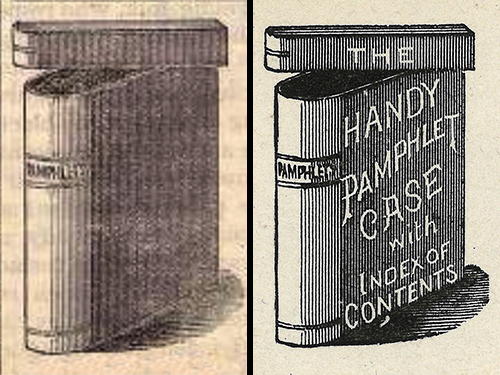
The H. B. Nims Handy Pamphlet Case, 1876


The Handy Pamphlet Case (depicted above) was produced by H. B. Nims and Co., Troy, NY, and advertised from 1875 to 1877. An 1875 advertisement in The American Stationer (here), reads as follows:

The HANDY PAMPHLET CASE.
With Index of Contents.

Useful to librarians and literary men for classifying pamphlets.
Useful to physicians for holding their journals previous to binding.
Useful to clergymen to keep their sermons in.
Useful to business men to keep price lists and catalogues in.
Useful to everyone who takes a magazine.

A neat, cheap and handy invention to preserve all kinds of paper-covered literature, that would otherwise be impaired or destroyed.

LARGE 8vo., PER DOZEN, $2.50
Samples sent by mail upon receipt of 25c

H. B, NIMS [and] CO., Manufacturers,
TROY, NEW YORK.


The advertisement text was re-set in the 1877 advertisements I have seen in The American Library Journal (here, for example), and the accompanying image changed to include the words "THE | HANDY | Pamphlet | CASE | with | Index of | Contents".


In addition to the advertisements in The American Stationer and The American Library Journal, Henry B. Nims—running a descendant business of W. H. Merriam (est. 1840)—printed advertising slips that were loosely inserted in new publications they sold. I found one (above) in a copy of H. R. Fox Bourne's The Life of John Lock (New York: Harper and Brothers, 1876), which provides a sharper image than those in the magazines on Google Books.

Unfortunately, I can find no trace of a surviving example of the Nims Handy Pamphlet Case, which is a shame. If they were tin they probably did a lot of damage to the pamphlets, journals, sermons and catalogues they contained, but if they were made of stiff card and paper they might have saved many of the same from destruction.


Anyone interested in H. B. Nims and Co., of Troy, New York—"the largest and most complete book store between Boston and Cleveland"—will find some information in The Industrial Advantages of Troy, N.Y. and Environs (1895; here; the source of the quote and the photos above and below) and The City of Troy and Its Vicinity (1886; here).


BTW: anyone interested in another example of the wonderful, book collecting-related, stationary items developed in the States in the late nineteenth-century, should see my post on "The Van Everen Fitsanybook Adjustable Book Cover" (here).

Sunday, 30 January 2022

Fabian’s Fine Old Furniture, Melbourne Bookshop

I first visited Fabian’s Fine Old Furniture, at 309 Swanston Street, Melbourne, during an Easter-holiday visit in 1990. Despite the name of his business, Fabian mostly sold books, and clearly had been selling books for many years, though I only discovered the shop in 1990, after many book-buying holidays in Melbourne.

Finding Fabian's was a red-letter day for me as a collector: I came away from my first visit with two eighteenth century first editions at bargain prices: a somewhat worn copy of Macpherson’s Fingal (1762), the first part of his Ossain cycle, and a very nice set of Le Sage’s Gil Blas, as translated by Smollett (1750).

Sadly, despite his long tenure in such a prominent location, Fabian’s seems to have left almost no trace on the internet. In offering up some personal memories of Fabian (and Fabian’s shop) below, I am partly relying on my recollection of my 1990 visit, but I am also making use of some notes I made in 1993, after a return visit, which I only re-discovered during a clean-up last week.


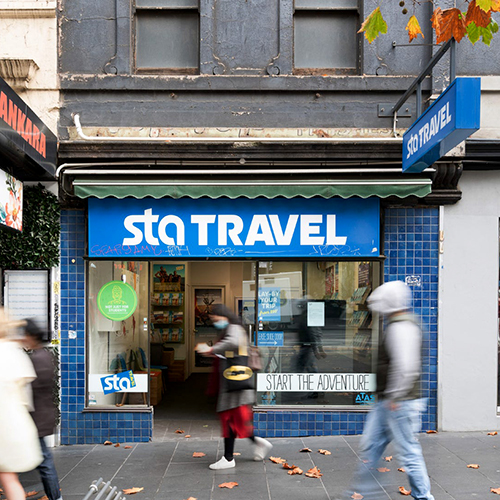
A bright, clean travel agent now occupies 309 Swanston Street (photo above), which is opposite the State Library of Victoria; but for many years it was occupied by a rather different business: Fabian’s Fine Old Furniture. The eponymous owner, Fabian, was a rather eccentric, wild-haired man who had many interesting old books held in three or four massive Victorian book cases, while a goodly number more were liberally distributed in messy piles in various corners, nooks and crannies on the floor. Like the owner, the books, and the bookcases, the shop was old.

In the early 1990s, it had the sort of deep, dusty, brass edged, shop-front display-window that all the best second hand bookshops ought to have. On display in this window were china cups and saucers, Wisden Cricketers’ Almanacks, faded copper plate engravings and maps with labels such as: “This map is 256 years old!”—“This book 152 years old!”—all with exclamation marks, silently bellowing at the passing foot-traffic. I don’t know how often these labels caught the eye of any passer by—with so much dust on the windows the signs were hard to read—but I remember very few interruptions whenever I visited Fabian’s—and all my visits to Fabian’s were lengthy.

The reason for the length of my visits was because Fabian was an unashamed biblioclast. Fabian liked neatly bound sets of books, but it was his practice to keep the different volumes of any set of books equally distributed between the shelves of however many bookcases he had or—whenever he sold a bookcase—between the shelves of the remaining bookcases and in piles on the floor.

He distributed the books in this was because—he explained to me—he wanted each bookcase to display a variety of titles, that a complete set of books was unsightly, and that complete sets would be likely to frighten off prospective buyers. His pricing is worked out on a per-volume basis, and was calculated solely on the size of a volume and the nature of its binding. I paid $45 per volume for my 12mo set (Gil Blas) and $100 for my folio volume (Fingal), but I think $80 was normally the going rate, when part of a set.

Since Fabian did not care for completeness—in fact, he disliked it—but he liked neatly bound books, he had bought and distributed around his small shop many incomplete sets. As a result, even after an extensive, laborious search, neither buyer nor seller could be entirely sure that every volume that Fabian actually had in his shop had been found, unless the books thus collected together from all corners of the shop formed an unambiguously-complete set.

Incomplete sets might be incomplete because Fabian bought them that way, or they may have been incomplete because the buyer had overlooked an odd-volume. This created a moral problem for a fastidious book buyer like myself: how could you be sure that, in the process of buying all the volumes of a seemingly-incomplete set that you had managed to accumulate, after hours spent turning over thousands of books, you were not thereby breaking up a complete set that you had simply failed to find all the volumes for?

Fabian was, obviously, unconcerned about this. Indeed, it seemed as if this sort of “accidental” breaking up of a set suited Fabian, the remaining volumes presented a more varied face to the buyer, and it made it easier for him to dispose of the remaining odd volumes.

Since I am a completist, I would spend hours patiently accumulating volumes of any and all sets that I was interested in; slowly building up piles of matching volumes. When—as was more often the case than not—I failed to find a complete set, I would leave without the books, and Fabian would re-distribute the volumes around the shop, according to whatever principle of aesthetics that drove him. A year or so later I would return, and go through the process again.

Eventually, despite the appeal of thousands of old, beautifully bound books, and the prosepect of a repeat of my 1990 success, I was worn down by my actual lack of success in finding anything that was new-to-stock or complete, and so I stopped visiting his shop. From the mid-90s, for about a decade after I moved to Melbourne I would regularly see Fabian on a Sandringham-line train, with his distinctive wild grey-white hair, on his way into or out of the city. I would seem at different times of the day, either on his way in or out, so I gather that, in old age, he simply went in whenever he felt like it. (There were no opening hours advertised on his shop, and it was often closed when I visited.)

* * * * *

Returning to 1993: a friend and I were occupied in the doomed process of uncovering the companion volumes of an early set of Smollett’s Peregrine Pickle and The Works of Madame de Genlis, ignoring Fabian’s protest that the set was probably never complete to begin with and fearing that, if it had been complete, he had probably rendered it otherwise long since due to his practice of selling off volumes at random, when a well-dressed young man came into the shop, drew the attention of Fabian, and left us to our dusty work.

The conversation began, as I recorded it, in the following fashion:

FABIAN: Hello. Can I help you?

VISITOR: Yes. I’ve bought an old table that I want to put a bit of a display on, y’know, and what I wanted was some old books. I’ve got a bit of a shelf, and some things, vases and things like that, too, but what I need is a few antique books to put on it. ’Bout four of them. It doesn’t matter what’s in them because I’m never going to look in them [this said emphatically] as long as they are old, and look good, like these [indicating a set I was accumulating of The Works of Hobbes].

FABIAN: Yes, well, I get quite a lot of people coming in who want books like you do, for display; I have lots of old books here, with old leather bindings, all sorts of sizes and colours, and prices, so I am sure to have something that will suit. Now, about how much did you want to spend?

There followed a discussion concerning how much the Visitor wished to spend, whether he preferred brown to black covers and so forth. Books in French or Latin, were offered, Fabian did his best to sell his books (“Now this one here is nearly a quarter of a thousand years old! Well, that’s older than the settlement in Australia”) and, at one memorable juncture, when Fabian was showing the Visitor a random selection of four of the twelve volumes of a Latin edition of the proceedings of the Council of Trent, the Visitor, admiring the binding, and in response to Fabian’s explanation of what the book was about, said “of course, I could always learn Latin if I bought them, and then I could read them.”

As I mentioned above, customers were rare; the shop was quiet, and the conversation struck a cord—I had recently read W. J. West’s The Strange Rise of Semi-Literate England (1991)—so I made notes as soon as I left the shop and recorded the details as well as I could soon after. Unfortunately, I did not make a note of whether the well-dressed young man bought any volumes of the proceedings of the Council of Trent. Even if he had, we will never know whether, by doing so, he was prompted to [1] learn Latin and then [2] immediately sit down to read his books, but I think it is very unlikely.

Saturday, 3 April 2021

Ron Abbey on the Cornerstones of Civilisation

In July 1968, Eve and Ron Abbey founded Abbey's Bookshop, a business which continues to this day at 131 York Street, Sydney (here).

Ron owned several other bookstores, most of which I remember: a Penguin bookshop, the Oxford and Cambridge Bookshop, Galaxy Bookshop, the Language Book Centre, and Henry Lawson's Bookshop, Pickwick Bookshop, and Ron Abbey's Bookhouse (according to his obituary).

Ron was vice-president of the Australian Bookseller's Association from 1973–75 and president from 1975–77 (according to Austlit); he died, aged 78, on 16 July 2005 (according to Informit).

I have recently been reading a little about Ron in an essay by Joan Lawrence on "Sydney Bookshops," which was published in December 2020 in Biblionews.

Given his significance in the Australian (particularly Sydney) book scene, it is disappointing that there is not more information readily available about Ron.

The photograph of Frank Moorhouse (right, speaking) and Ron Abbey (left, listening) is the only one I can find online (here). It was taken during Australian Library Week in September 1974, when Ron was vice-president of the ABA.


The most extensive account I can find comes from the obituary written by his son Alan Abbey (linked above). According to Alan:

Ron Abbey greatly admired the self-educated man, living his life by the words of Bertrand Russell: "Books and bookshops are the cornerstones of civilisation; as to self-education, what other kind is there?"

* * * * *

Although it has been years since I read any Bertrand Russell, I was once a great fan. Curious about this unfamiliar quotations, which Joan also quotes, I went looking for the source … and couldn't find one. In fact, I can't find anything even close to it.

It is possible that this quotation is beyond the reach of Google, that it was said in an interview rather than a book or article, and has never been quoted in print, but it is more likely that either Ron or Alan (or both Ron and Alan) have misremembered it, and rephrased it during many years of repetition.

However, Googling both "Books and bookshops are" and "are the cornerstones of civilisation" does lead to some interesting claims:

Books and bookshops are a beloved hobby (here)
Books and bookshops are full of nostalgia and imagination (here)
Books and bookshops are retail therapy (here)
Books and bookshops are doomed (here)
Books and bookshops are fighting back (here)
Books and bookshops are moving up (here)
Books and bookshops are reinventing themselves (here)
Books and bookshops are always essential (here)
Books and bookshops are flourishing (here)

Reading and writing are the cornerstones of civilisation (here)
Story, or discourse are [sic] the cornerstones of civilisation (here)
Knowledge and culture are the cornerstones of civilisation (here)
Knowledge and expertise the cornerstones of civilisation (here)
Liberty, equality and a cup of tea are the cornerstones of civilisation (here)
Families are the cornerstones of civilisation (here)
Humour and sex are the cornerstones of civilisation (here)
Toleration and respect are the cornerstones of civilisation (here)
Judgement and public shaming are the cornerstones of civilisation (here)

The closest match I could find for the (seemingly, faux-)Russell quote is: "At EIBF, we recognise the importance of books and reading in people’s lives. Books, and bookshops, are one of the cornerstones of our civilization. Booksellers enrich the communities they are part of, offering cultural, economic, and educational contribution to society" (here).

In the faux-Russell quote, "cornerstones" is plural: an acknowledgment that "Books and bookshops" are separate things, and that each is a cornerstone in its own right. This does raise the question: how many cornerstones can a building have? A rectangular building will have four, though many buildings have more corners than this, it is customary to only celebrate one, the first.

(In the image below we see three cornerstones, though only one has been dated—1909—and celebrated.)


So, faux-Russell / Ron Abbey is making a claim to double the usual number; whereas the European and International Booksellers Federation (EIBF) wants you to know they are only claiming one: weak! Pathetic! Are they setting aside scores of imaginary cornerstones for Reading, Writing, Liberty, Equality, Families, Humour, Sex, Public Shaming and a cup of tea!?

I would expect a Booksellers Federation to make a stronger claim these EU flunkies: why not either two cornerstones (if you allow more than one) or the only cornerstone (if one). I hope Ron Abbey's successors at the Australian Bookseller's Association reject this cowardly and pusillanimous EIBF statement, and embrace, instead, that of their one-time president.

[UPDATE 2021.04.08: Blogger tells me that this was my 300th post]

Tuesday, 9 March 2021

Frances Zabel, pioneering bookseller, book reviewer, journalist

Mrs Frances Zabel (1868–1933) was the copyright holder (and, I assume, publisher) of the poem in my January post: “The Lender’s Library” (here). Curious about the poem, I found myself quickly becoming intrigued by both the author and publisher too.

I have now completed my post concerning the author (here). Typically, what was intended to be a short post about the publisher has grown well beyond what I had in mind, such that it now threatens to become a collaborative research project!

Rather than leave Mrs Zabel completely neglected until the results of that research can be published I thought that—as a placeholder, a teaser, and an International Women's Day celebration—I'd transcribe and reprint an interview with Zabel that was written by the late, great Zora Cross (1890–1964): Australian poet, best-selling novelist and journalist.

The Cross-Zabel interview was published in the Sydney Mail (22 January 1930): 29 (on Trove, here), and is reproduced below in its entirety.

* * * * *

Australian Women Pioneers: In the Literary World

When the story of Australian literature is finally told it will not be complete without mention of that brave band of pioneers who blazed trails for others to follow.

IN this field the name of Mrs. Zabel, the first woman to establish a literary journal—the ‘F.Z. Review,’ in Perth, in 1904—must, be remembered. Her little paper, which she managed, wrote, and distributed herself, is a credit not only to Perth, but to Australia.
  Born in Victoria. Mrs. Zabel, who now conducts a library in Sydney, was one of the first women on the goldfields in Western Australia. But her heart had been given to books from childhood, and when she later settled in Perth she wrote book reviews for a local paper.
  At, that time, there was only one woman bookseller in Australia—Mrs. H. Champion, wife of the late H. H. Champion, the man who was the first, daring enough to publish one of George Bernard Shaw’s novels. Mrs. Champion was selling books in Melbourne.
  “All honour to Mrs. Champion,” Mrs. Zabel says, “for she was the woman pioneer of book-selling, which I believe is a woman’s business, not a man’s. A woman has the intuition to fit the book to the reader more readily than a man has.”
  Mrs. Zabel was the second woman bookseller in the Commonwealth, and she also began on a small scale. She began in Perth at the Book Lovers’ Library, and it was from there she published her unique and admirable newspaper. Nothing commercial seems to have entered into her scheme, for here in her journal are reviewed rare and foreign books, belles lettres, historical studies, essays, poetry, as well as the latest in fiction, showing that as a buyer of books she discriminated.
  One is struck by the ability Mrs. Zabel had for judging a book for posterity as well as the day. Thus, in her review of Marie Corelli’s work she never gave extravagant praise, as so many papers of the time did, even though, as recorded in the “F.Z. Review,” 43 tons of paper were used in the first edition of one of Miss Corelli’s popular books of the time. Mrs. Zabel did not trade in best-sellers.

ABOUT five years ago this interesting woman took over the Roycroft Library, which Miss Peacock established in Sydney over thirty years ago. A charming historical library, this!
  I asked Mrs, Zabel recently if she did not become tired of books, having had them for daily companions so long.
  “Not a bit,” she replied, just as enthusiastic over the new writers now as she was twenty years ago. “I was born to sell books, and I put in twenty years’ spade work before I came here. But isn't this beautiful? It has only just come in.”
  I admired the new Lily Yeats masterpiece of framed embroidery—a veritable Irish garden of flowers woven of bright threads, reminiscent of something out of faerie or the Land of Heart's Desire itself.
  “This is from a most beautiful and interesting women’s industry,” Mrs. Zabel explained, “conducted by Lily and Elizabeth Yeats, sisters of the famous W. B. Yeats—the Cuala Press and Industries in Dublin. Jack Yeats, a brother, does coloured woodcuts characteristic of Irish life; Elizabeth conducts the Press, and has produced lovely editions (highly prized by collectors) of W. B. Yeats. Lily attends to the needlecraft industry; she has taught, and employs, Irish peasant girls, and from Cuala comes exquisite scarves, traditional Irish cloaks, as well as pictures; and their white linen with colour design is seemingly out of fairyland. Mrs. Lane-Poole, their cousin, now in Canberra, was one of the designers. I must show you some of their illuminated manuscripts, rare and beautiful—done on a hand press, of course. There! Isn’t that something like one of the old Celtic vellums?”

TRAVEL has broadened Mrs. Zabel’s out look on all things, and it is her delight to go to the source, for the beautiful glass and pottery wares which she self up as a coloured background for her books.
  About four years ago she began to import curious and quaint and beautiful objects of art and pottery as well as books. She did not do this purposely to create an ideal atmosphere for her beloved books, but naturally it became that.
  Though she hides her writing identity under pen-names her pen is never idle, and it is a very graceful and charmingly witty one.
  Specialising as she does in limited editions, foreign plays and poetry, children’s books and the books that are not ephemeral, it is a delightful experience to wander amongst them with her for a while and listen to her as she discusses literature.
  Old boys of the Melbourne Church of England Grammar School will recall memories of Mrs. Zabel's son, whose untimely end abroad deprived Australia of one of her greatest geologists.

Thursday, 20 December 2018

More Bookseller Trade Cards of the 18C

The trade-cards, trade tokens or bookplates below, are from a collection of English engraved advertisements compiled around 1758 by F. Legge of St. James’s Market preserved at Yale’s Walpole Library.

The Legge collection has been given the title “Trade tokens and bookplates, 1705–1799 (bulk 1757–1758)” and a scan of the entire volume has been published online (here). The images have been colour-corrected and reduced to 500 pixels wide.

The fourteen trade-cards below are of for “Darres,” John Kendray, John Leake, Henry Lewis, James Noyes, Samuel Paterson, S. Pitt, John Pridden, William Separd, G. Vander Gucht, John Ward, John Wilke, Robert Withy, and Ryall Withy (again, none of which are in the Franks Bequest Catalogue).

For my previous posts on bookseller trade cards of the eighteenth century, see here and here.

* * * * *


Saturday, 15 December 2018

Bookseller trade cards of the 18C

Sir Ambrose Heal's "Bookseller and Stationers' trade-cards of the eighteenth century" appeared in The Penrose Annual, vol. 45 (1951), 29–32. It contains one page of introductory text (which says nothing about the production, publication, distribution and history of bookplates and trade cards or anything of note concerning bookselling and printing in the eighteenth century), four pages of illustrations (showing sixteen separate trade cards, below) and three pages of notes on the booksellers.

About four years ago, shortly after publishing my post on Bookplates of Booksellers and Circulating Libraries, I checked out Heal's essay in the hope that it would provide either more information on (no), or more images of (yes), the 164 bookplates and trade-cards listed in the Franks Bequest Catalogue—of which I was only able to provide two in my original post.

I am not sure why it has taken four years to post these scans, perhaps I was hoping to find more images in his other works. If so, it would appear that I was unsuccessful. However, I have fond a few more images on line, which I will post shortly.

* * * * *

The sixteen trade-cards below are of for James Adams, John Bromley, James Brooke, James Buckland, Thomas Edlin, William Kerby, Lackington, Allen & Co., Arthur Lyon, Ralph Minors, Francis Noble, Bartholomew Penny, Daniel Richards, William Sanby, J. Shove, Samuel Stillingfleet, and Thomas Worrall (none of which are in the Franks Bequest Catalogue).